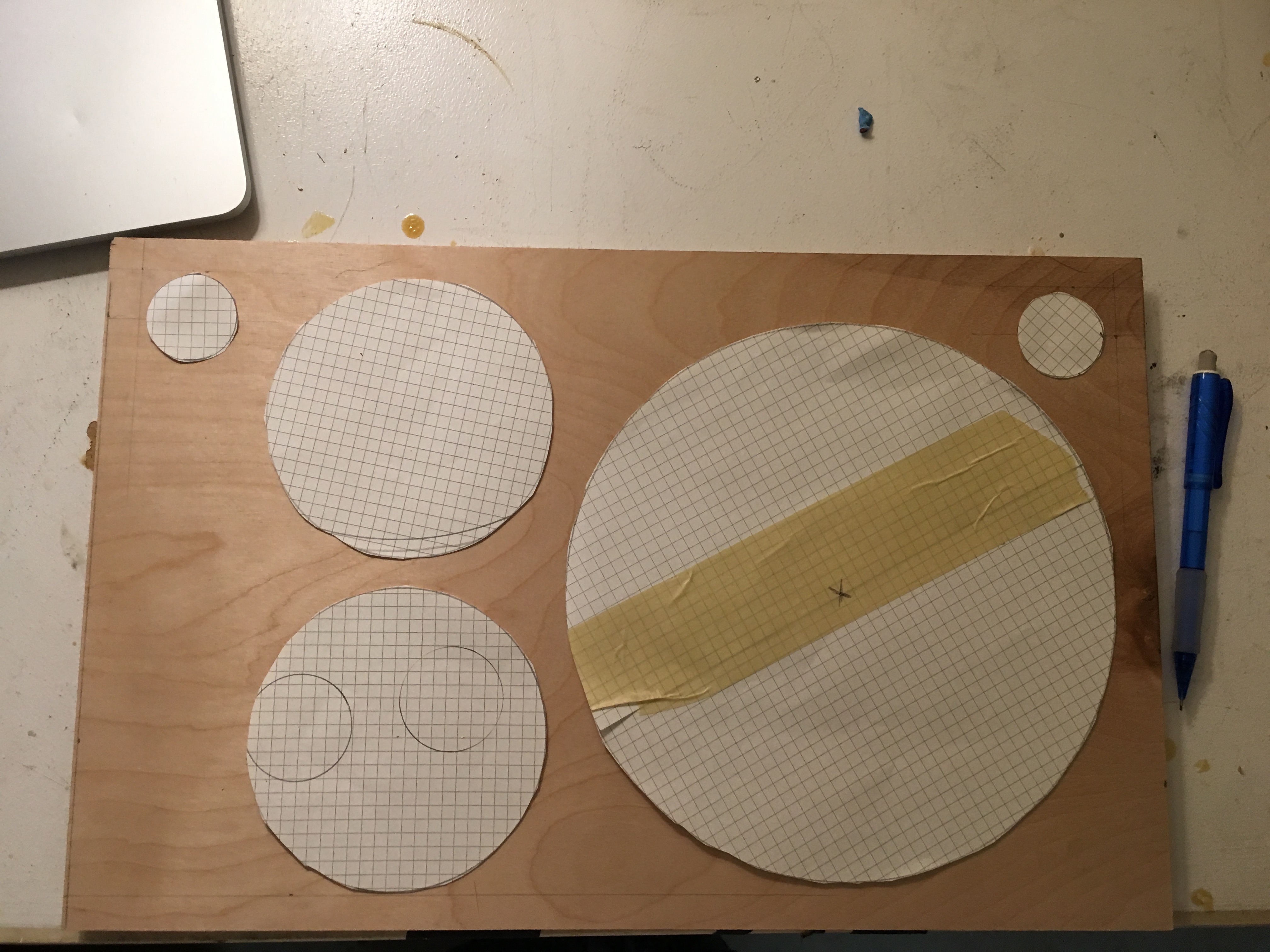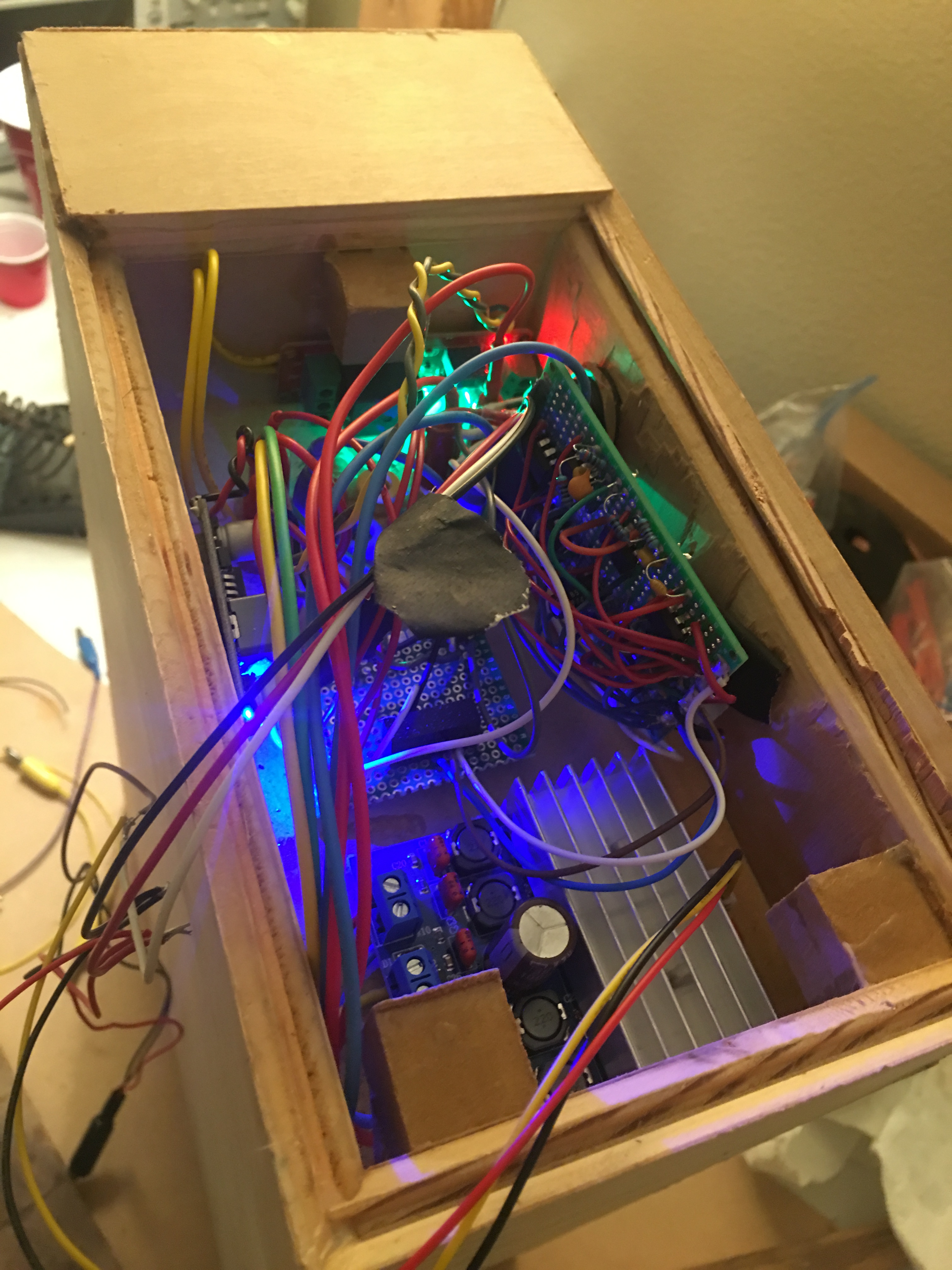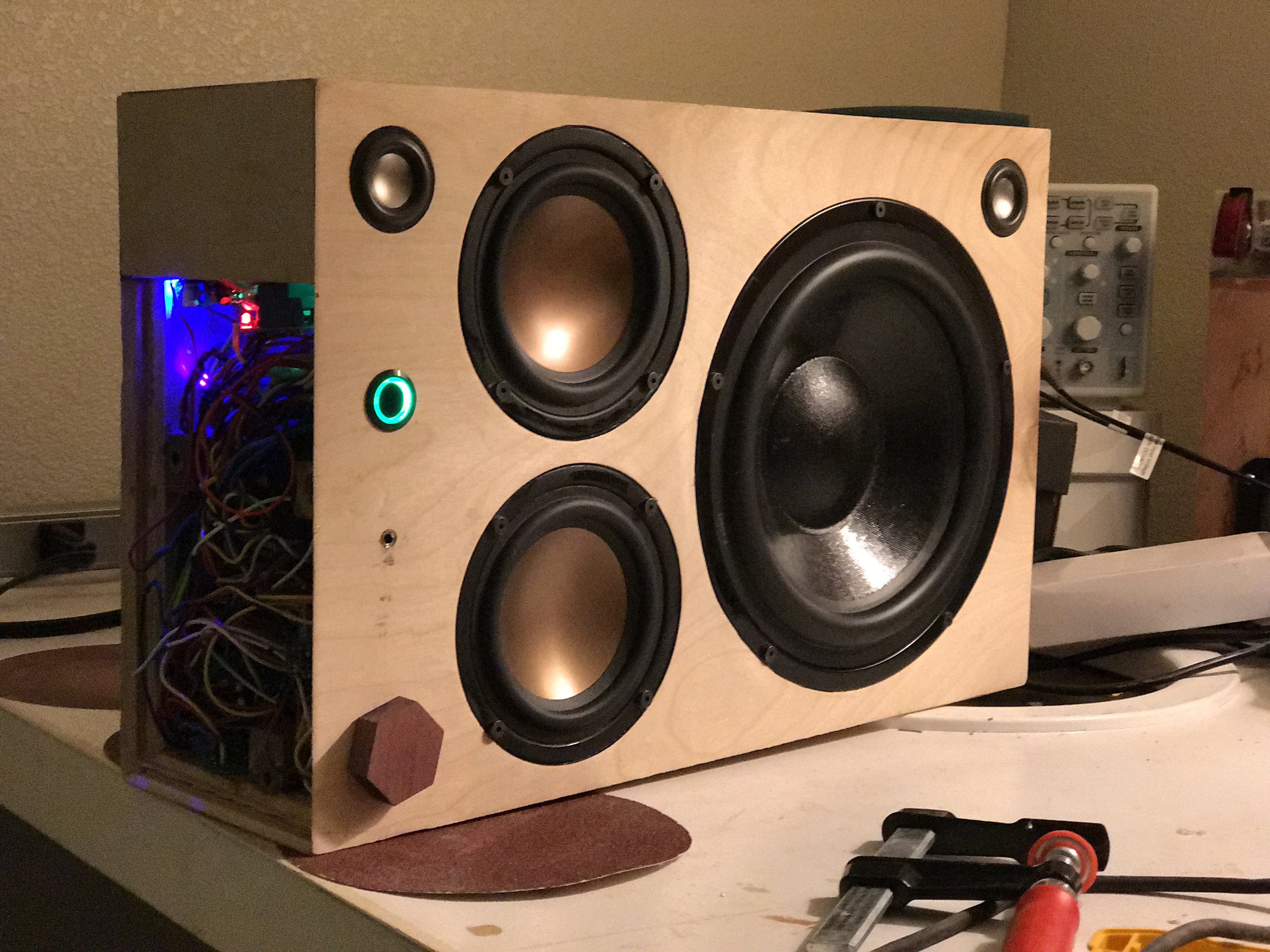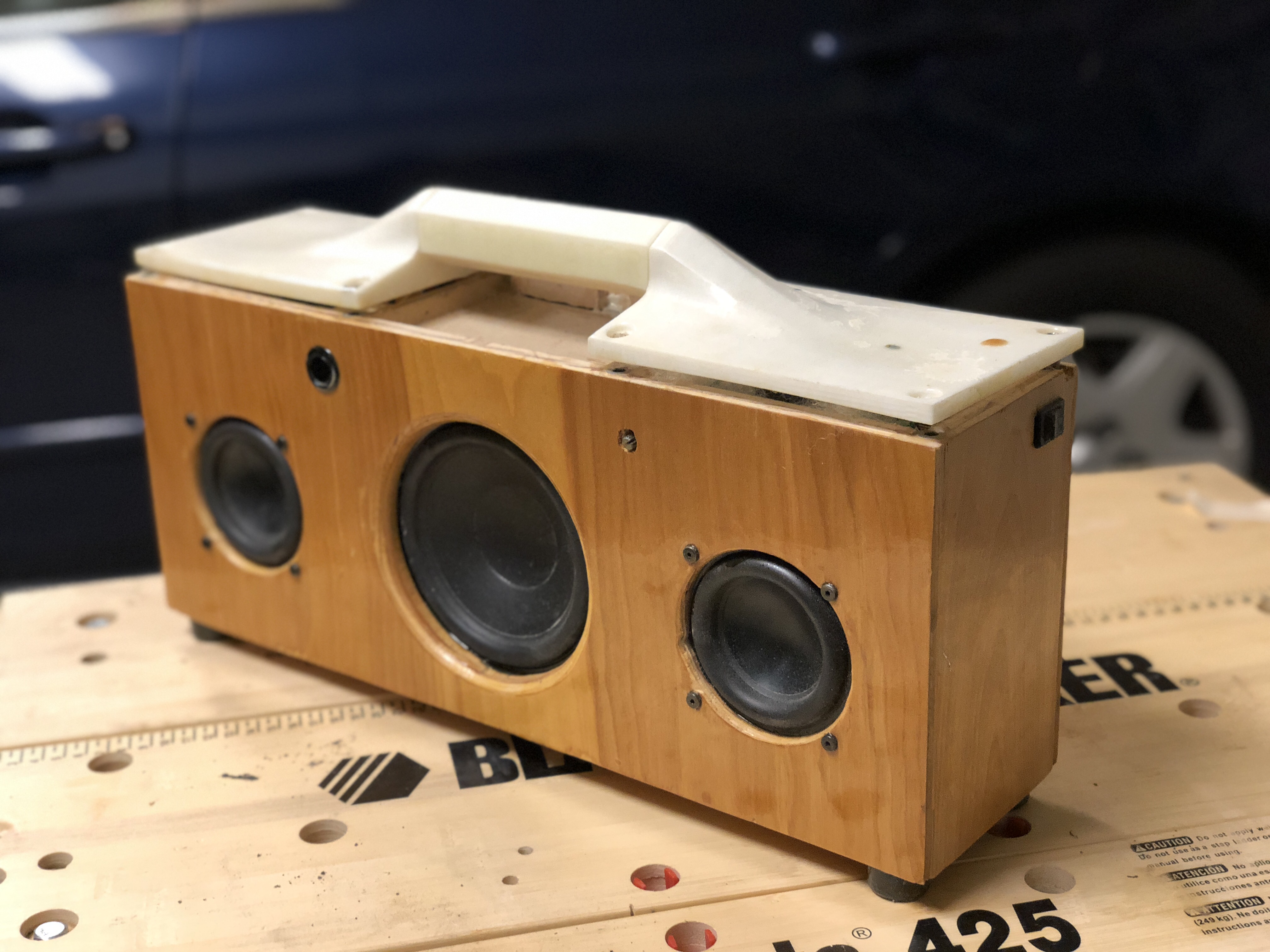
RETURN II-II: THE ELECTRIC BOOGALOO

Back by popular demand. Here’s how I designed the electronics to power the 120 dBSPL (@ 1m, ±3dB 40Hz-20kHz) beast to defeat the new generation of super mid “Soundboks” type devices.

As you can tell there are some peculiarities to this design, including a dual battery rails supporting the “low power” section.

POWER

THE AMP
The first thing to do is to down-select the amplifier chip-set to deliver the hundreds of watts required to hit target levels.

There are very few amplifiers in this power range that will meet this need.

  • IRS 2092 with ±50V rails and adequate MOSFETs
    • ruled out for the reason that I don’t want to source ±50V
  • WONDOM AA-AB31395: 1 X 1000Watt Class D Audio Amplifier Board – T-AMP – LV
    • Out because 500W into 4 Ohms @ 10% THD @ 60V
    • No THD/Power curves
  • WONDOM AA-AB35511 3 X 500Watt Class D Audio Amplifier Board – T-AMP
    • Out because it actually can only sink 300W into 3 ohms @ 50V @ 10% THD
  • ICEpower 300A1: single channel 300W @ 1% THD @ 55V
    • this is a strong contender, but it’s single channel and requires a ±12V input and is therefore slightly more expensive and complicated than the TPA3255
  • ICE Power 500ASP
    • Honestly more than perfect but requires 120V AC
  • ICEpower 300A2
    • Also an incredible amp but requires ±35-65V which is annoying with batteries
  • TPA3255 Capable of 500W into 4 ohms (PBTL) @ 50V @ 1% THD
    • best contender
    • 3e-audio sells a balanced input version which is great for low noise!

The TPA3255 chip-set is the winner here for cost and simplicity while maintaining high quality.

In my experience, a lot of these amps will “overspec” their power output, as they’ll rate their amp in a very specific set of conditions. Let’s dive further into the TPA3255 to confirm it can meet our needs. There are a few dimensions we care about:

  • power required by speaker to hit target SPL
  • impedance of speaker at frequencies of highest power
  • voltage/current required by amplifier at highest power

Woofers are almost always the least efficient and most power intensive part of an acoustic system, so we’ll focus on the woofers for now. To determine “how much power into what impedance” we refer to the target response from the simulation in part 1 and check power required and impedance:
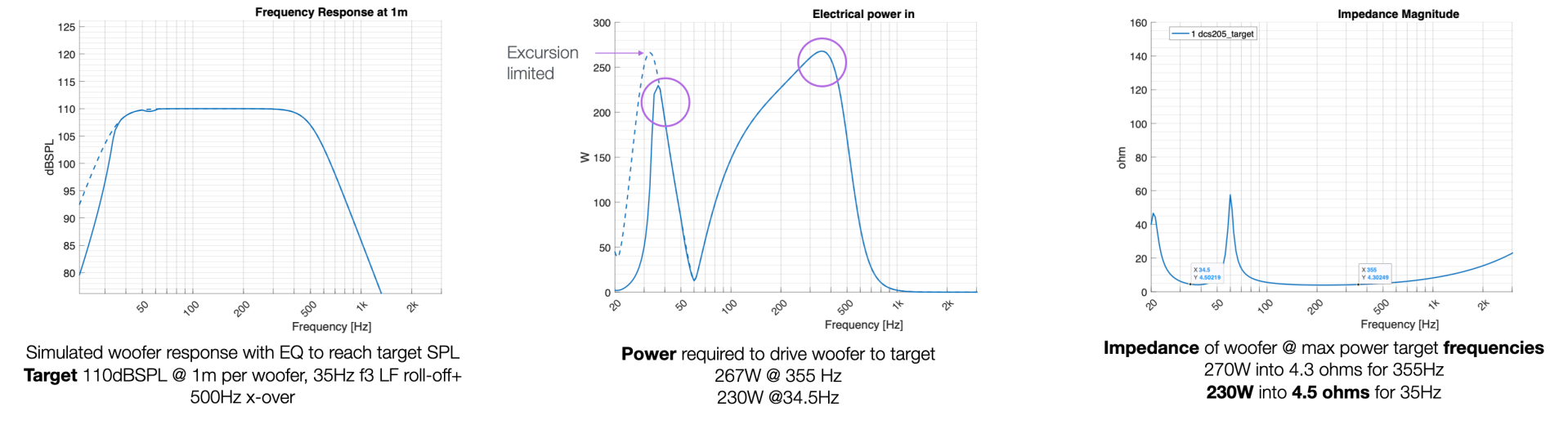
So we need 270W into 4.3 ohms at 355Hz and 230W into 4.5 ohms at 35 Hz! Then we refer to the TPA3255 data sheet to determine if it can deliver that power:

Based in the data sheet, it looks like we can do 260W into 4 ohms, which is precisely 231W into 4.5 ohms—perfect!. The amp will not be able to deliver the full power required at 355Hz, but that’s OK—that’s firmly in the lower vocal range, where I expect less general signal level in normal use. The data sheet also informs us that the amplifier expects 54V to deliver this wattage. We can then refer to the efficiency curves to understand the maximum current the amplifier will draw:

Based on these two graphs we can expect that for two woofer channels we’ll be looking at a maximum power draw of about 700W. We can apply this same process to the mid-range and tweeter to determine the total power draw of all 4 channels of this speaker, but to cut to the chase, we’re looking at a power draw of about 1kW peak.

From Ohms law, we can determine that 1000W at 54V is about 18 Amps, which we’ll use to spec the power supply portion. For now, we can be confident that the TPA3255 amplifier will suit our needs.

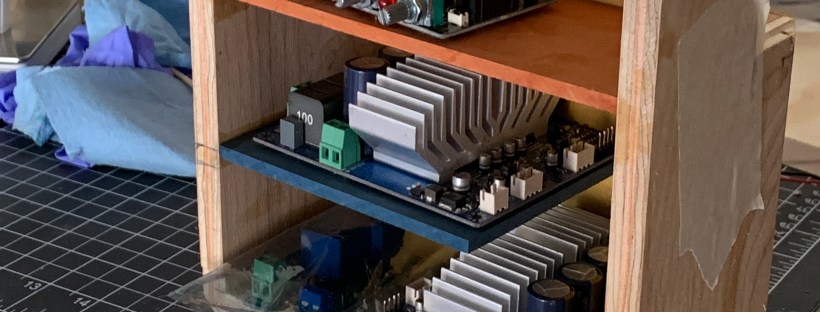
3e-audio’s TPA3255 boards are also beautiful, compact and expensive. Here they are in the (as typical for every project I do) completely undersized electronics box.

THE BATTERY
Based on the acoustic simulations above, the power draw for the whole system looks something like this:

The peak load of about 1kW is an absolute maximum— all of the driver’s stated power handling exceeds their actual linear excursion (in simulation). We need to be able to deliver 1kW for transients but an actual input (sine wave being the worse case equating to 1kW peak) would destroy the speakers rather quickly. I accidentally verified this fact when I mis-programmed the DSP, which caused it to output full-scale white noise; the tweeter burnt immediately. Armed with this knowledge, I can happily specify a 48V 1kW battery to handle the peak demands. The continuous load—i.e. the crest factor (or the ratio between the RMS value and peak value of a signal)—for very loud music content will be <-10dB below this peak, so the battery will be chillin’. Not only is -10dB the 99th percentile of music loudness (more on this later), but most playback environments (e.g. Spotify) have a metadata normalization scheme that limits CF to < -14dB.

Moving on to runtime, my target was “a while” at max volume, 6 hours for party usage and ~all day for normal-to-loud listening levels. I added a quick calc in the bottom of the power table—a typical battery capacity in the 48V range is 20Ah, which yields about 2.75 hours at maximum power output with music, and 5.63 hours at a click or two down from that (-6dB). Keep in mind, this is still using -10dB CF, which is, like, hella loud. For reference, the crest factor of a loud metal song like System of a Down’s “Take the Power Back” is -14.2dB. Taking that into account, 20Ah seems like a reasonable capacity.

Writing this from the perspective of having already built the device and used it for parties, the battery life is great. Max volume is enough to irritate the house next door and more than enough to cover a 30 person party on the beach, the battery typically lasts for about 6 hours in this usage, so -10dB CF is certainly a very aggressive estimator for battery life.

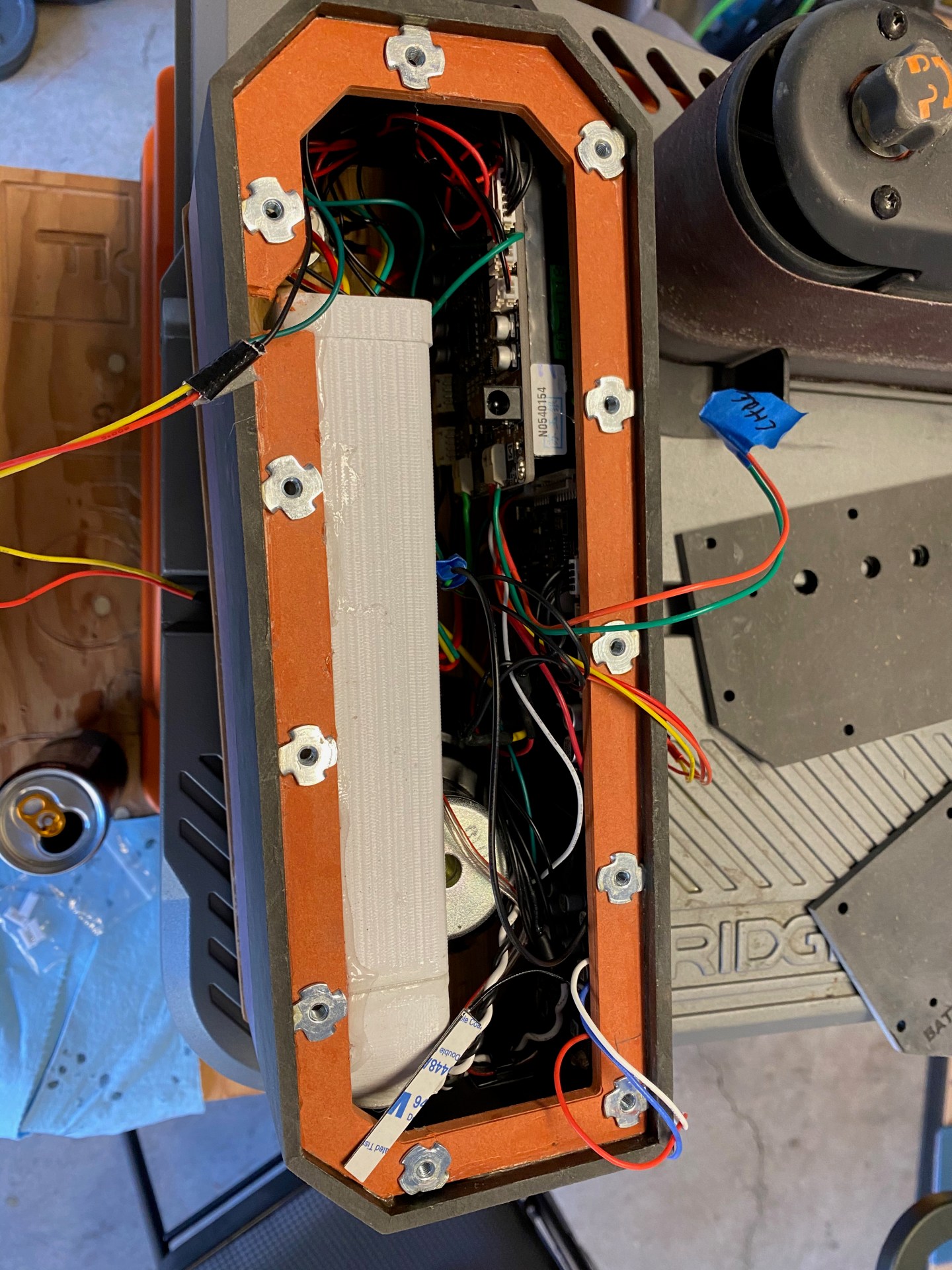
One thing not mentioned so far: a 20Ah 48v battery is massive. I had trouble fitting it into box in any orientation that did not interfere with the isolated electronics box, so I had to glue it in at an angle and take a chunk out of the electronics box:
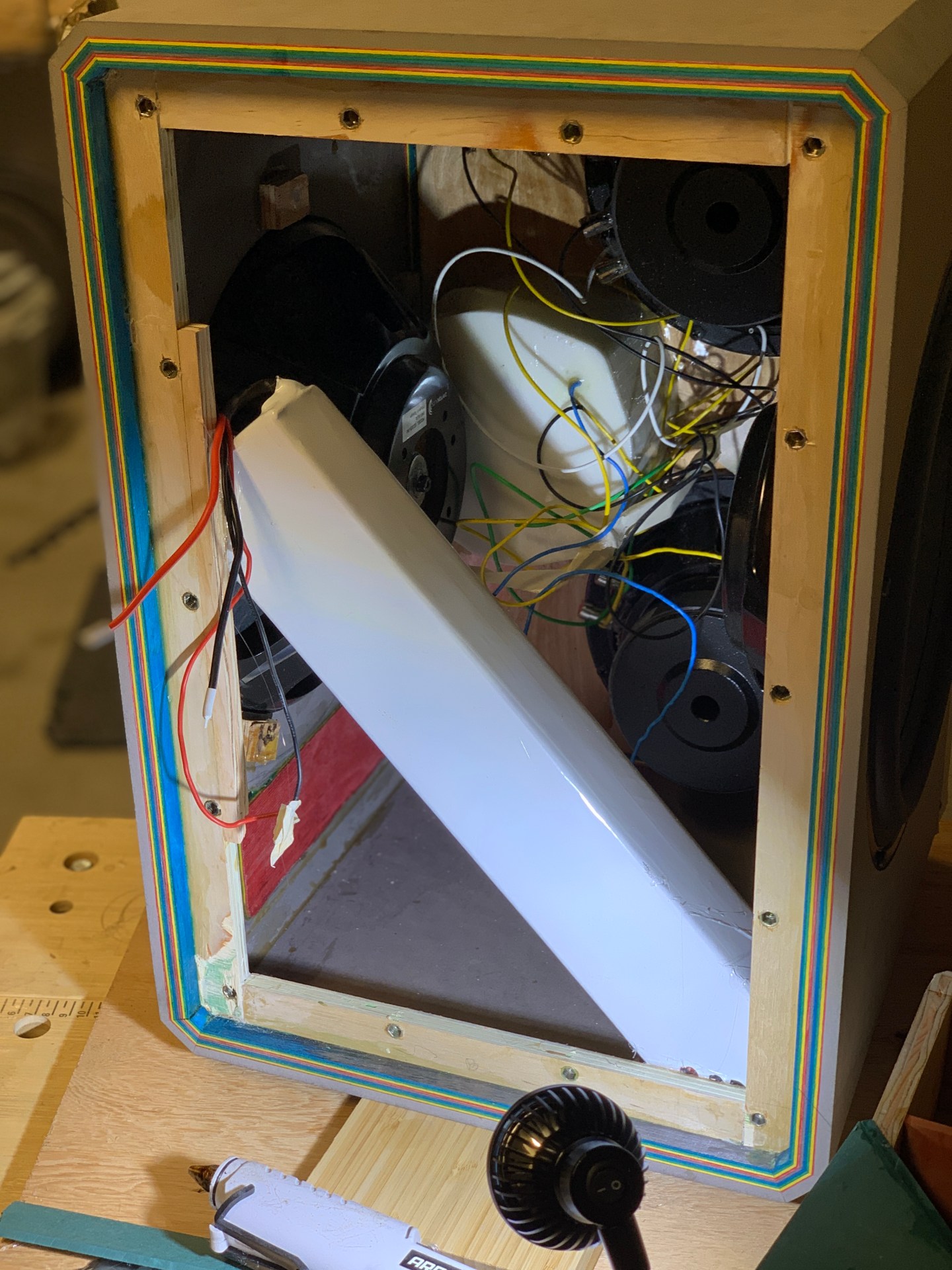
big white rectangle is battery
electronics box from above with a nice miter through it

DSP AND TUNING

SIGNAL CHAIN

The beauty of the TPA3255 by 3eAudio is that it runs a differential input which is massive for noise management. At the time, 3eAudio also sold a beautiful differential-out DSP board with an integrated Bluetooth chip. The integration of the BT chip eliminates BT radio noise at the source while the differential signal chain allows the removal of any injected EMI or ripple noise on the voltage sources.
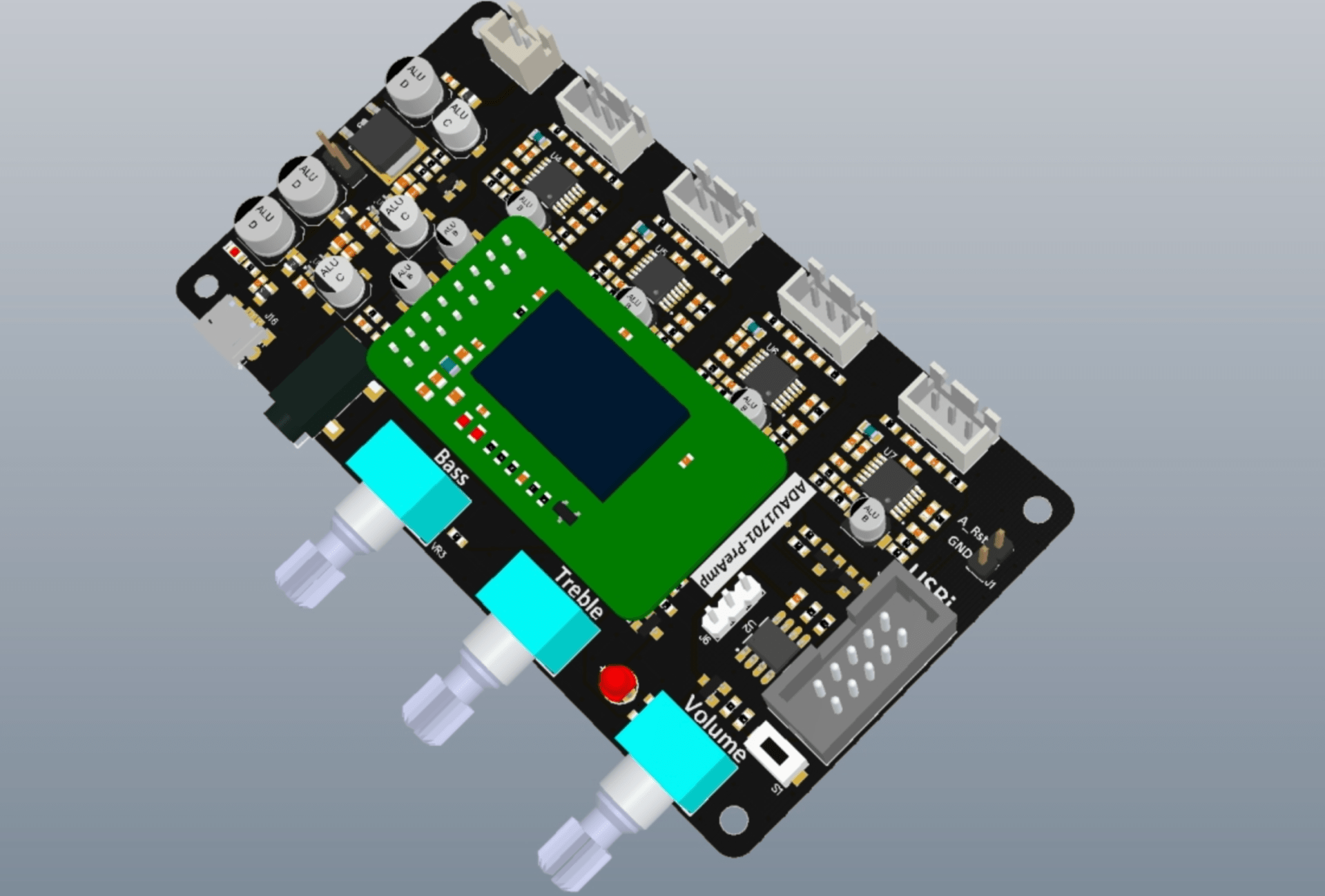
from 3e-audio’s website

This nearly fully integrated solution simplifies a lot of the process for creating a low noise signal chain. The amps themselves have a 12V line to run the DSP off of! However, I ended up forgoing this 12V rail for something much more ridiculous (see noise section)

Tuning with ADAU1701 is a breeze once you figure out SigmaDSP’s interface and how to write to EEPROM (hint: you have to right click).

Here’s an overview of the DSP employed to get this beast of an acoustic system sounding good at all levels:
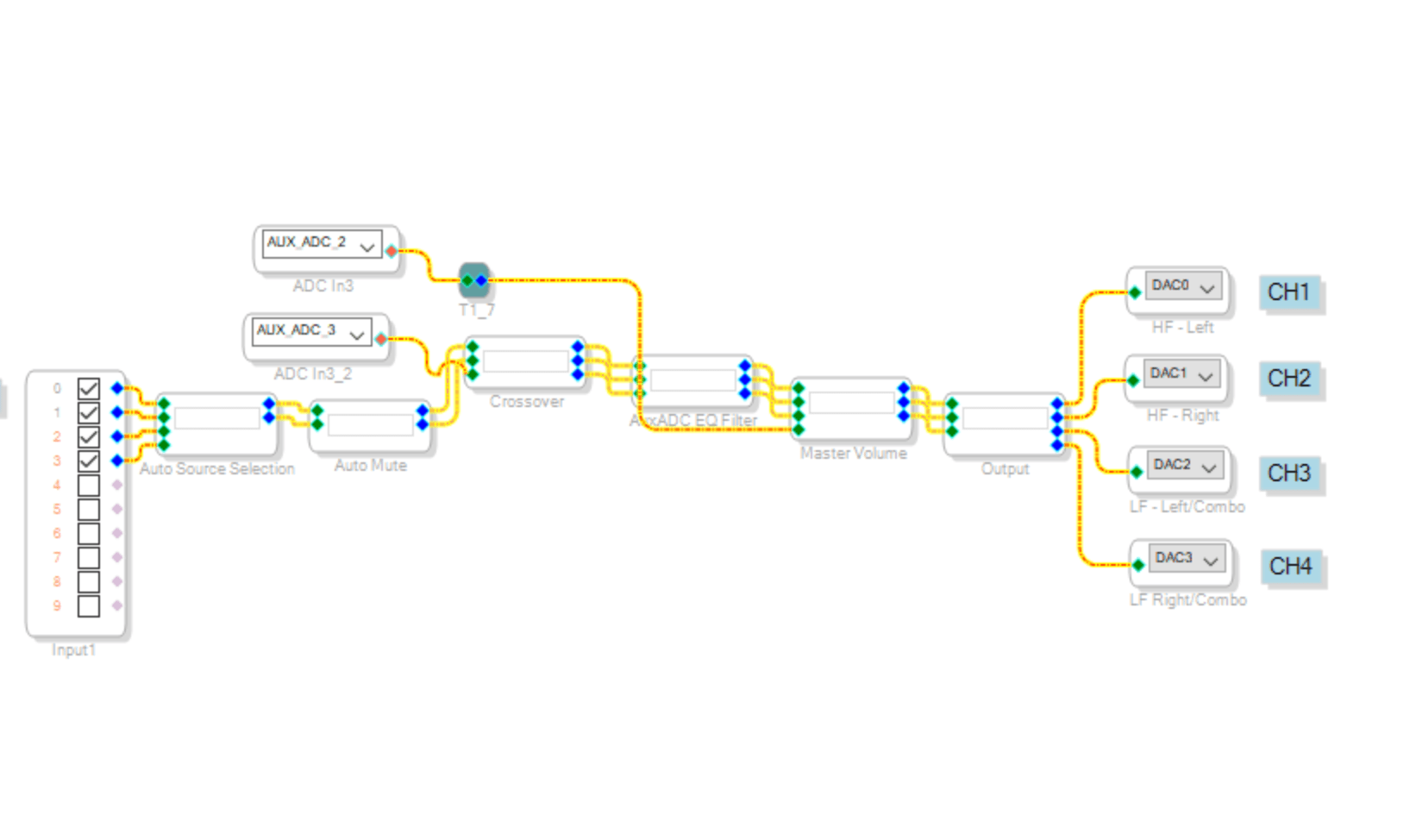
The first block labeledx-over handles several global EQs as well as some volume-tone compensation. Here’s the signal flow:
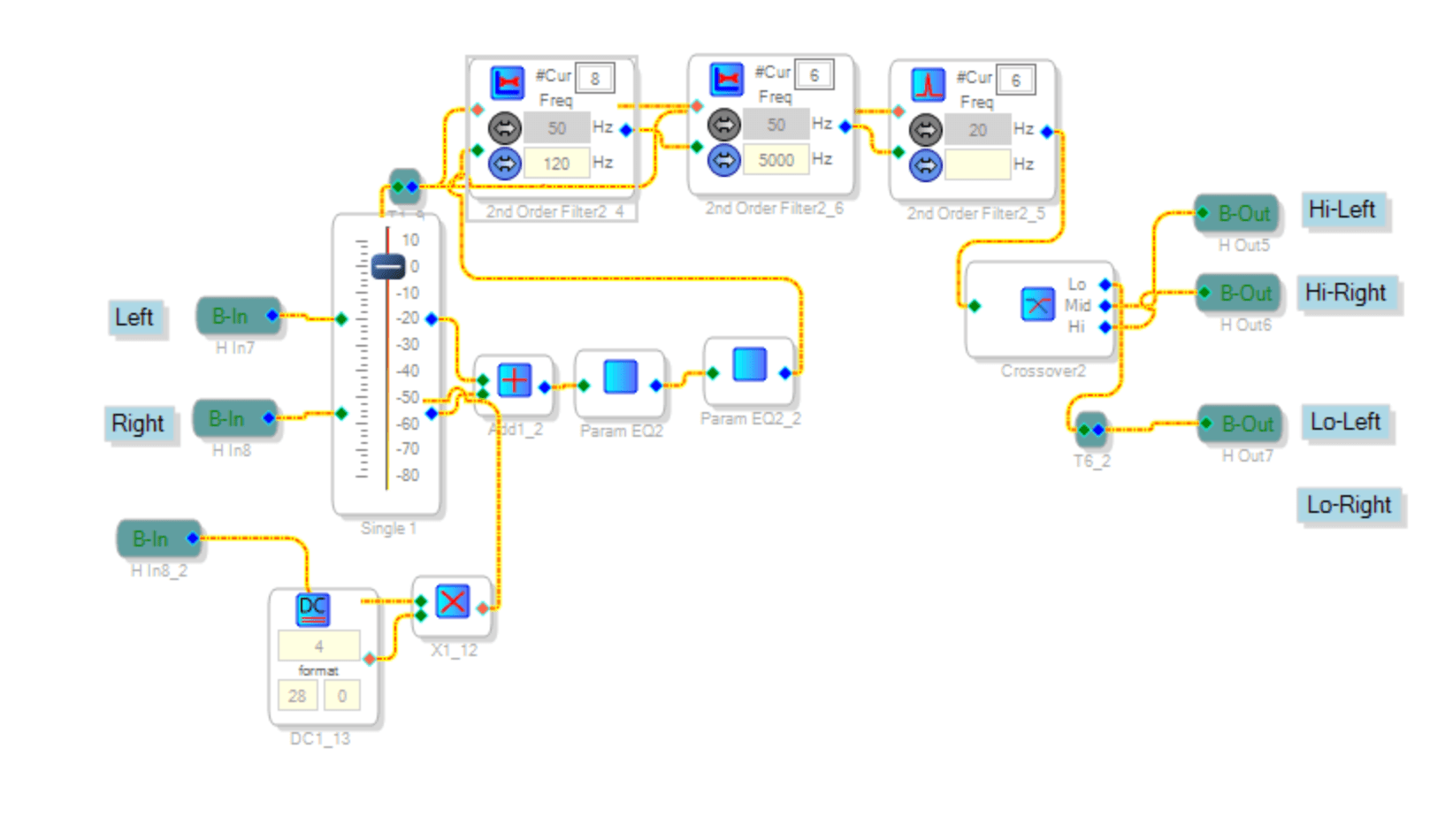
Inside the first parametric EQ, the analytical for the midrange and tweeter takes out the resonance peaks (occurring from horn loading, and the rear-mounted design of the mid-range).
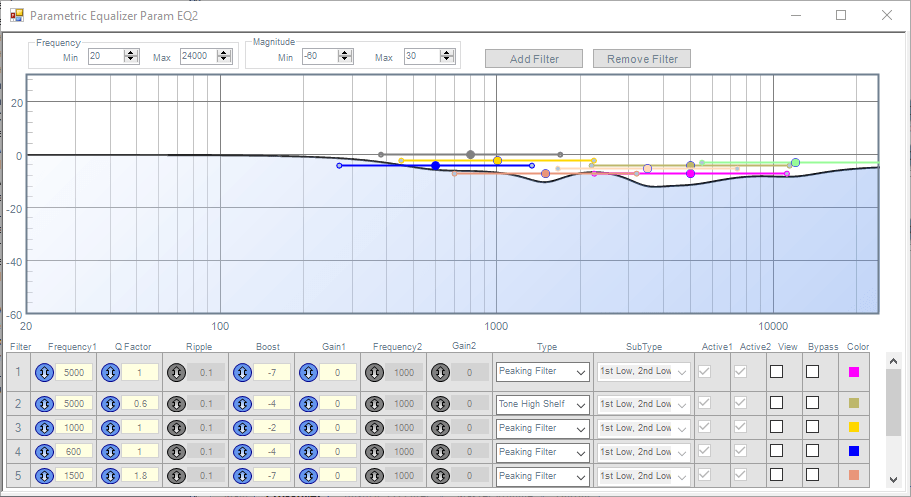
Inside the second EQ block is an absolute mess of peaking filters to carefully control the excursion and system resonances of the woofers and the woofer box.

After the parametric EQs are a bunch of volume control filters which have a very specific and unusual function: to enable party mode. The intent of the party mode knob is to shape the output of the whole system to be focused on higher output. Ideally, the whole system has been tuned for a very pleasant Hi-Fi response, with rich, deep bass, balanced vocals, and sizzling highs. But sometimes you just want a little extra punch, and that’s what party mode is for.
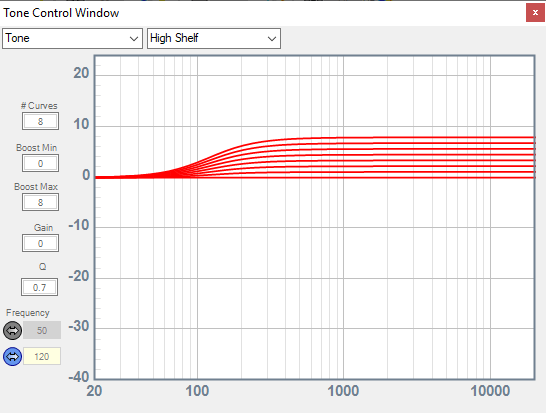
X-over, as low as possible for the midrange and tweeter to limit directivity effects. Two notes:

  1. Typically crossovers are a bit higher for this kind of application (800-900Hz), I am of the personal preference to push crossovers as low as possible for better efficiency and directivity. Generally I think the worry for low crossover is either distortion due to high excursion at resonance, but with careful calculation and proper DSP, this can be easily avoided.
  2. The LR alignments often prefer a phase inversion for the TW for proper summation, which can be confirmed in real life by measuring in the farfield.
Moving on the the next section: the master volume!
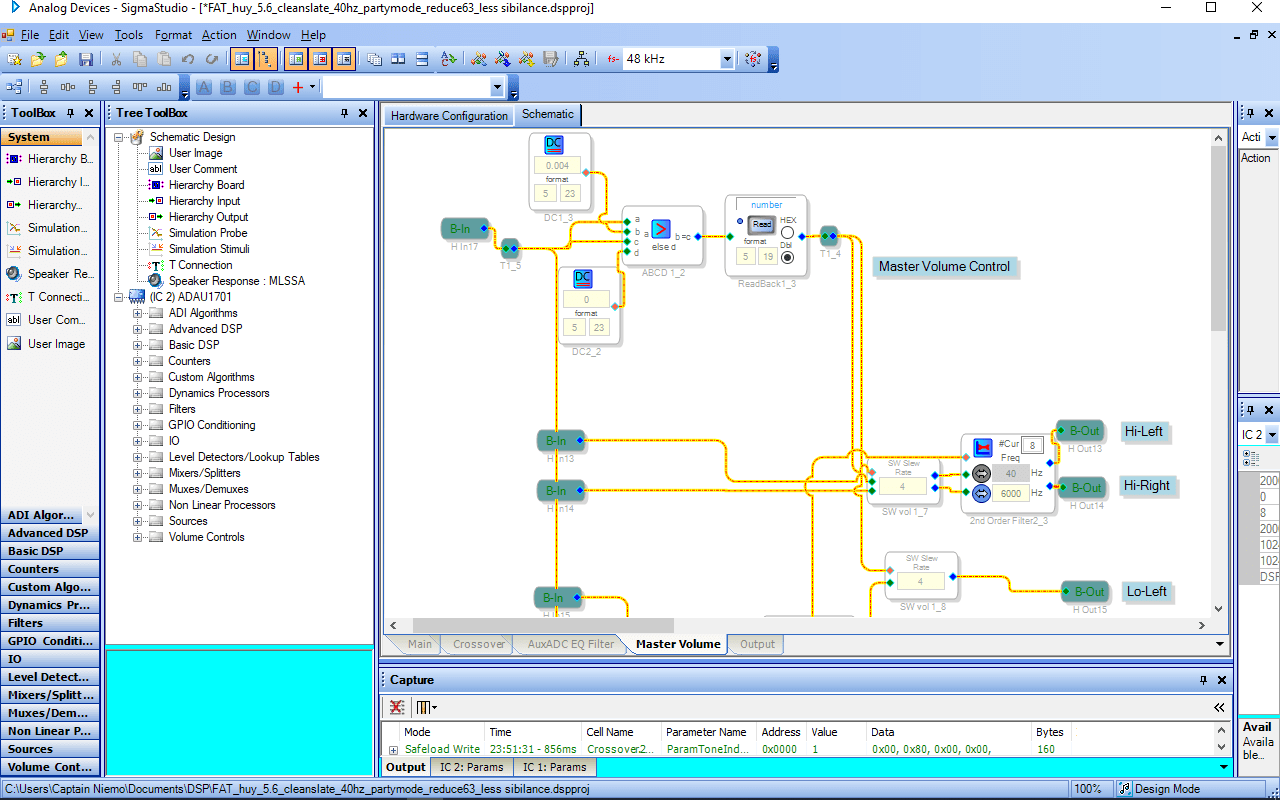
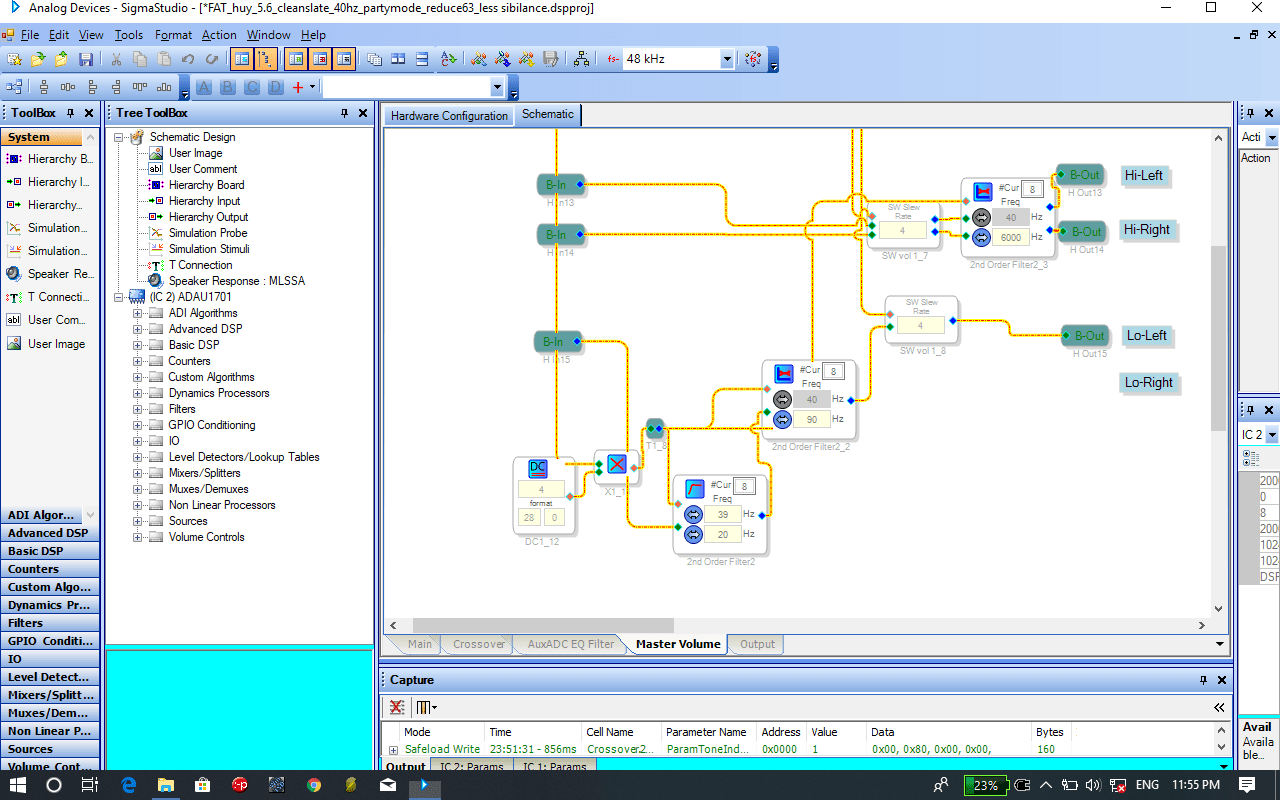
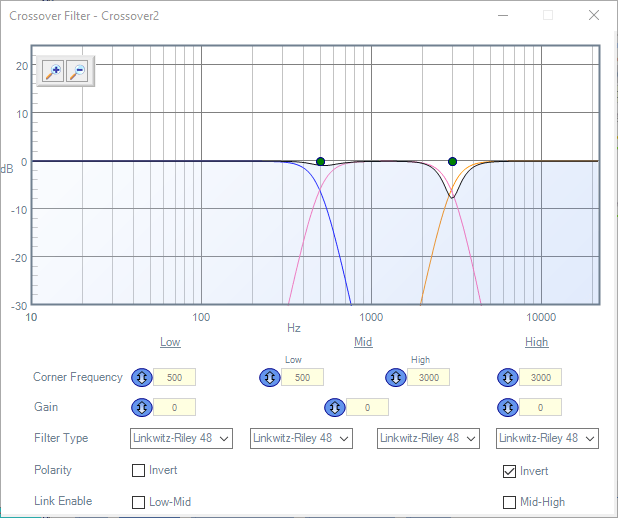
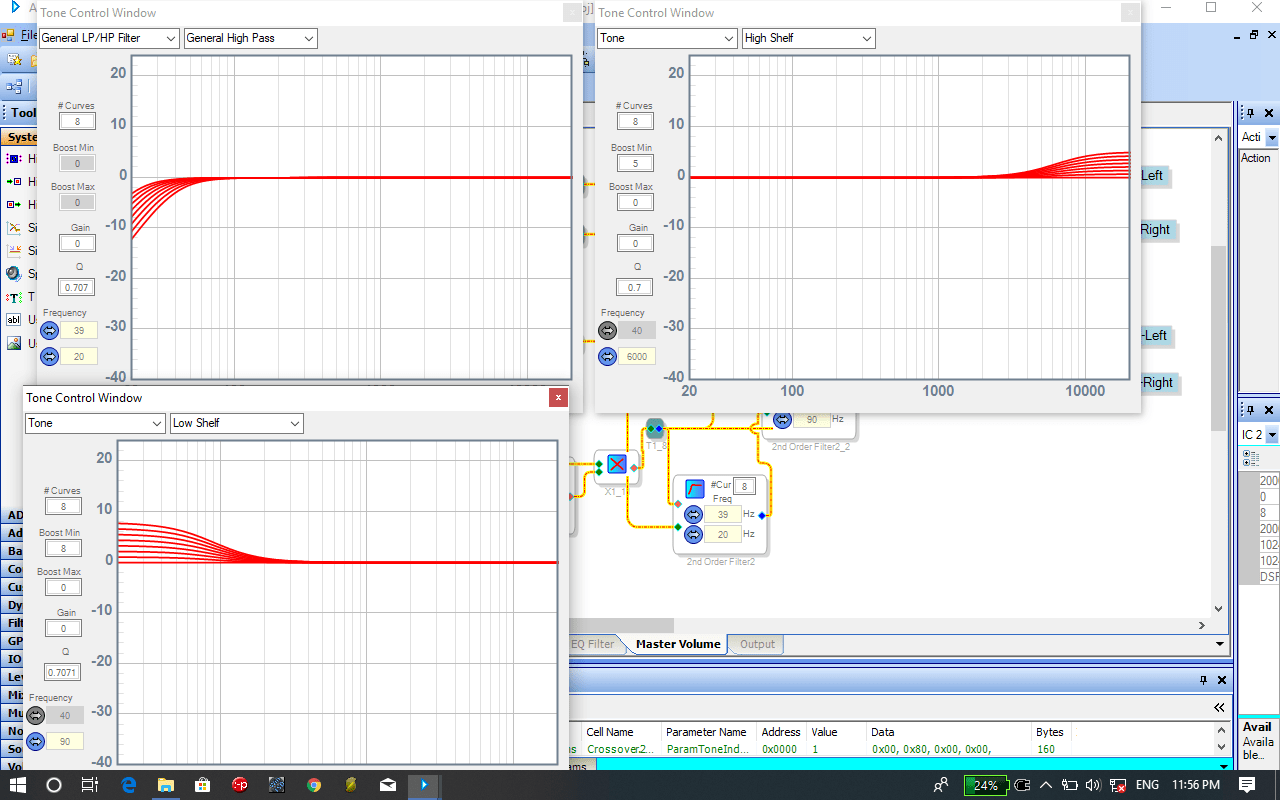
These essentially are optimized to allow maximum excursion at a variety of levels, while also respecting the equal-loudness contours (in short, our perception of a “flat” frequency response changes with a change in output level; lower listening levels require more bass/treble to sound balanced). The HP filter moves down as volume moves down, while the low shelf increases LF gain, allowing deep bass at lower listening levels and controlling over excursion at high levels. A similar behavior is required for high frequency.
Finally, the output stage requires some gain reduction for the more sensitive mid-range/tweeter, an overall lowpass for the subwoofers, and a soft clipper to limit digital distortion:

THERMALS, NOISE AND ACCESORIES

THERMALS

While in theory the idle losses of the TPA3255 (2.5W) should only imply a 6°C rise with Junction-to-ambient thermal resistance of a fixed 85°C heatsink, it turns out that 1) thermals are much more complicated than that and dependent on a multitude of design factors 2) in reality the TPA3255 with a heatsink gets quite hot at idle.
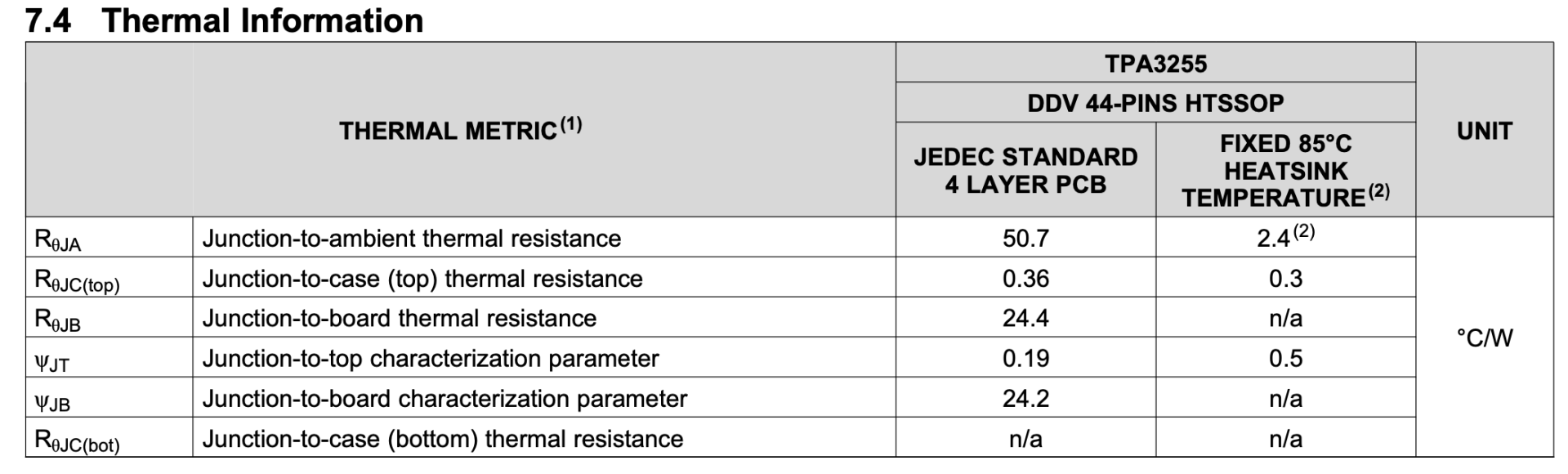
Further still, the power dissipated by the amplifier rises non-linearly with output power, and at the (woofer) rated 600W total output power, the amplifier will be dissipating nearly 90W in heat. While 600W is the upper boundary (consider duty cycle, crest factor, etc), again, in practice, what I observed is that the amplifier gets hot hot. For instance, standard wire (PVC) temperature ratings are ~80°C which only allows a maximum output power of 100W total (assuming ambient at 25°C and an ideal heatsink).

To combat this, I installed thermo-couple controlled 80mm case fans to the heatsinks, with exhaust vents in the electronics box, to enhance the heat dissipation capacity of the system and prevent heat-soak. I also upgraded some the wiring for this project to silicone-sleeved wires, which besides tasting great being luxurious in quality and feel are much easier to route, handle and bundle.

in this terrible picture you can see the Arctic F8 TC case fan nestled right above the heatsink

ACCESSORIES AND NOISE

The fans themselves consume enough wattage that the TPA3255 onboard 12V line was not sufficient. I also wanted a battery meter, and a backlight VU meter. I trialed a HV DC-DC step down to run all the 12V auxiliary bits; in most applications, I would use a simple low noise buck converter like an LM2596, but these tap out around 36V. To step down the 50V battery voltage, I had to find specialty voltage converters, but the ones I found for reasonable prices tended to inject too much noise into the signal path. Due to the high gain and high efficiency of the acoustic section, the whole set up caused tons of quiescent noise, which only increased with the power draw of the aux electronics (e.g. fans). So I opted for a truly ridiculous solution.

‘DC-DC converters do come in various flavors of ground-loop isolation, ranging from 0 isolation (cheap) to kV of isolation (very expensive for higher ampacity), but you know what’s cheap and intrinsically highly isolated? A completely floating power supply.

Having lost all sense in the pursuit of FAT bass, I built a separate 3S battery pack to run all auxiliaries which has the advantage of excellent isolation and the massive disadvantage of added complexity. In addition to having to have two battery management boards, two separate grounds, carefully calculated battery capacities, the device now requires two separate chargers and a 4-pin charging connector.

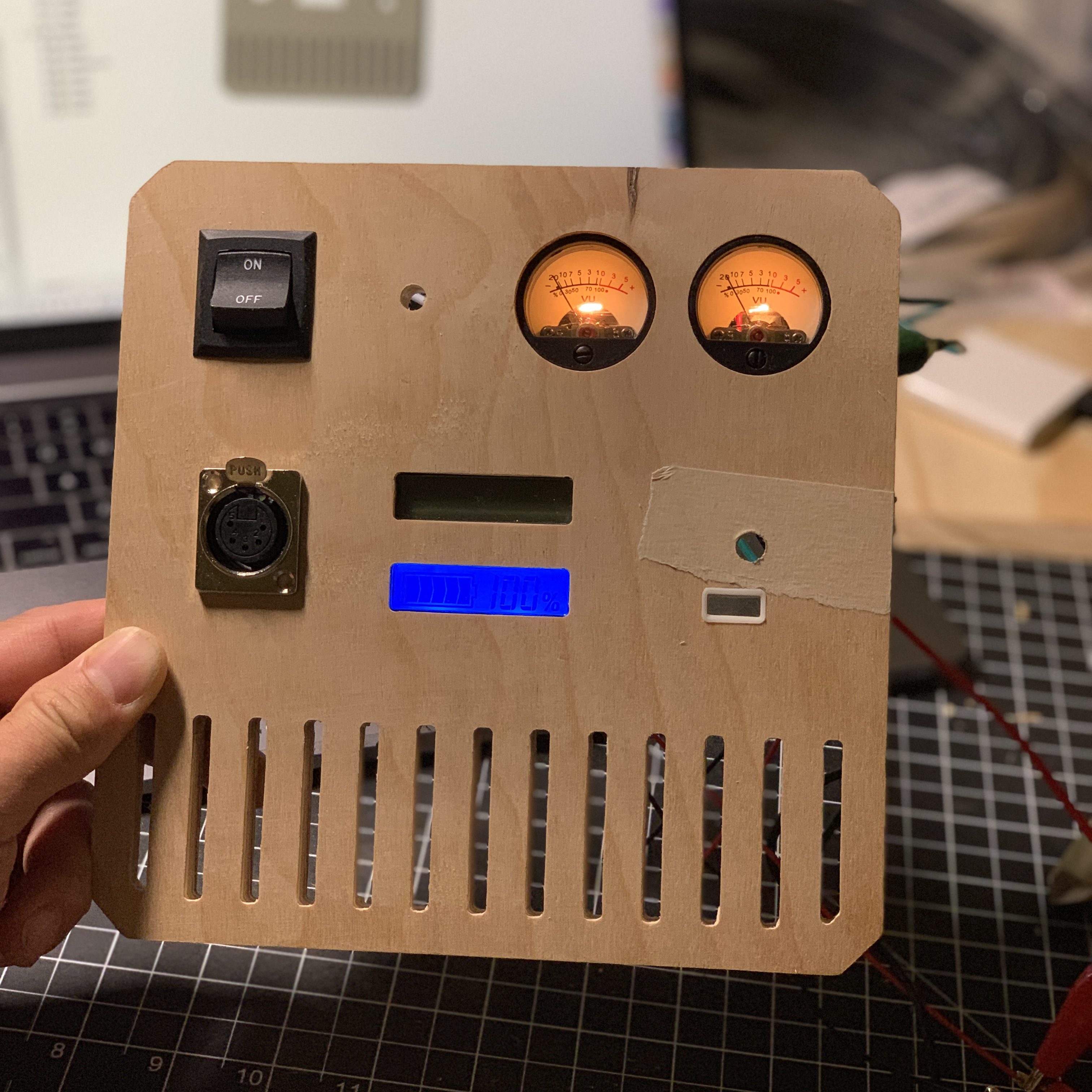
But it was all worth it for the VU meters, which flick to the beat independently:
FINISHING THE BUILD

At this point, all that was left was to put everything together

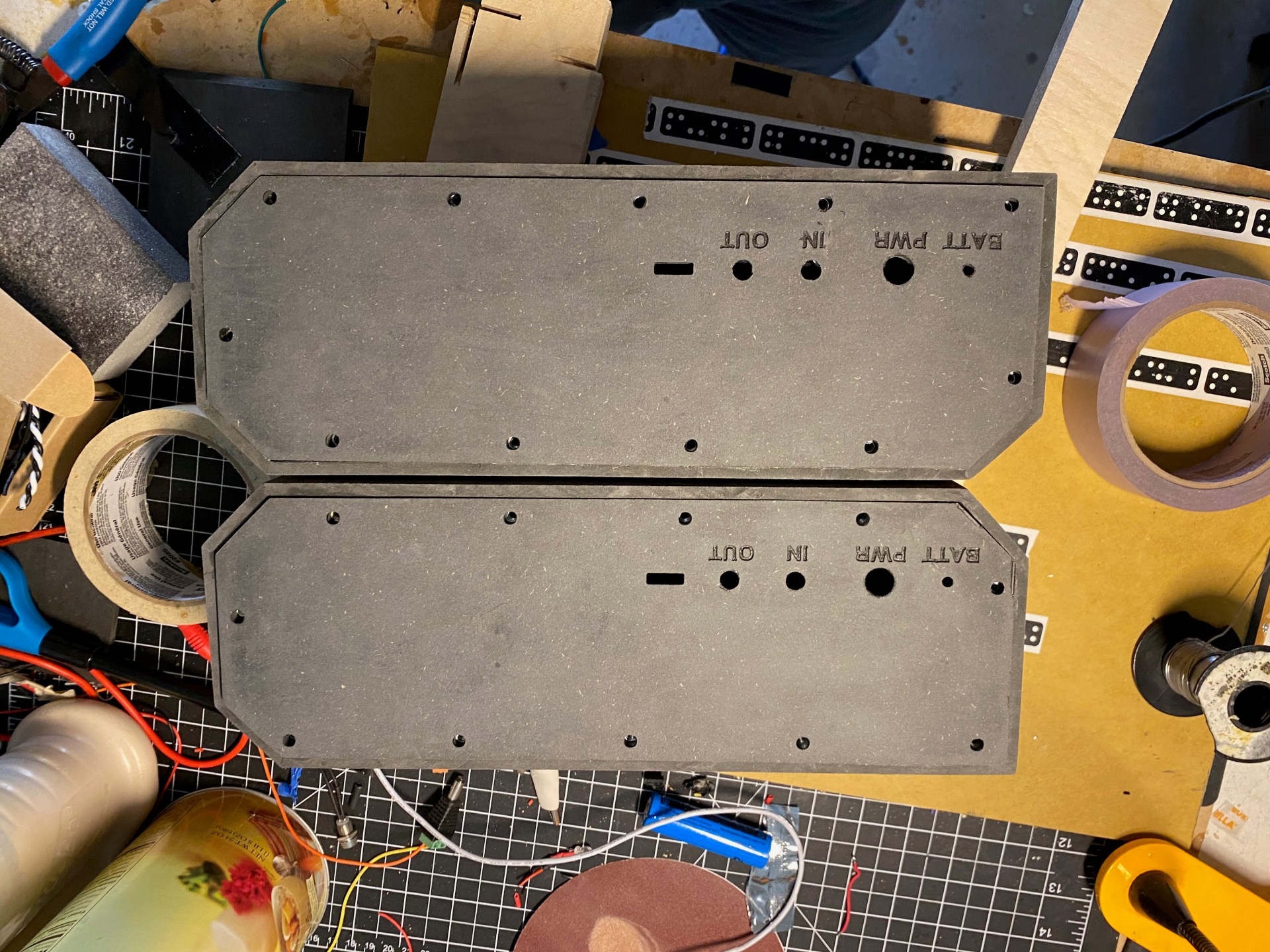
Testing the cut outs for the rear electronics panel:

The VU meters look amazing:

Adding stuffing, and a mess of wiring

The wiring can only get more messy

Sound testing before finally assembly:
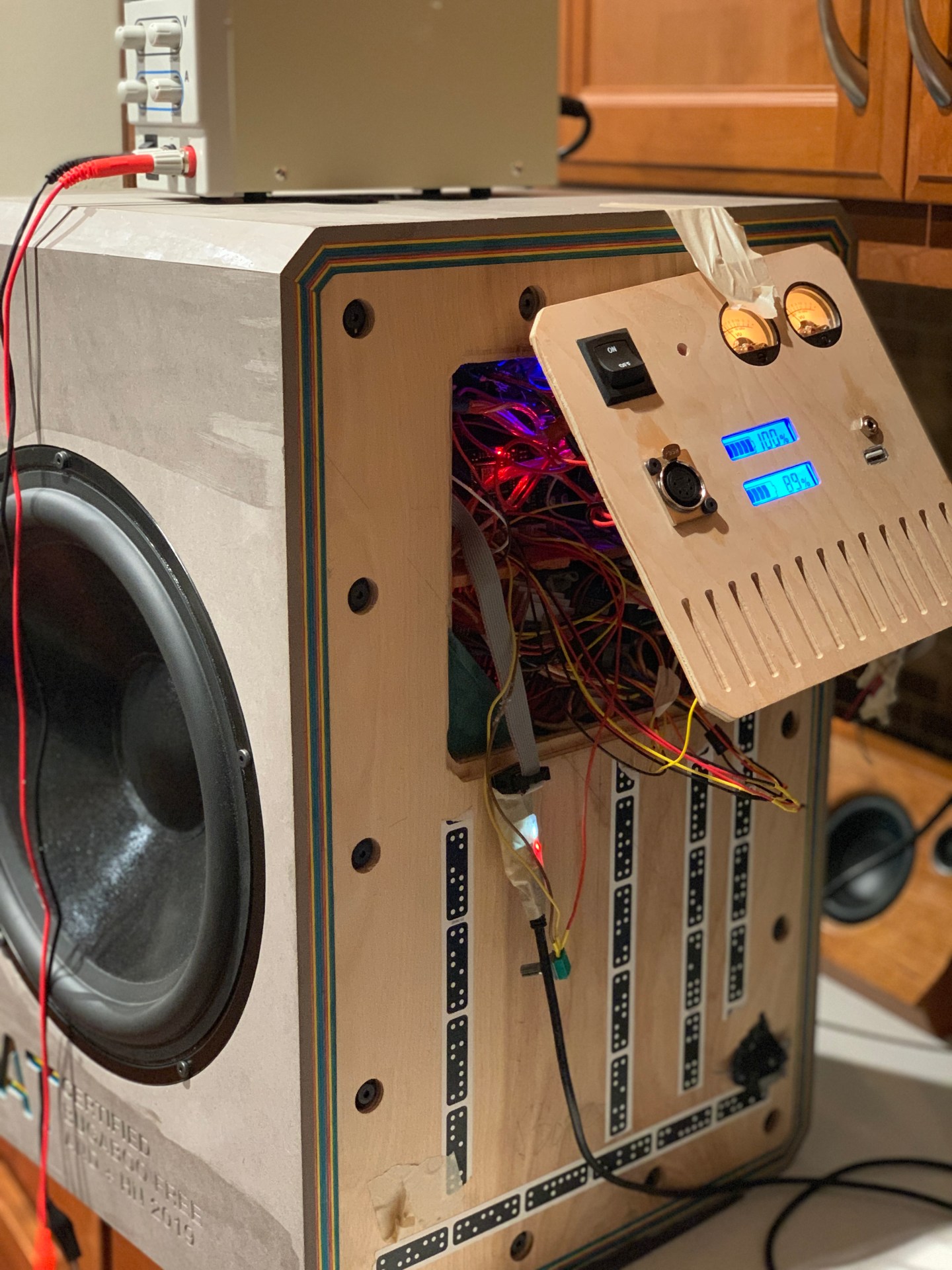
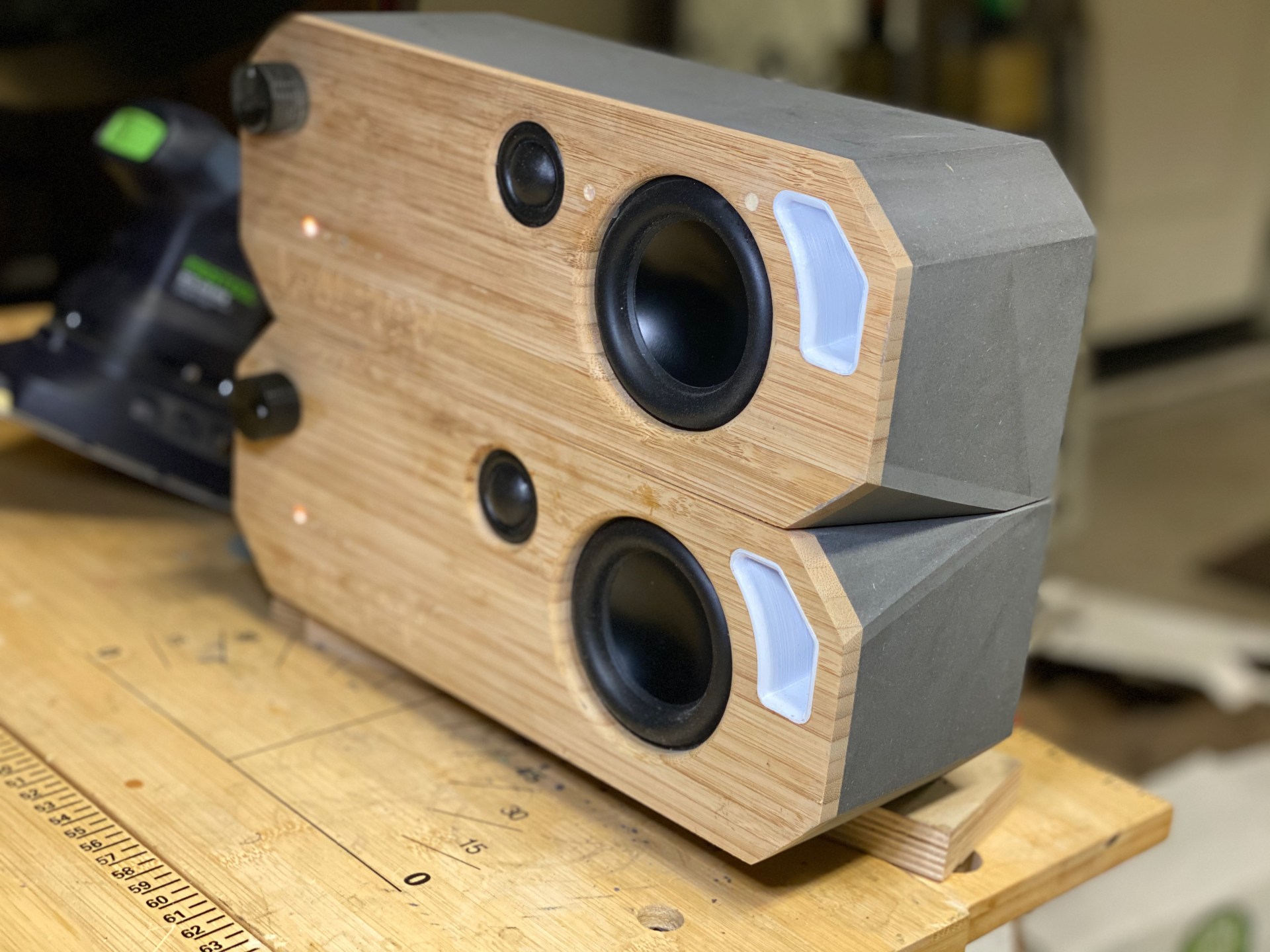
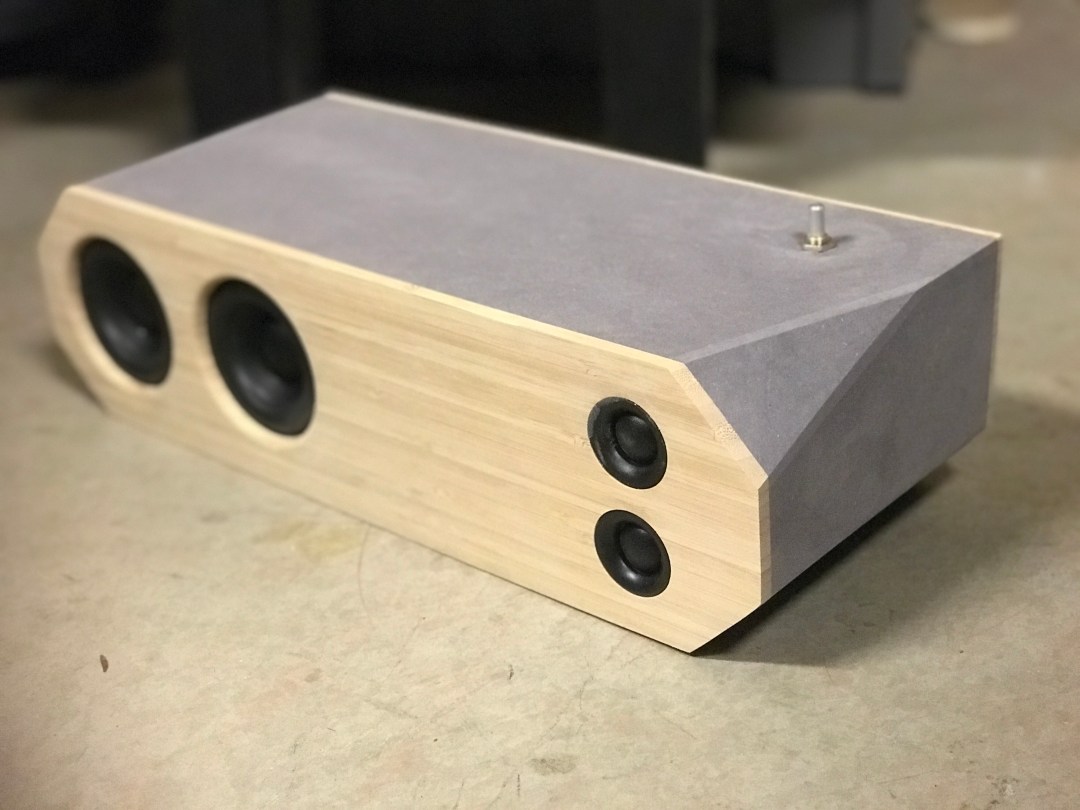
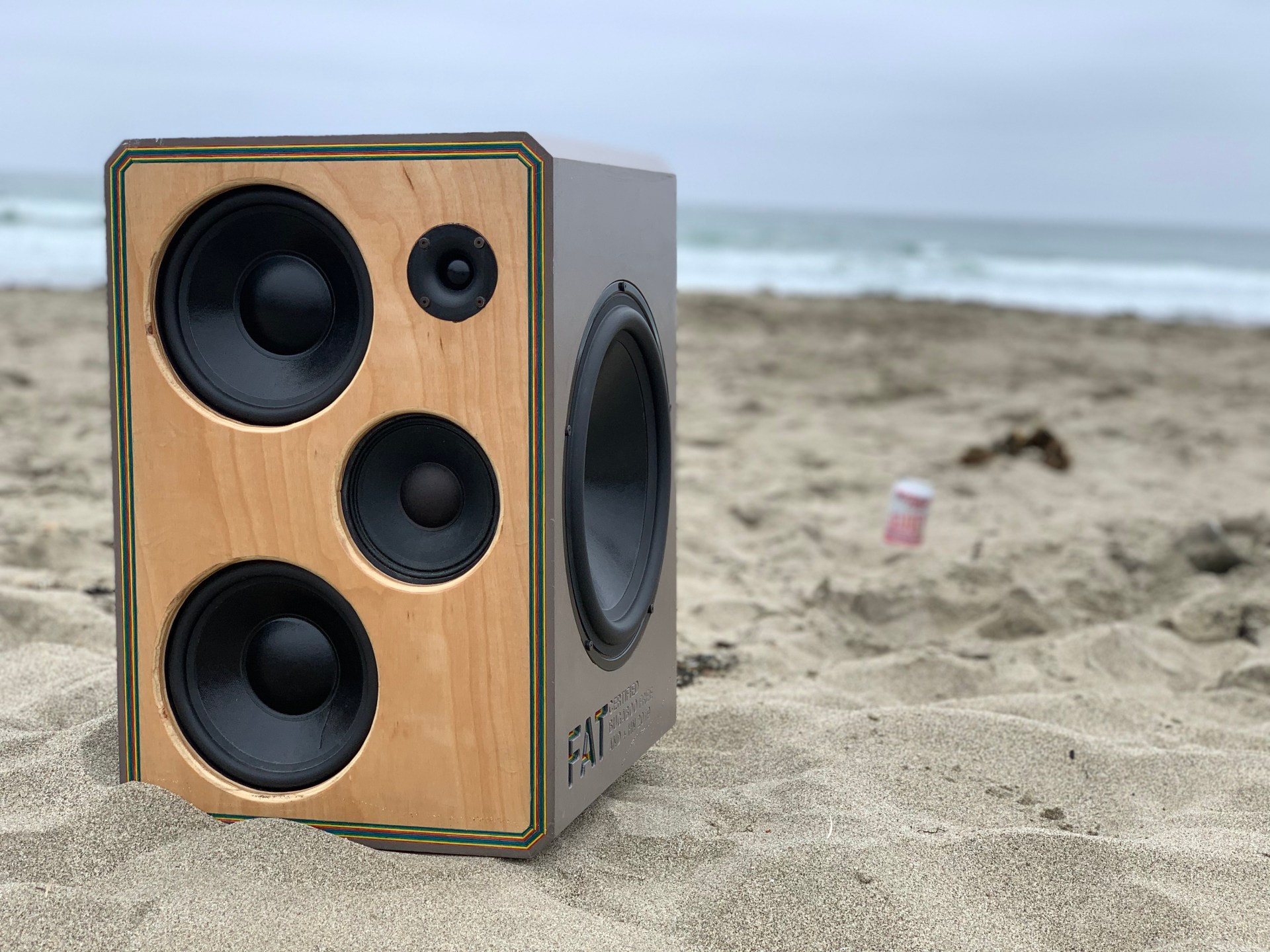
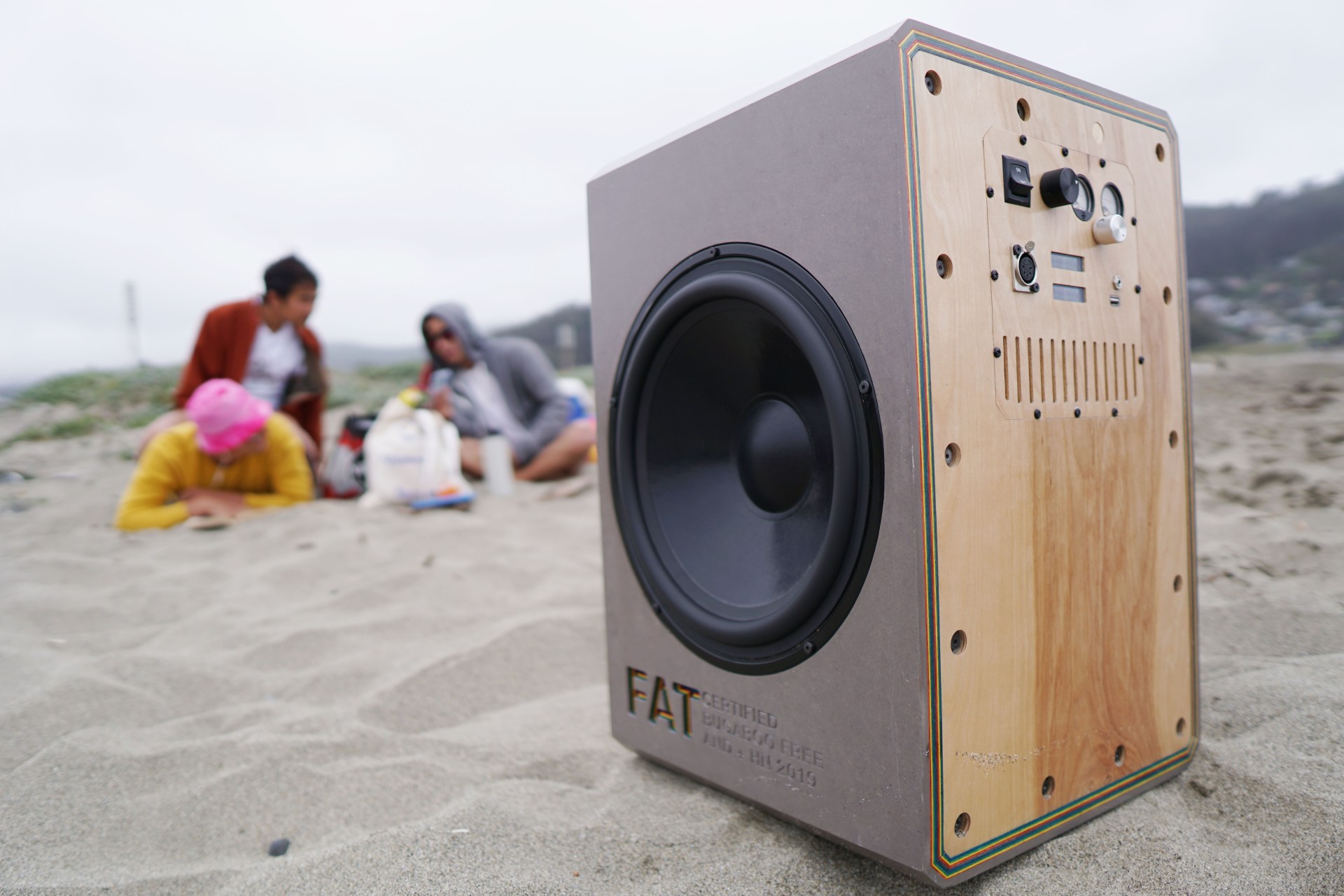
Finished product:
MARRIAGE SOUNDS GOOD

What’s the right wedding gift with 30 days of lead time when your friends are stranded across the Canadian border because of a global pandemic but they’re willing to risk it all for love and get married in a DMZ? I went with an Ikea cutting board. Well—to start.

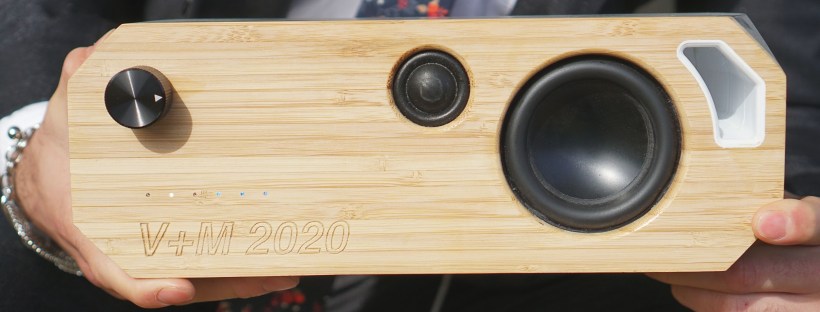
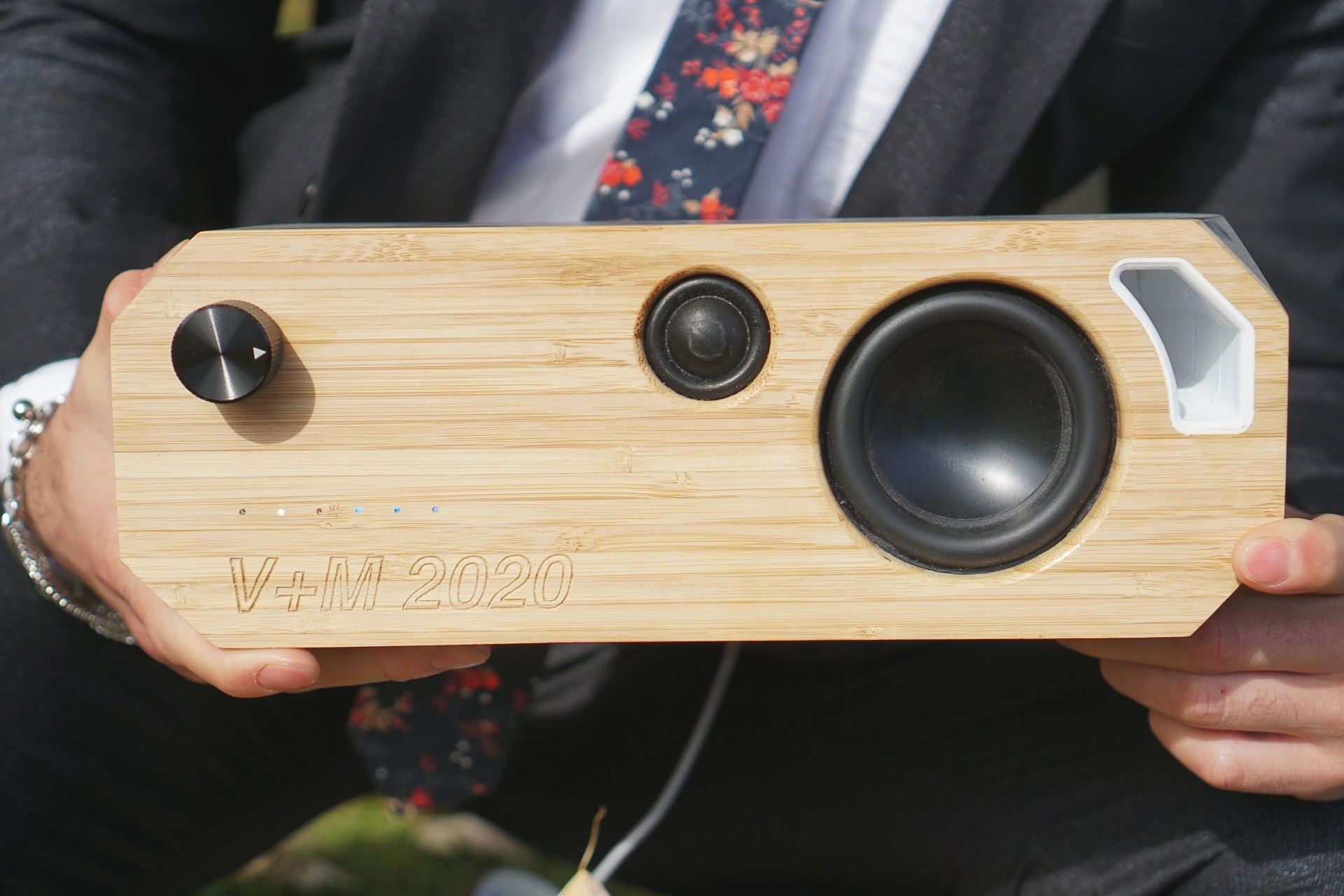
It turns out that in places where border boundaries are blurred the acoustic offerings are slim. Without loud music (and strong drinks) no party is bompin, and without a bompin party, it’s not a wedding, so there was really only one thing to do: make a matching & linkable set of portable, hi-fidelity bluetooth speakers:

DESIGN SPECS

Cost of parts: $150 (ea.)
Loudness: 96dBSPL, 1m, @ 10% THD, A-weighted
Frequency Response: 50Hz to 20kHz ±5dB (but look at the curves down below)
Connectivity: Bluetooth 5.0
Battery: 3S Lithium-Ion, 37Wh
Runtime: 10 hours at “half volume” input (92dBA output)
Amplifier: 2x50W TPA3116D2 running @ 24V
Difficulty of Build: Dummy high—approx 120hrs from start to finish, requiring 2 CNCs and a 3D printer

In a lot of ways, this was a 2020 capstone project for me: to make something that’s loud, compact, and full of deep bass, with a 30-day conception to finish timeline, I had to pull out at least half of the dirty tricks I’ve learned over the last six years. Here’s how it went down.

ACOUSTIC DESIGN

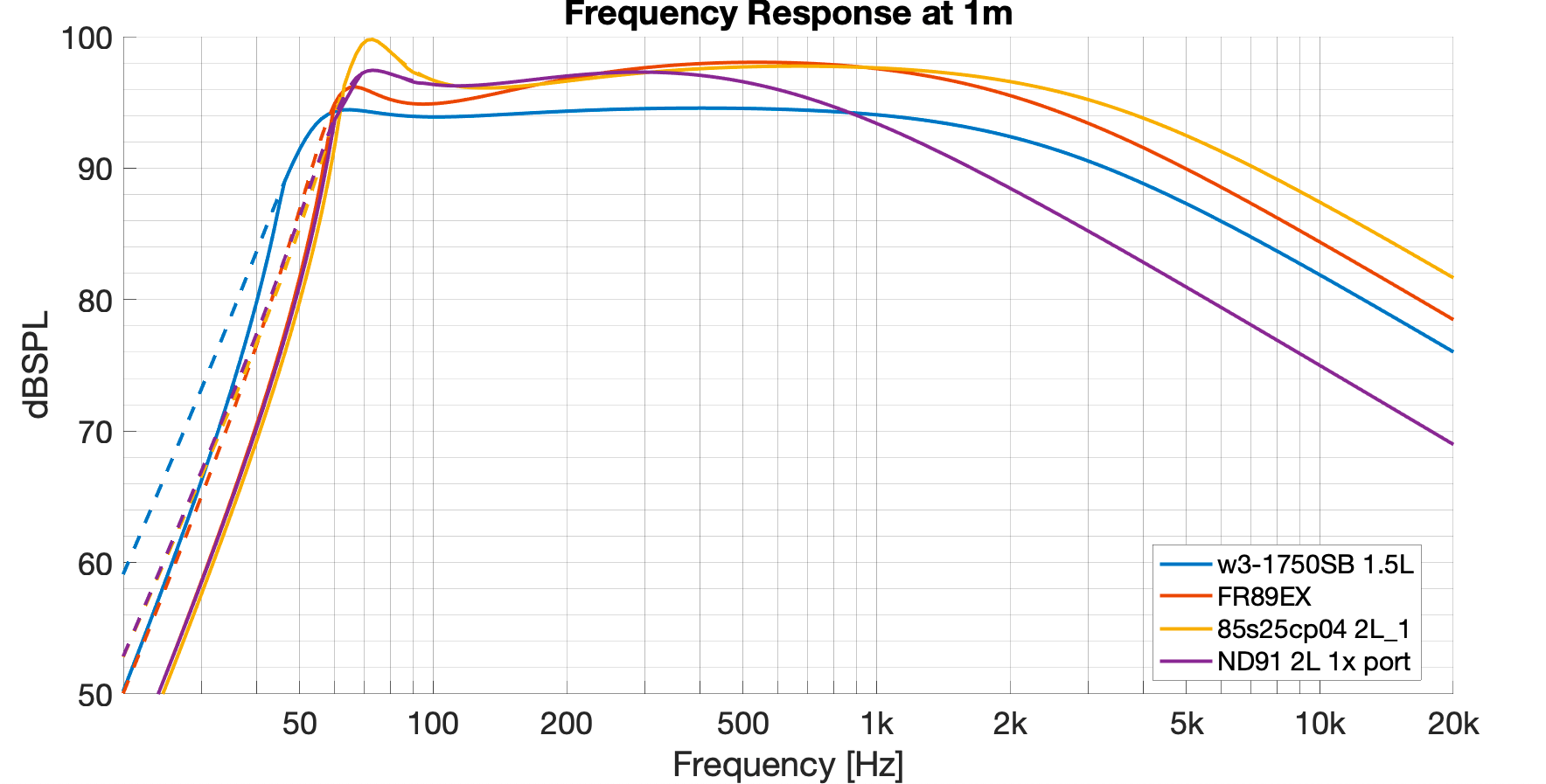
When it comes to compact loudness with a lot of bass, excursion and efficiency are the belles of the ball, and although I simulated almost every 2-4″ driver I could find, the Dayton ND91-4 drivers (descended from long-gone AuraSound’s Neo-Radial IP) are nearly unbeatable when you factor in magnet strength, Fs, Xmax, price and weight. E.g. Peerless SLS-85S25CP04-04’s (catchy name huh) are potentially 1dB louder for a similar box size but weigh 285% more, while the Fountek FR89EX win for Xmax but need too much back volume and are 2dB less efficient…etc and so on. Just trust me on this one. In a 1.5-2.5 litre box: ND91-4, tuned low.

Tweeters are a fair sight more efficient, so down selection should be mostly driven by crossover frequency, dispersion and ease of integration. The ND91s break up right after 3kHz:

While the ND16/ND20 tweeters are truly amazing, they have to be crossed higher, and they come with a bunch of extra plastic, which clashes with the ultra compact layout I pushed.  LaVoce’s TN100.70 did the trick and can be crossed over at 1.5kHz, which was perfect—the lower a tweeter can be crossed (disclaimer: within its volume displacement limit), the better. Finally, the TN100.70 dispersion is on par with the ND20FA tweeter @ 20kHz (-15dB):

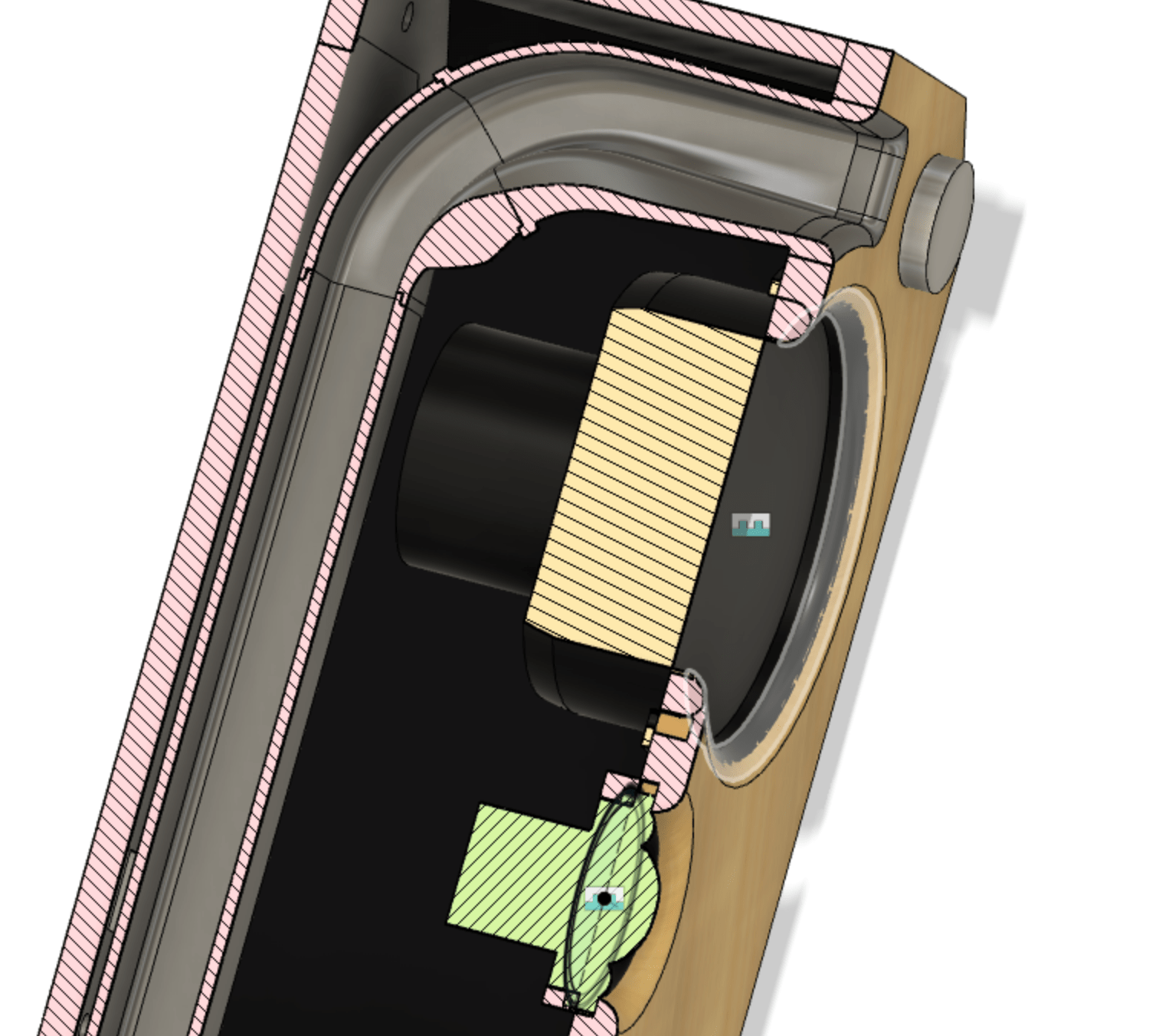
As for the port, in order to maintain compactness and b-b-bass, I had to fit 250mm of port into a 2.5L box while keeping a holdable 4-inch width so I folded it around the ND91 and then crushed the port geometry until it fit in between the driver and borders of the speaker. Tweeter in green, port/body in pink, and woofer in yellow below:

Driving the woofer and tweeter is a 3S 3500mAh battery pack (I use LG 18650s that I order B2B from the factory) paired to a 2x50W Class D TPA3116 D2 amplifier through DC-DC step up converter for maximum power delivery. WONDOM makes a wonderful TPA3116 board with the DSP integrated, which merges with their 3S MPPT Battery Management Board, although to my late-stage chagrin neither of the boards have a step up to power the TPA chipset at an adequate 24V.

BUILD PROCESS

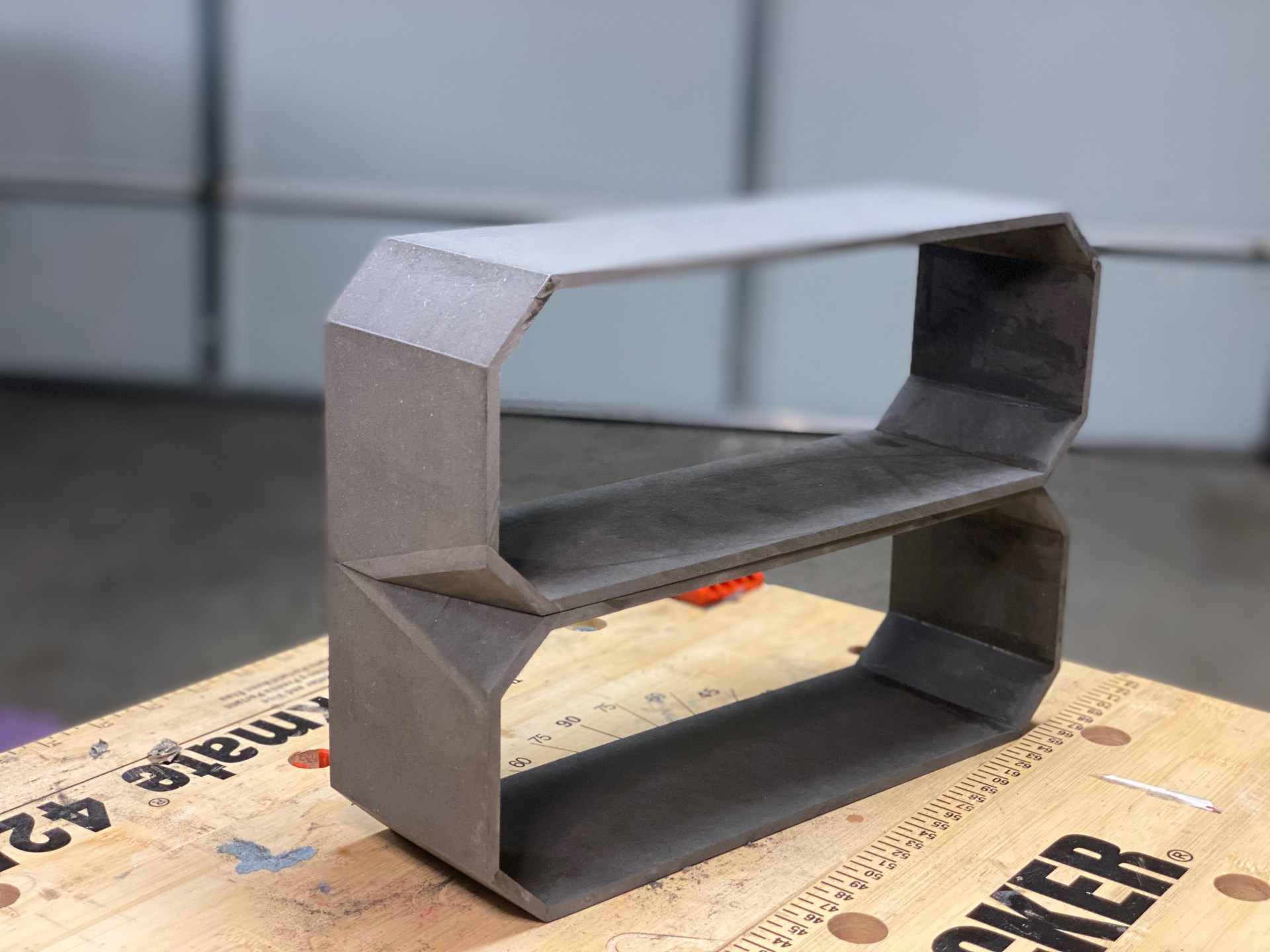
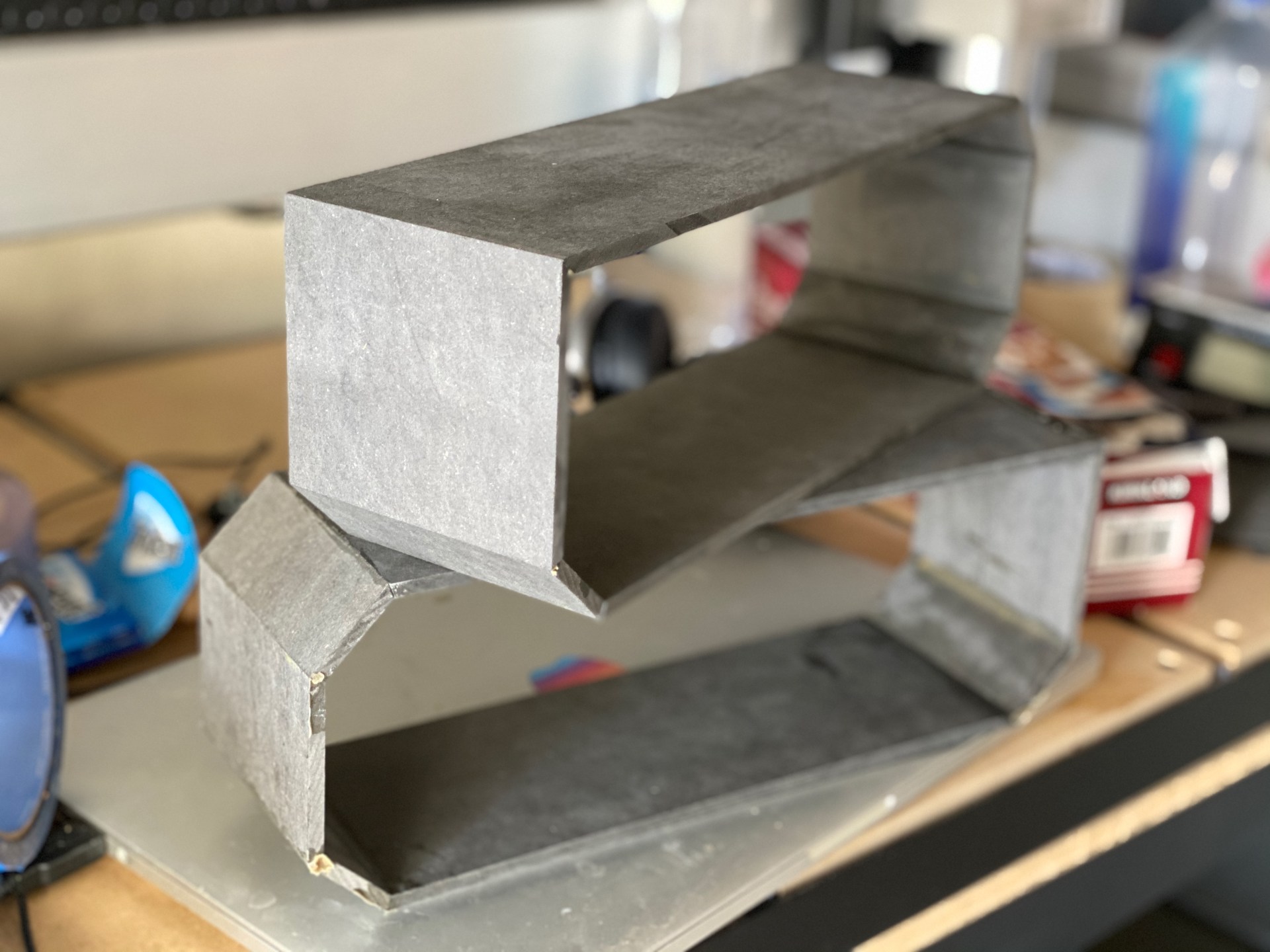
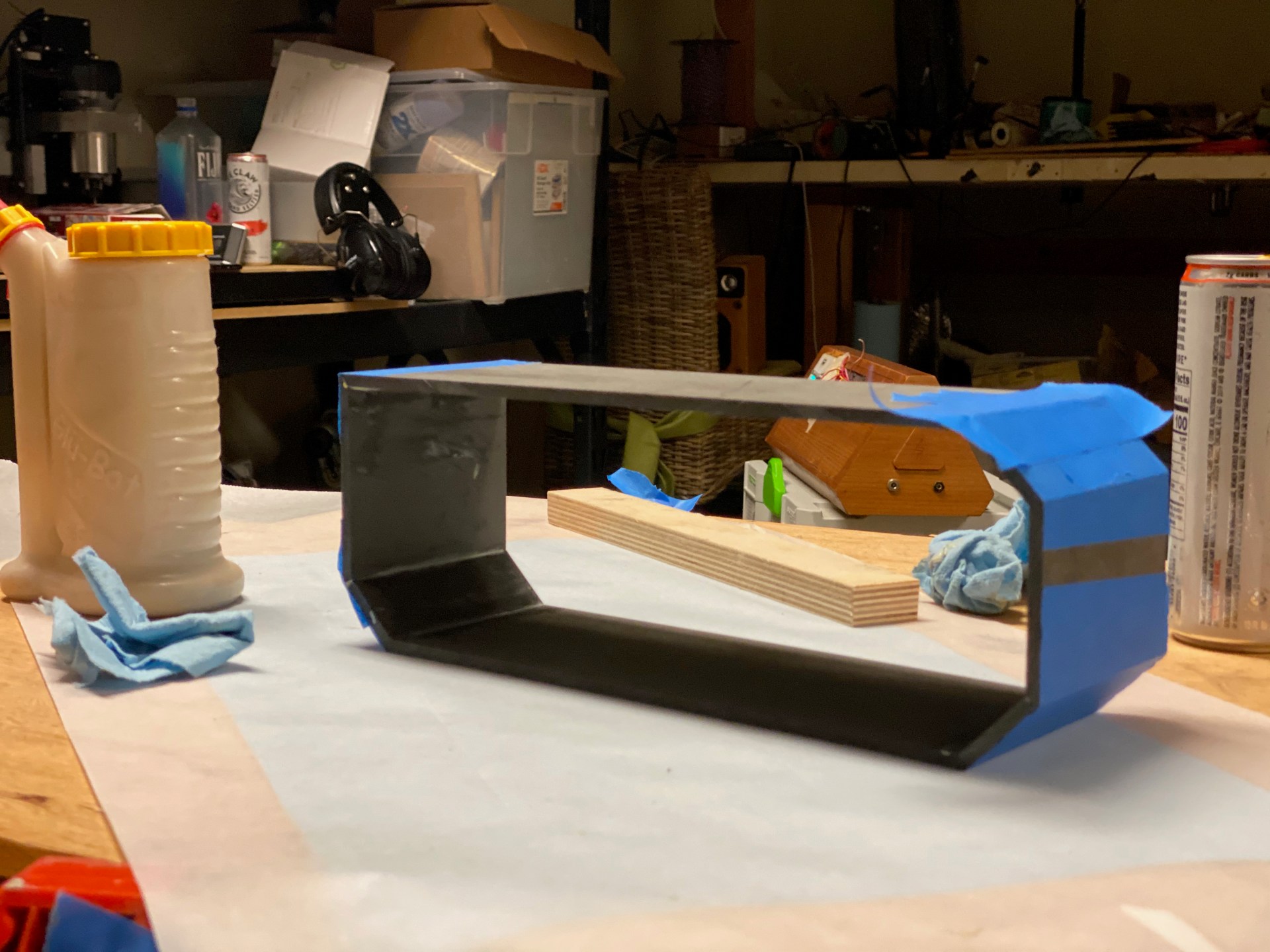
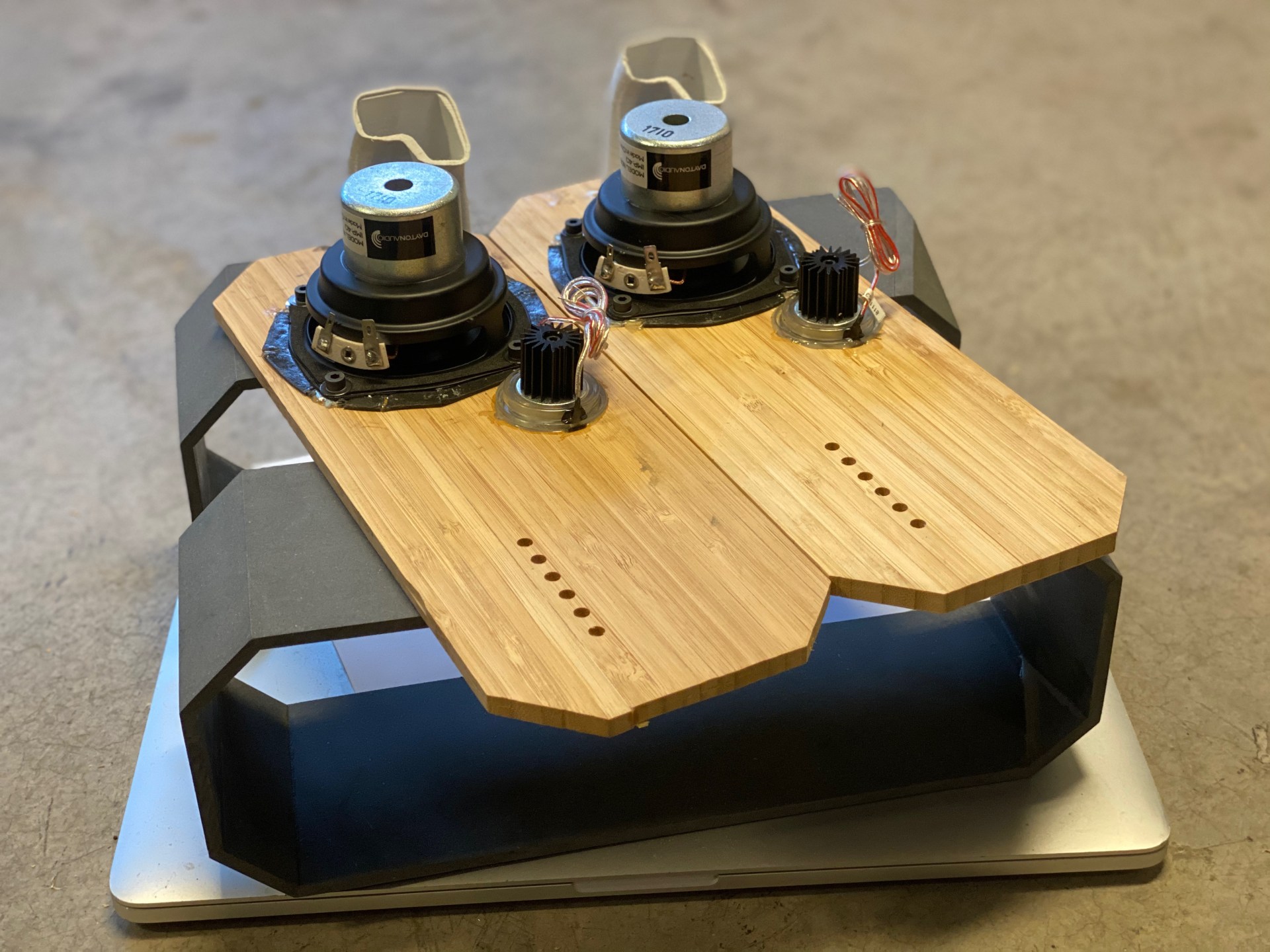
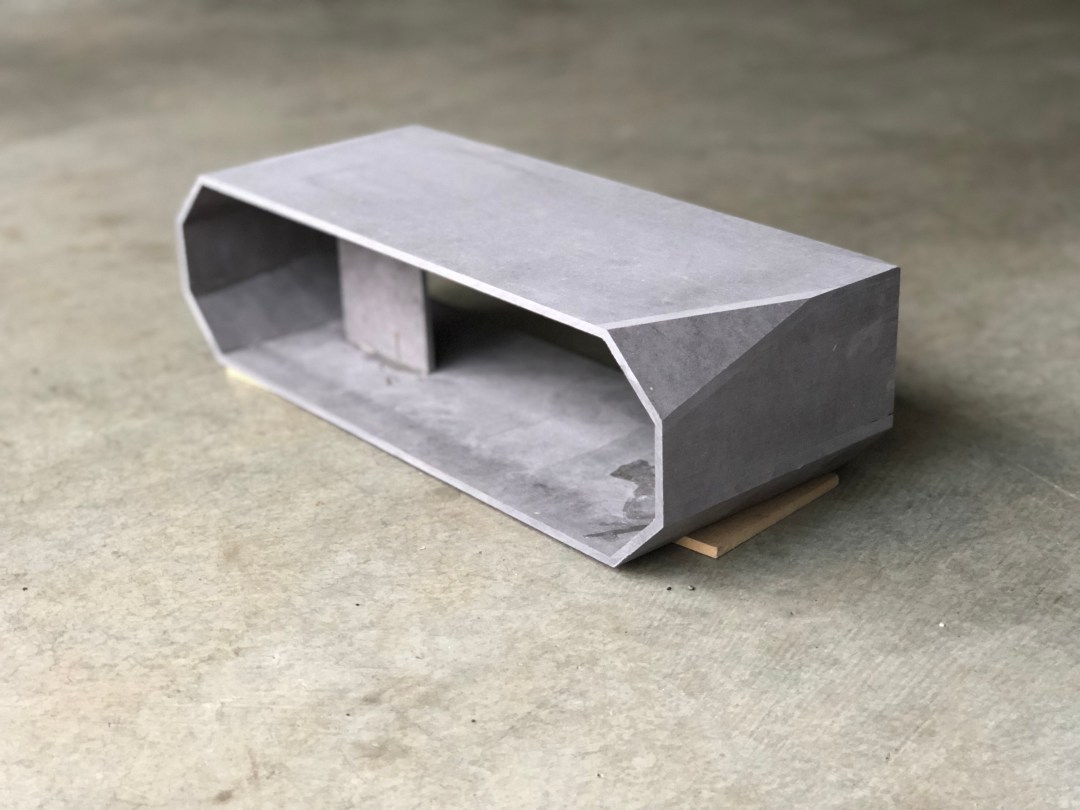
With the acoustic design tucked away 15 days from the deadline, it was time to build. The octagonal outer shell is just a set of 22.5° mitres, tape-clamped, with the patent-pending dual-bevel 8th wall precision cut to match:

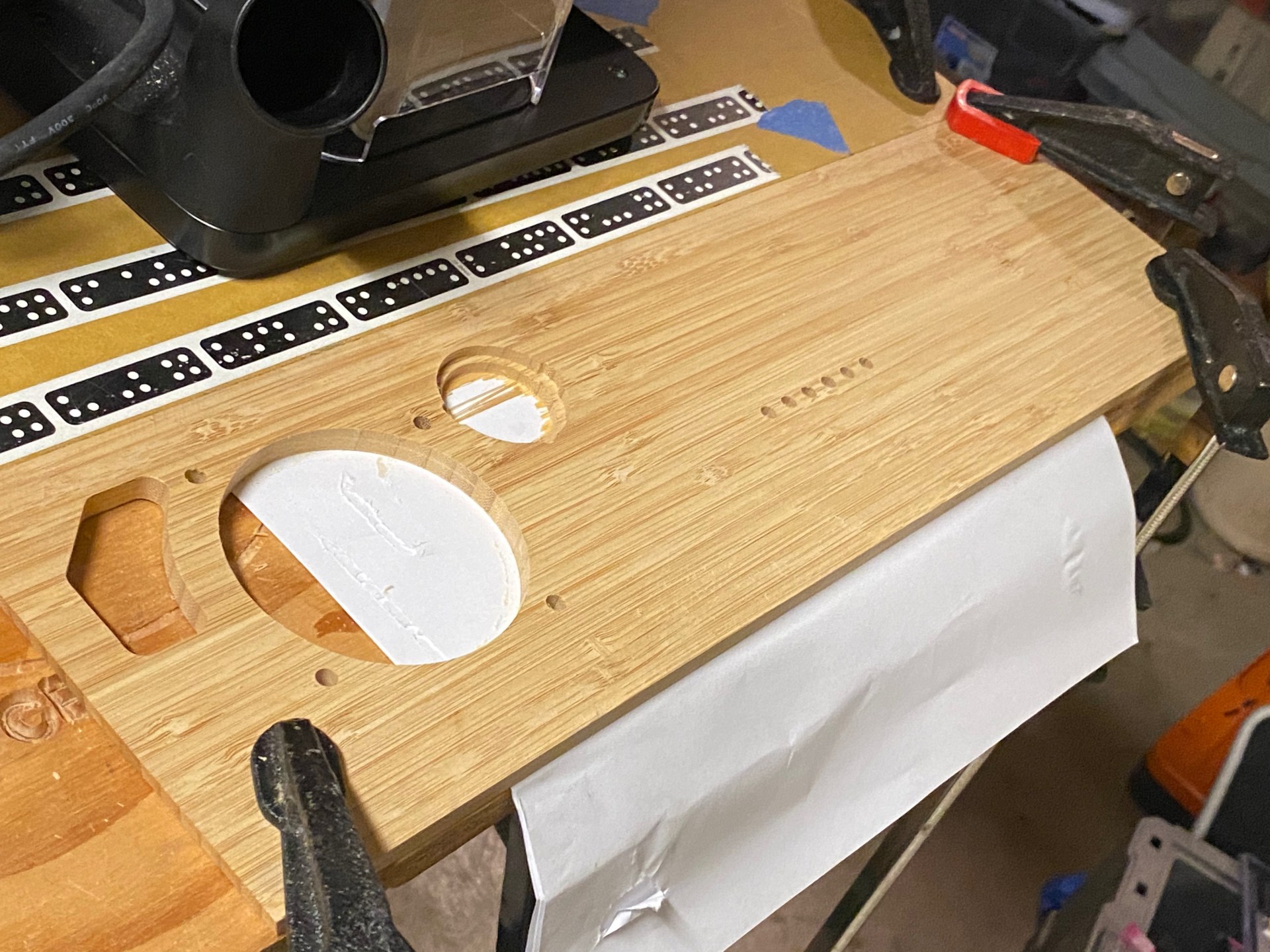
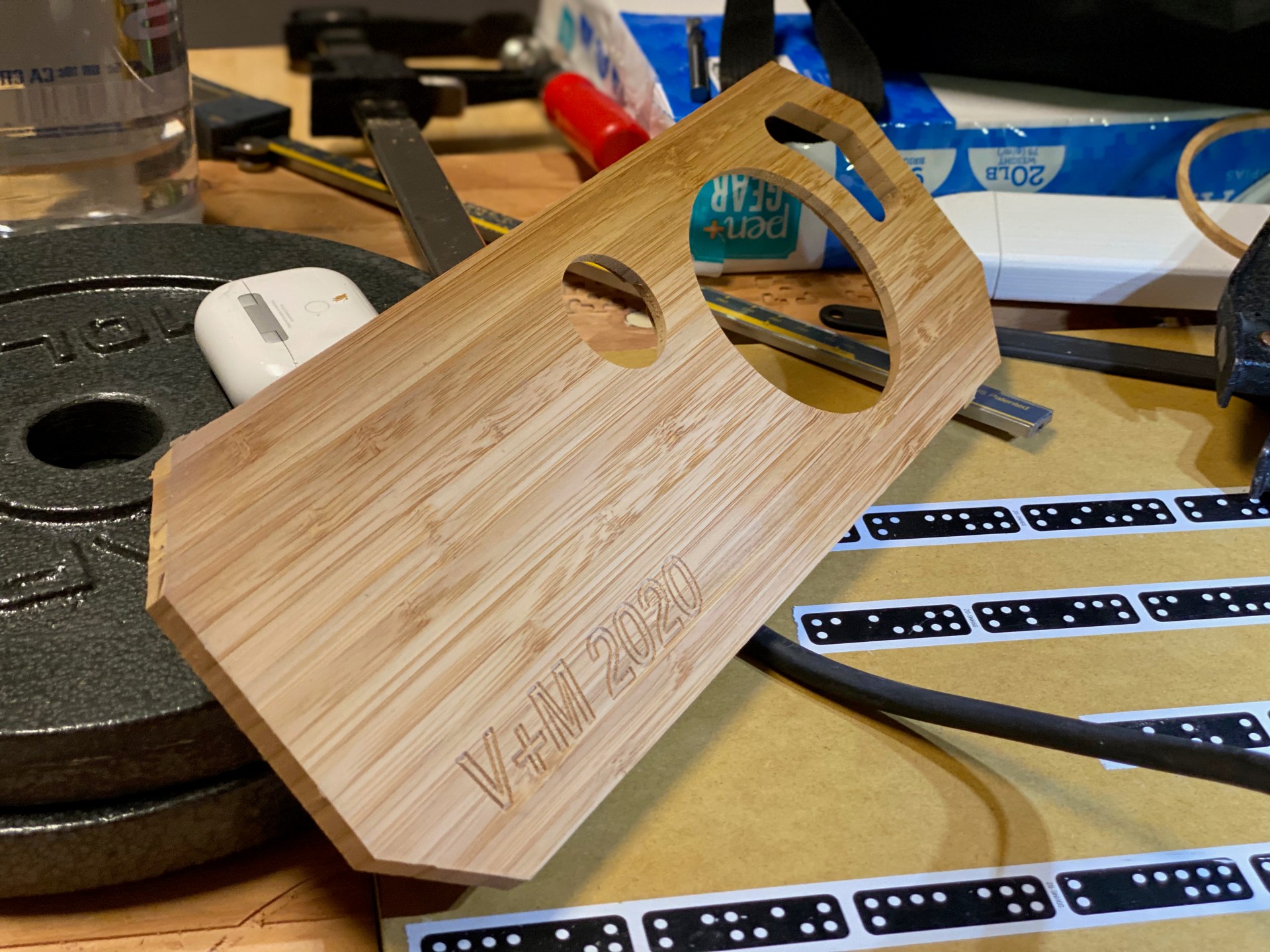
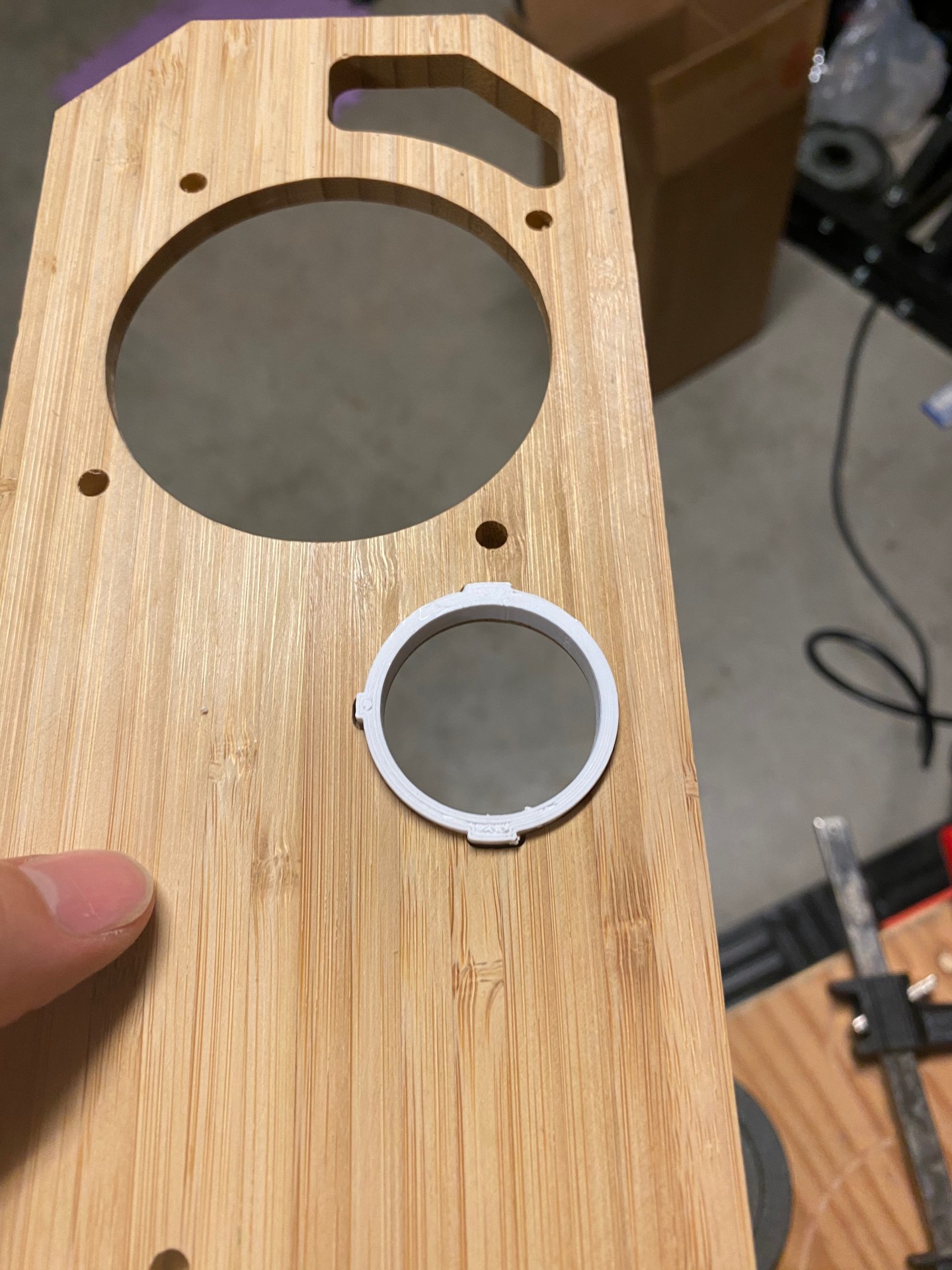
The front face was a 2 sided CNC operation, which required calibrating features for aligning the Shaper Origin I used.

Merging the two pieces with the speakers and the front mounted the port was rather easy except for some minor mishaps with a few missing microns; the t-nut I planned to use to rear-mount the woofers were exactly 300 microns short of the planned front face thickness, so after sanding I had two t-nut holes showing on the front face. The port itself had to be printed in 3 pieces because of the complexity of the geometry to fit it both on the border and between the woofer and the back panel:

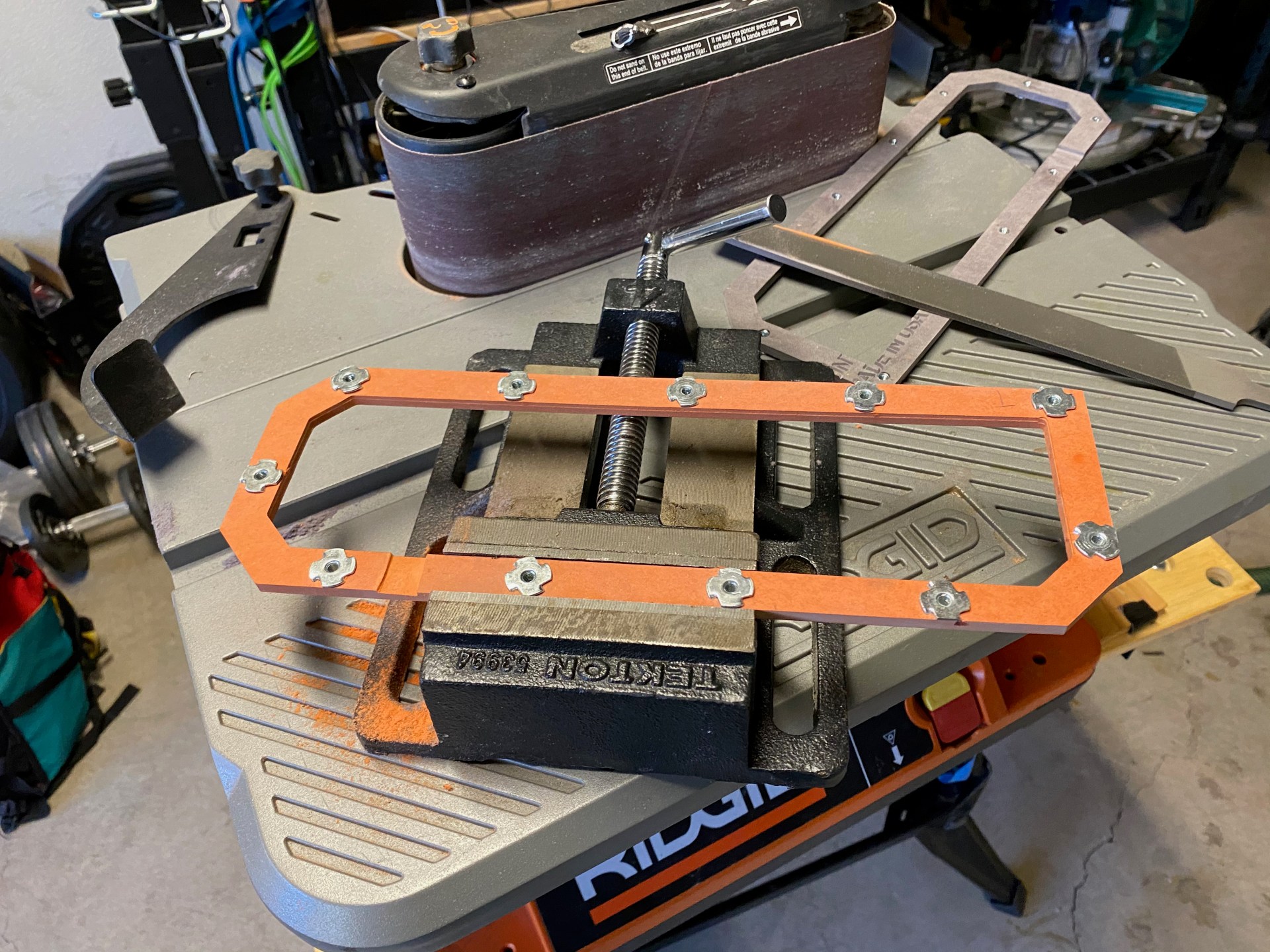
With space at a premium, but also for aesthetics, I used an LED array for status lights and integrated the on switch into the potentiometer. With that in mind, I also fabbed an ultra slim 6mm bracing/sealing ring for the rear panel mounting, as a butt joint would’ve been ugly but the shell was too thin/weak for threaded inserts. Those loose microns got me again and the flange on the port interfered with the built dimensions of the rear panel, so I slotted that out, but after some truly painstaking finagling of circuit boards, 5 days before the wedding ship date, I was ready for sound test.

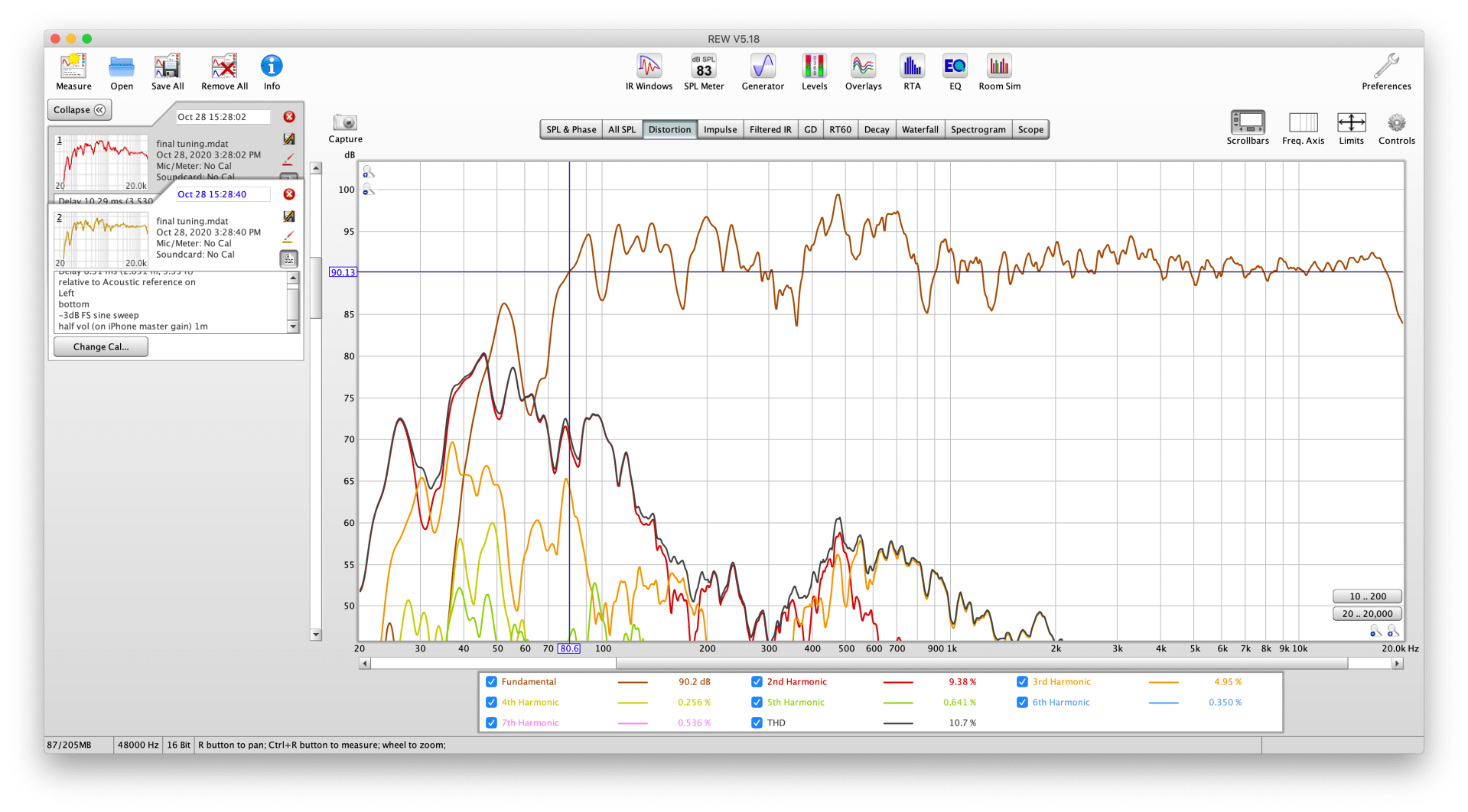
That’s when I realized neither the BMS nor the Amp was using a boosted rail which was causing very noticeable voltage clipping, so I had to rip everything open and shove not only a DC-DC buck converter but a giant LC ripple filter (1.3mH L and 100µF C) onto the voltage rail. The only DC-DC buck converters I had in house were straight outta Hua Qiang Bei which means the were both cheap and poorly designed. Buck converters are in general awesome, and about as efficient as one could hope (for 12 to 24V boost, I saw ~85% efficiency depending on load), but the switching causes a lot of load-dependent ripple, which adds both noise and intermodulation into the signal chain. But with that bullet bitten, and with 1 day until ship, it was time to tune. And boy does this design sound good. Sparing the details of the tuning, here’s the final frequency response with a -3dBFS sine sweep @ half input “volume.”

The 2nd harmonic distortion looks pretty high @ 50Hz but this is mostly due to the aggressive non-linear processing I added in for extra kick; a more reasonable measure of THD in this scenario are the 3rd order harmonics, which I kept below 8%. The dips in the mid band (400Hz, 800Hz) are regrettable from a data standpoint (probably due to product baffle dimensions) but overall, these speakers deliver supple bass, smooth vocals, crisp treble, and excellent definition from 50Hz all the way to 20kHz. I added a little bit of level-dependent EQ, so at maximum volume these speakers are loud enough to kick off a backyard party, and at reasonable volumes they deliver a little extra extension for a very full, deep, frequency response. In my book, a thermos-sized speaker that can fill a room down to 50Hz ticks the “bigger than it looks” box; even from another room I found my self saying “damn, these sound good.”

TESSELATION

There are far more than five senses available in the bleak sensorium of human existence, and one of them is the sense that you could’ve done better. Could I have done better? Let’s find out.

Obligatory finished product first:

IMG_3752.JPG

I think the journey began confidently over beers, but the tolerances involved in interpreting what someone means by “portable and loud but doesn’t have to be too loud but also make it look really cool” can allow for a lot of design doubt (by no fault of their own–it’s just hard to gauge what reference points people have for “small” and “loud”), and so by the time I packed the Tesselator out, I had built 6 separate designs, each one but the last dusted in a fine sheen of “not-quite-good-enough.” This is their story (dim the lights).

ROUND 1: TOO BIG

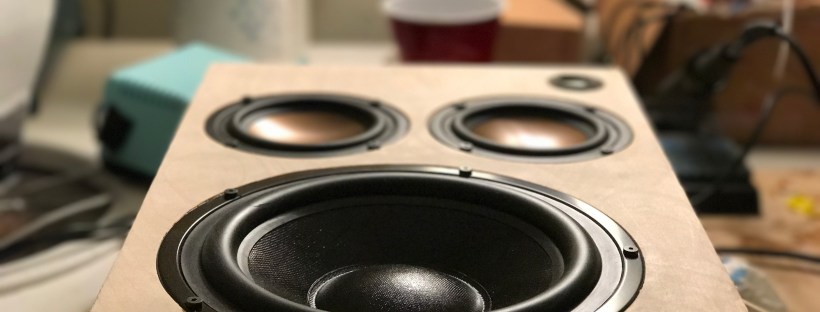
Try 1 was actually pretty awesome. Basically, I wanted to see what the hype was about with the HiVi B4N’s. Ports in small boxes often of chuff me the wrong way and the client wanted “big circles on the front,” which I interpreted to mean speakers. Plus, I go for passive radiators when I can…and so I went for a passive radiator design. I had been having luck with asymmetry, and I wanted to carry a “T” motif through the design.

IMG_2487.JPG

The problem with the B4N’s that all the fanboys won’t admit is there’s an insanely high Q 15 dB break up mode right at 3kHz, and it likes to jump around depending on boundary conditions, air temperature, zodiac sign, etc. [For the uninitiated, basically the B4N is the classic DIY beginner speaker design because it sounds and looks good, is cheap to make, and because so many other people have built it. However, the all metal cone it’s based around tends to “ring” like a bell at annoying frequencies]. So I wanted to be at least 15 dB down by 3kHz which meant a tweeter that could hit 1.5 kHz, and for directivity reasons, I decided on a 500 Hz crossover, which obviously meant I was going to use the Aurasound NS1s.

Then I found a sweet spot of plywood that I could waterfall from top to front face to edge, cut with confidence, laid out some paper circles for test fit, and very poorly lock-mitered the shit out of the wood.

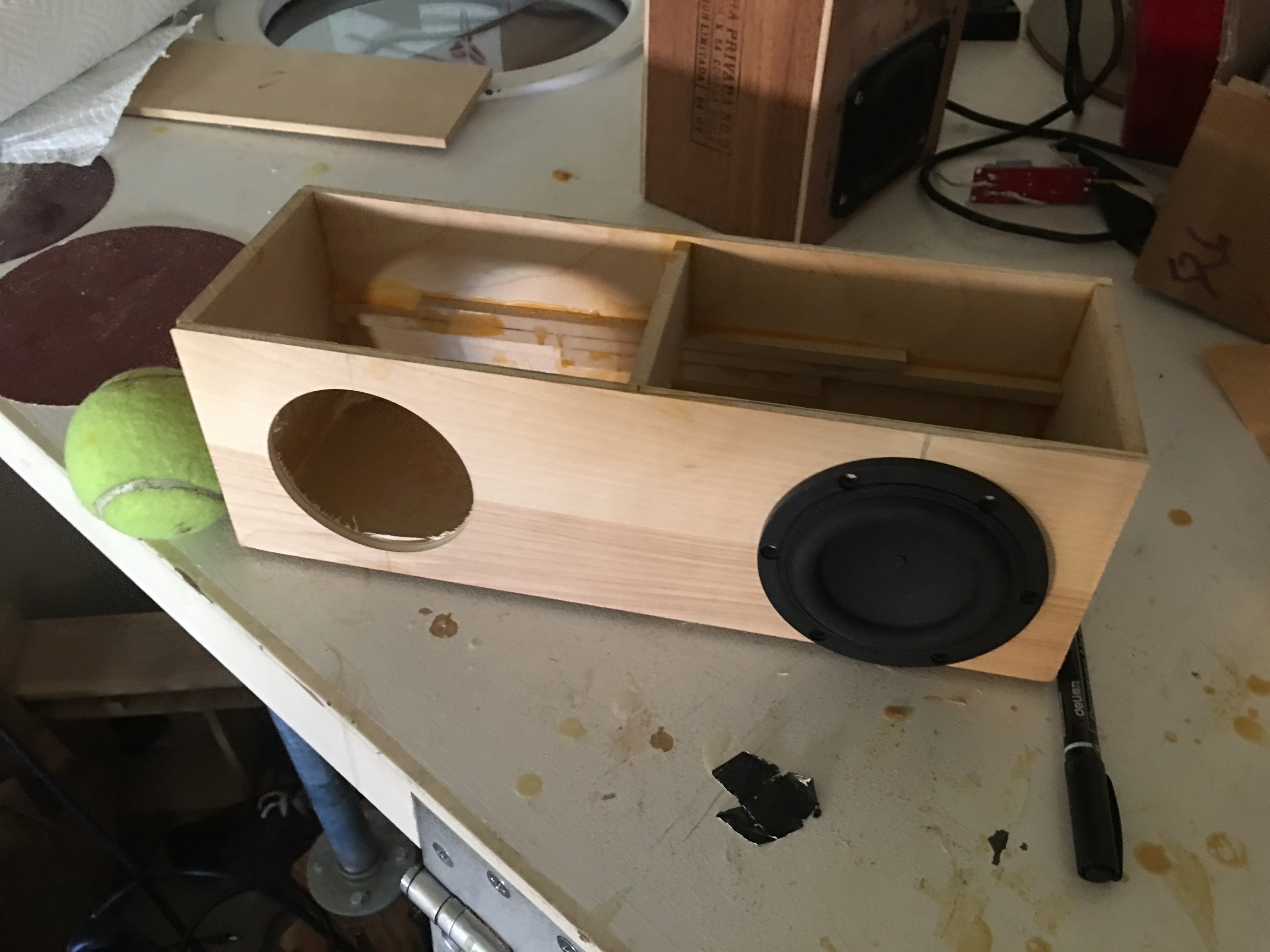
Lock miters as promised:IMG_2498.JPGThe separated volume is for the electronics–lesson learned from previous projects is when trying to attain a good seal, either get better at electrical engineering, or compartmentalize your bad work.
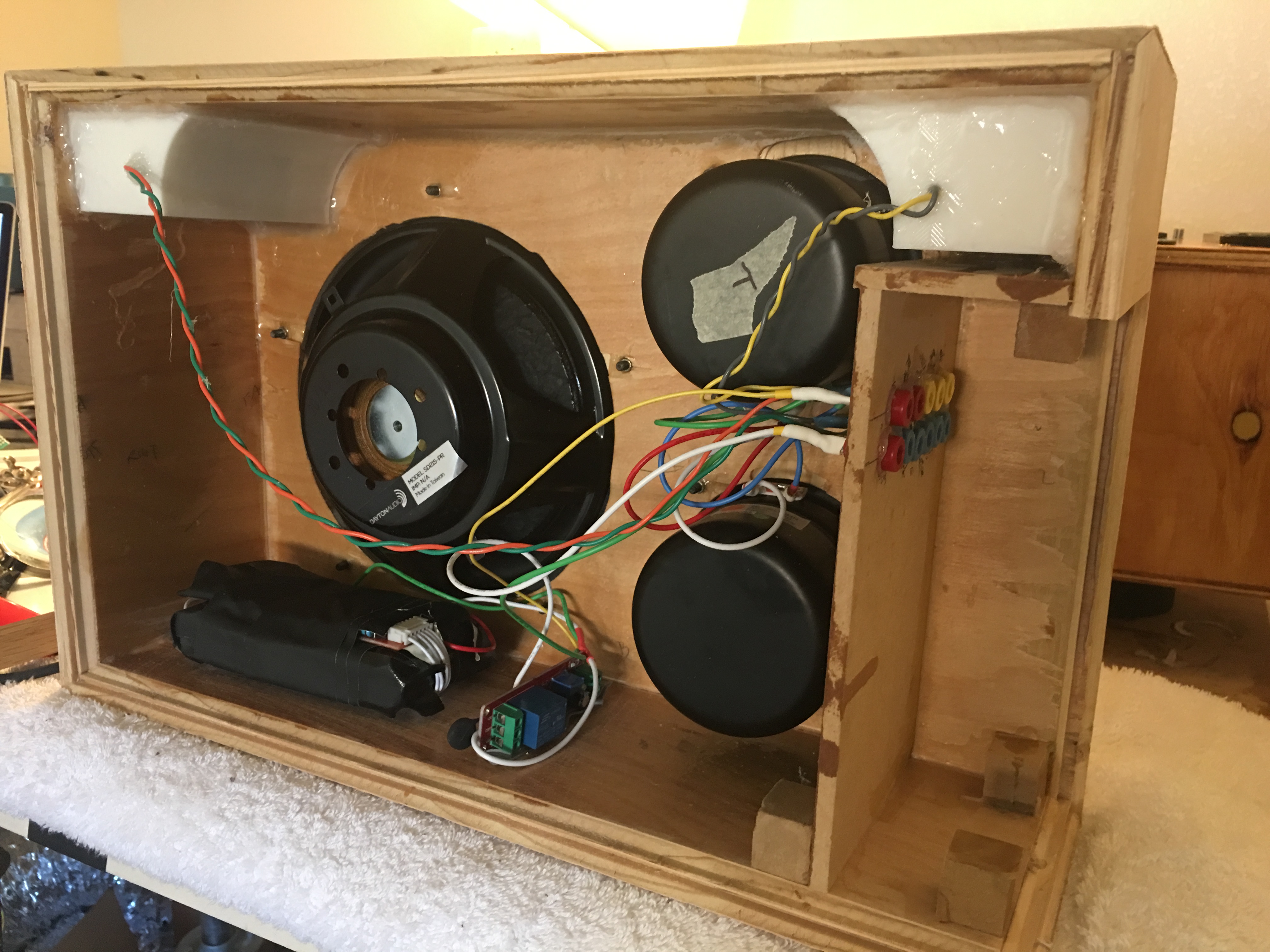
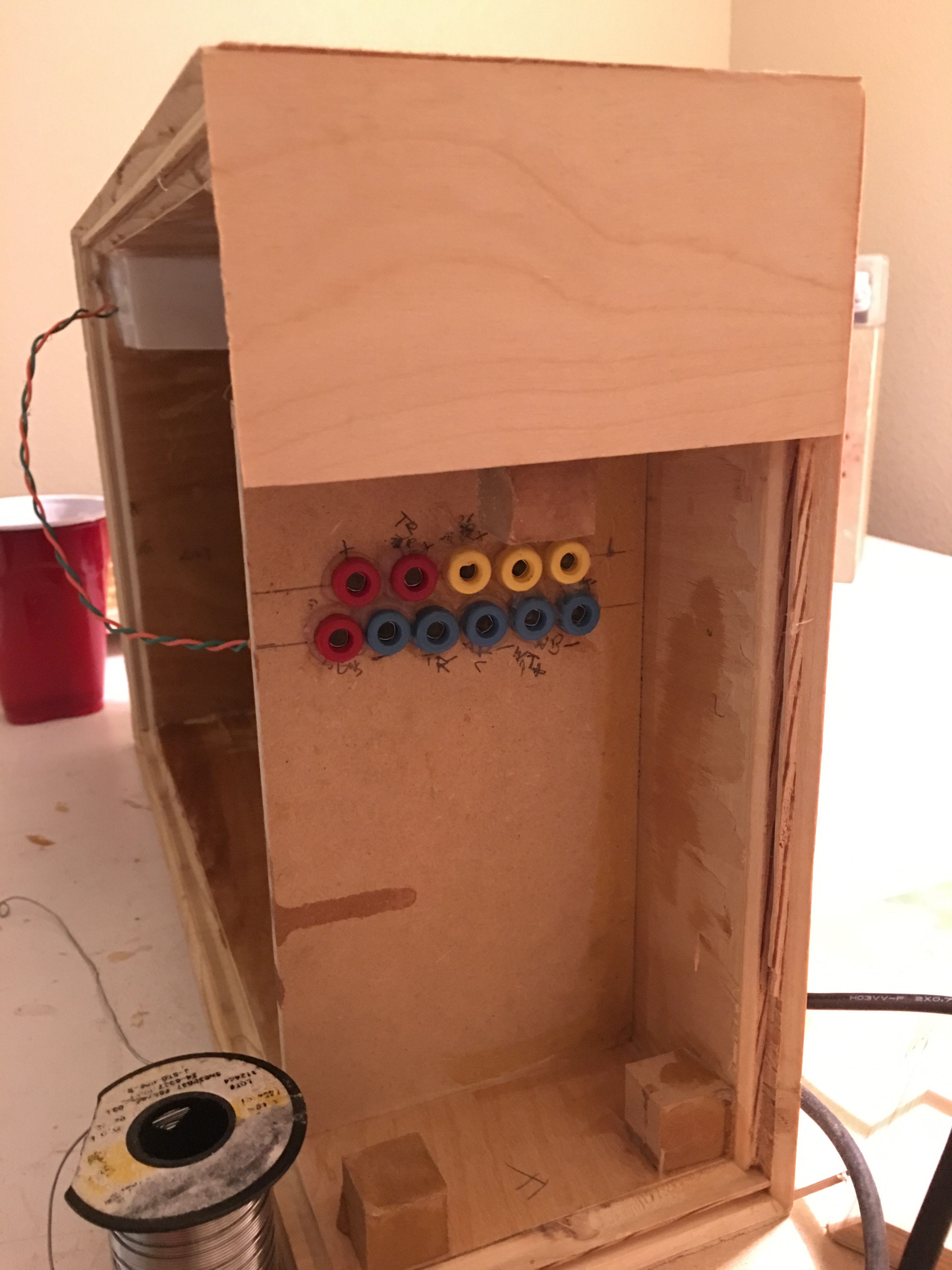
Of course, I still overestimated my abilities and placed the batteries in the acoustic chamber for space reasons. The white boxes are the enclosures for the NS1s.IMG_2522.JPG

I also had the idiotic notion that using banana plugs as pass-throughs would be simplest, but not only did I get the polarities wrong, it turns out banana plugs are super expensive and take up tons of space:IMG_2503.JPG

I didn’t manage to fuck up the miters too much and the face is perhaps lovable by more than it’s mother:IMG_2947.JPG

I cut out some purple heart and embedded some glow in the dark for the volume knob:

IMG_2690.JPG

With all that shit sorted, it was time to make an absolute mess of the ASP. The signal chain starts with a power-source isolated bluetooth chip, which is split by an op-amp active crossover, the low frequencies going to a china-market bought TDA7492 class D amp and then to the B4N’s while the high frequencies are padded down by potentiometer and sent to a similarly procured TPA3118D2 amp. The TDA7492 is rated for 40W into 8 ohms @ 25V @10% THD, which works reasonably with the B4N’s 25W RMS rating. Typically it’s better to spec an amp with more headroom (@ less THD) over the continuous power rating of a woofer in order to match the crest factor of music, but I didn’t think of that at the time.

IMG_2530.JPG

This is the last build I used analog signal processing on, partially because of the above mess of wires. Here’s the terrible wire management in context:

IMG_3299.JPG

I opted for a glow in the dark,  3D printed, inset handle to preserve the form factor, and then slapped some spar varnish all over that bad boy and called it a day.

IMG_3346.jpg

ROUND 2: TOO QUIET

Sometimes things come together, and sometimes they come together perfectly. This was not either of those scenarios; the “Tesselator” it’s actually just a decent name pun. Honestly, I was pretty happy with Round 1, but it was just not quite there. It was a little too big, and the lock miter bit I used for the edging was one of those cheap amazon finds that reflect their pricing in their quality. So, I started completely anew…by taking an old project that had been called into half-hearted existence with 3 other siblings in a similarly iterative process that finally yielded the Krump Kanon and cutting it in half. In general, this approach is poor.

It sucked for multiple reasons, some of which were that it was ugly and sounded bad and was still too big. Essentially, it failed to meet any of the criteria laid forth.

IMG_8529.jpg

ROUND 3: TOO LITTLE BASS

I then tried a new design that was basically Round 1 but with half the stuff in half the space. It also sucked. I was convinced that it wouldn’t because of my experiential lesson on KK Round 2–“efficiency is king”–but it turns out that only works if you have a pleasing natural response or some good DSP.

It was doubly a shame because the wood that went into the box was beautiful, but for some misguided reason, I used the cheap lock miter bit from Round 1 and, completely to my surprise, it didn’t work well the second time either.

IMG_8530.jpg

ROUND 4: TOO HAMMERED

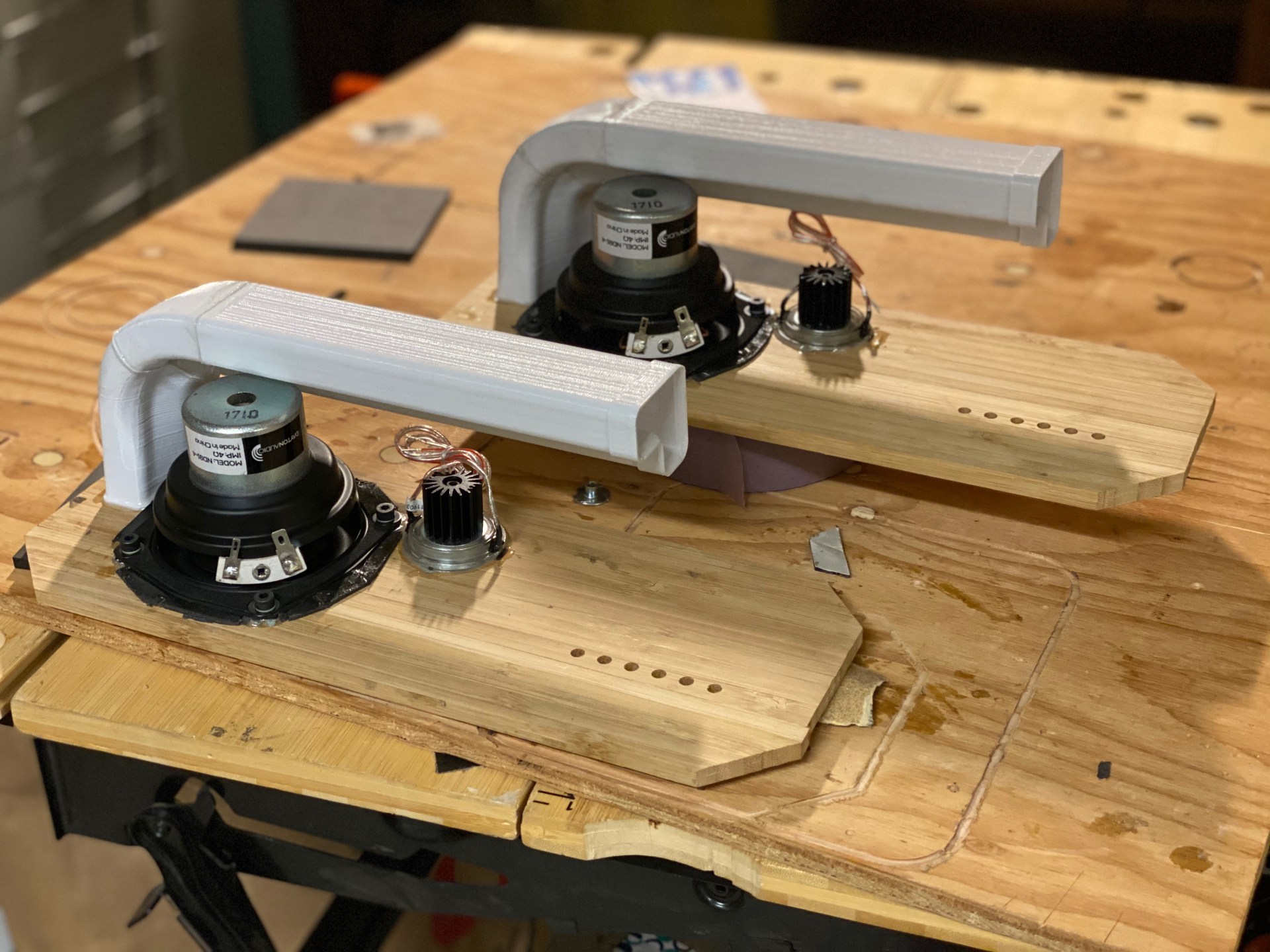
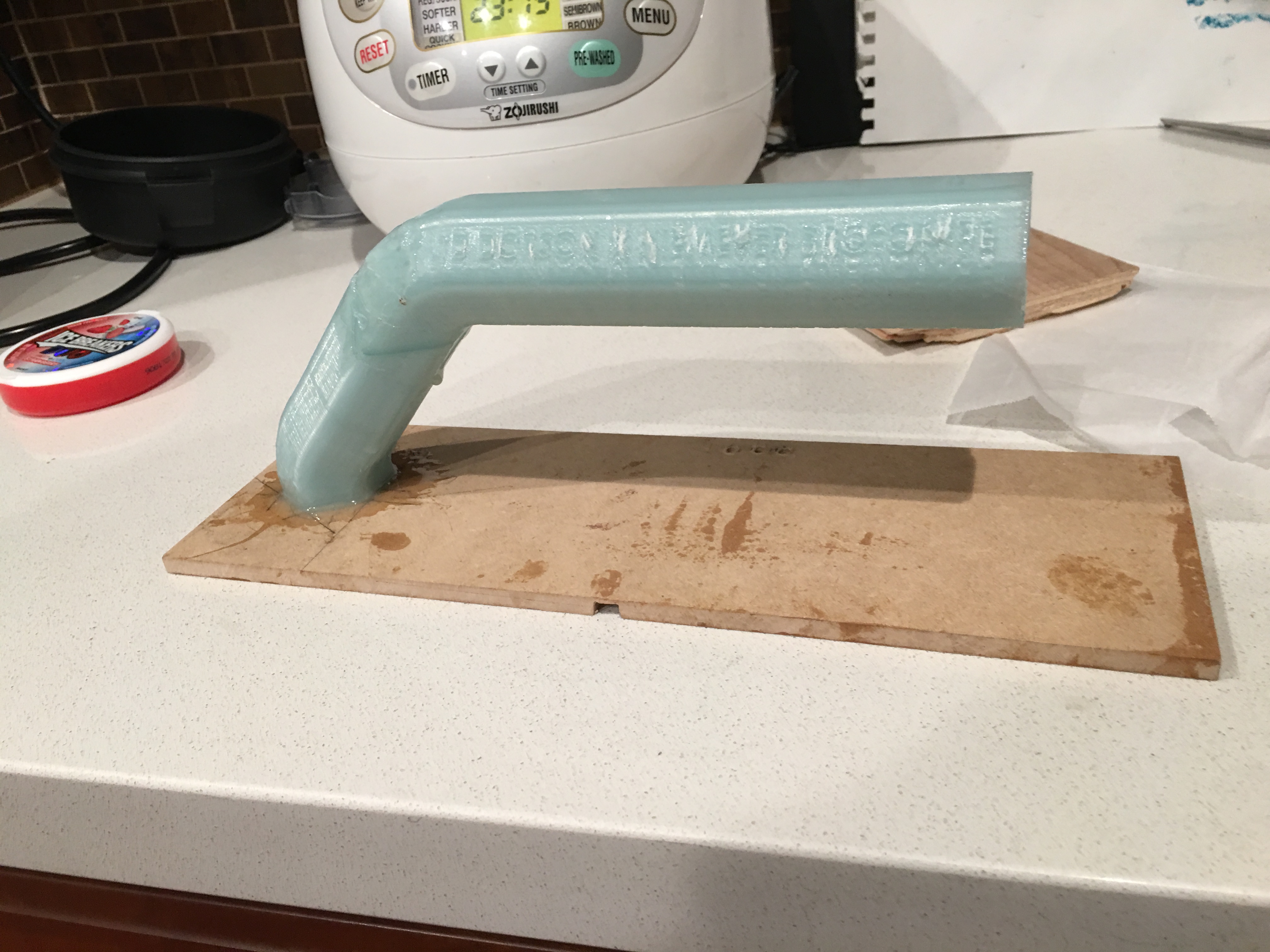
I then decided that everything I had decided was wrong, that efficiency wasn’t king, and it was all about extension. I went back to some of my “super-compact design” notes and decided to drag some micro-subwoofer Tang Bands into wretched existence. The only problem is that tuning a small box to subwoofer frequencies requires a long-ass tube (because the air spring in a small box is relatively stiff, you need a lot of acoustic mass in the resonating port to get a low resonance frequency), and long-ass ports are very inconvenient to fit into small boxes (not a problem encountered in my daily life). I had a minor stroke of brilliance stroke and decided to make a port that was both a long-ass tube AND a handle, therefore circumnavigating this issue.  Here is the relatively tiny box, which looks shitty because I had also come up with the terrible idea that I’d wrap the whole thing in carbon fiber once assembled:

IMG_2774

And the incredibly sleek and not at all awkwardly protruding port/handle design. IMG_2794

I set the thing up, hit play and was, for the first time in a long time, pleasantly surprised. Here’s a casual video of it in a living room (turn ya sound up and throw on some head phones to appreciate the FIDELITY that’s SPEWING out of this BOOMBOX).

For such a tiny little thing, it was really moving air. It had real potential until I hit it with a hammer.

ROUND 5: TOO UGLY

Not really much to go on about here. It was ugly. I underestimated how weird it would look to have the speakers sticking out of the face instead of flush mounted, and the thing looks like a damn bug-eyed pug.

ROUND 6: NOT BAD

In a surprisingly reflective and narratively satisfying moment, I decided to combine the lessons of the last 5 iterations. I drew up a plan for a small, relatively efficient boombox with precise waterfall miters, inset speakers, DSP, and a port handle. And no fucking carbon fiber.

IMG_3748.JPG

THE DESIGN

On to the even more boring stuff. Yes, yes, I know the stereo image is going to be ruined by placing the “tweeters”  on top of each other. But it looks cool, and there’s no point in attempting to get stereo width out of a box narrower than one’s head.

Anyway, it’s got 2x TB W3-1876 in a mono “sub” configuration, sitting in a 3.7L box stuffed with light polyfill, tuned to 48 Hz with a 12″ long by 1.2″ diameter port. This theoretically gives an f3 of 42 Hz. The port is a 3D printed 3-section design that was epoxied together for surface finish and adhesion. It’s flared on both sides equally for symmetry. The “tweeters” are 1″ W1-1070SH, which are sitting in a 0.1L box and crossed over in a 48 dB/oct LW DSP crossover at 500 Hz. The outer dimensions are approx 4.5″Hx4.5″Dx14″ and the 80Wh battery supplies 24V (nominal) to a China Black Market TDA7492 (to run the woofers) and a CBM TPA3118D2 (for the tweeters) for about 8h of quite listening and 4 hours of TURNT listening  MiniDSP 2×4 runs the tuning, and the bluetooth is run by an APT-X Bluetooth 4.0 chip. The advantages of this chip are high quality transmission with surprisingly low radio noise, but by some trick of China-blackmarket circuitry, it manages to clip it’s output stage at maximum source volumes. I suspect they added a NE5532 output buffer but didn’t manage the gain properly. The numbers on the edge display battery voltage, which is my lazy solution for a battery gauge.

The wood itself is is 1/4″ maple ply, reinforced on the interior with another 1/8″ of ultra-stiff epoxy and some bracing. I finished the wood Water-Lox high gloss finish, which I enjoyed for the simplicity of use and quality of finish. It brings out the grain and luster of the wood beautifully, and it dries quickly into a reasonably durable exterior finish.

THE SUMMARY

Subjectively, the thing is awesome. It sounds far bigger than it looks, and with DSP trickery, there are little concerns of over-excursion despite a relatively low tuning for such small woofers and such a small box. It’s a good feather in the cap for extension over general sensitivity, though it seems that the “high-moving mass, giant coil, really strong magnet” combination that Tang Band is throwing into their designs does a decent job of balancing sensitivity with extension, and this design ends up being a good compromise of the two. The stereo image is shit for previously mentioned issues, but it manages to have pretty laid-back directivity, which is all you could hope for from a small source.

Final assessment: can fill a living room with danceably loud music, yet it is small enough to hand carry to a barbecue. Ship it.