There are far more than five senses available to you in this awful wonderful human sensorium and one of them is the sense that You Could’ve Done Better. But this was not one of those times.
You ever see something and think “I bet I could make that, but better, and more cost-effective”? You ever think “I could make a portable, hi-fi, PA speaker with shit-your-pants bass, noise-complaint SPL, and art-gallery looks”? You ever sit at home and wonder “what if I went all out? What if it was way too big and way too loud and way too pretty?” Yeah, me too. This time I did it.
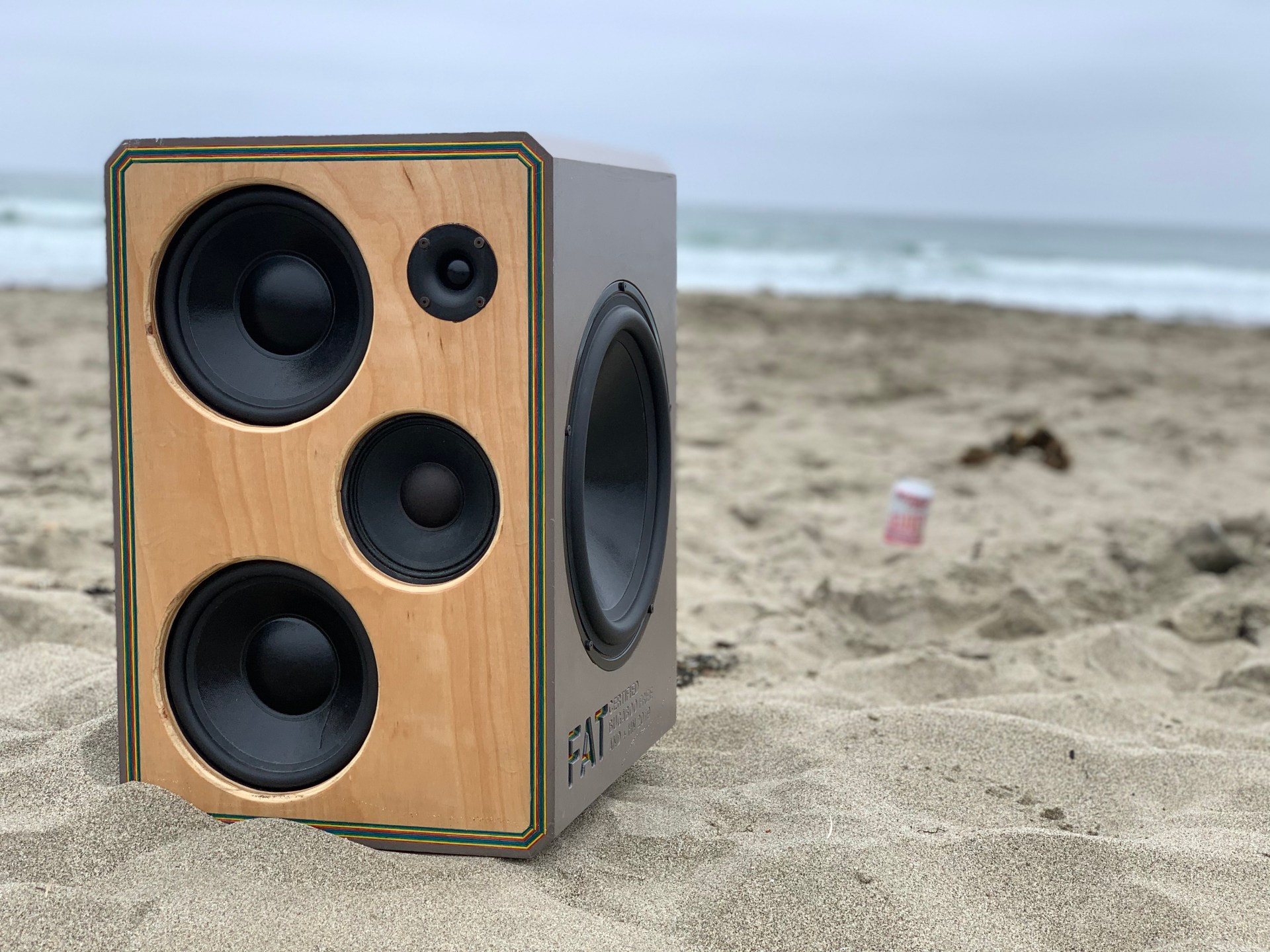

SCOPE
This was probably a time that I should’ve done less, but didn’t. In scoping out a project on commission I usually discuss
- Portability
- Loudness
- Bass/quality
AssAesthetics
The discussion should and usually does occur late at night over libations which contributes to some amount of scope creep—in a good way—and in this case we started at:
- Portable enough
- Loud enough the neighbors want to come to the party too
- Yass bass
- Museum worthy
I was thinking of a very reasonable design—1 cu ft, 36V battery, maybe 2 W6-1138 (but with Neo woofers for weight). But then something terrible happened. I saw a targeted Facebook ad for the Soundboks 2; it was was full of shitty marketing claims and absurd dBSPL/battery life statements and poorly mixed dubstep (like, dubstep is fine, just don’t mix it badly or use it to tout sound quality). Here are some reference claims:


I’m not an acoustic engineer, but—wait, no, no I am. These are bullshit metrics. What kind of half-assed sound company specifies a “dB” value but no reference for the units (SPL? Re?), distance, or weighting (A? K?). I could fart at 122 “dB” for a battery life of 40 hours if I’d put the mic by my arse.
For the un-initiated this is the equivalent of saying “Oh yeah my car is sick, it goes 150.” 150…what? MPH? KPH? Like when you drive it? Or when you throw it off a cliff?
Anyway fair to say this bothered me slightly and the new goal was to make a speaker that was better than the Soundboks 2. A portable party in a box. My specific objective goals were:
- 122dBSPL (Re) @ 1m in the passband
- Passband 40Hz to 20 kHz
- f3 @ 38 Hz
- Directivity controlled ± 4 dB up to 15 kHz
*For the sake of clarity, if not otherwise specified, all dB numbers in this document will be dBSPL @ 1m relative to 20 µPa.
ACOUSTIC DESIGN
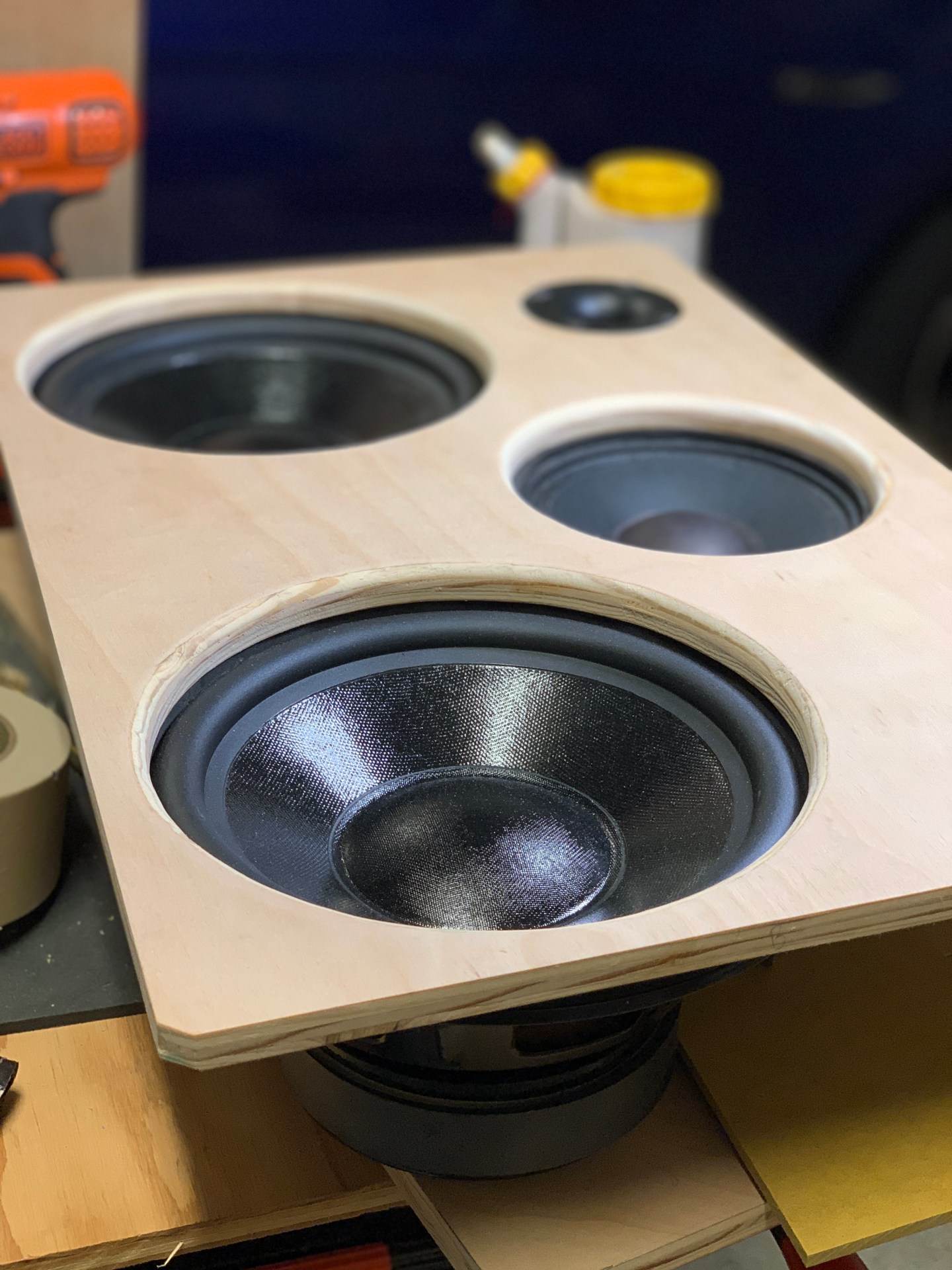
BASS
On the spectrum of “large/efficient” and “small/inefficient” for a constant bandwidth target, there are three main real-life ways to achieve this in the range of “reasonably portable.”
“Pro” speakers in a large box, i.e. lots of magnet, low moving mass, stiff surround. Think FaitalPro12XL
- + efficient as hell
- – generally 8 ohms
- – $$
- – Fs is often quite high
“Tang band” style in small box, i.e. lots of magnet, lots of coil, tons of moving mass, allowing for really low free-air resonance and massive linear excursion space.
- + compact
- + always impressive for size
- – $$
- – low efficiency
“Dayton Audio” style in a medium box: Medium BL, medium mms, heavy magnet
- + cheaper
- + pro-sumer design means well controlled directivity, well designed in-band response
- + reasonably efficient
- – heavy
- – has potential to be “worst of both worlds”
Here’s a quick comparison of the three designs plotted at a very reasonable 100Wrms:
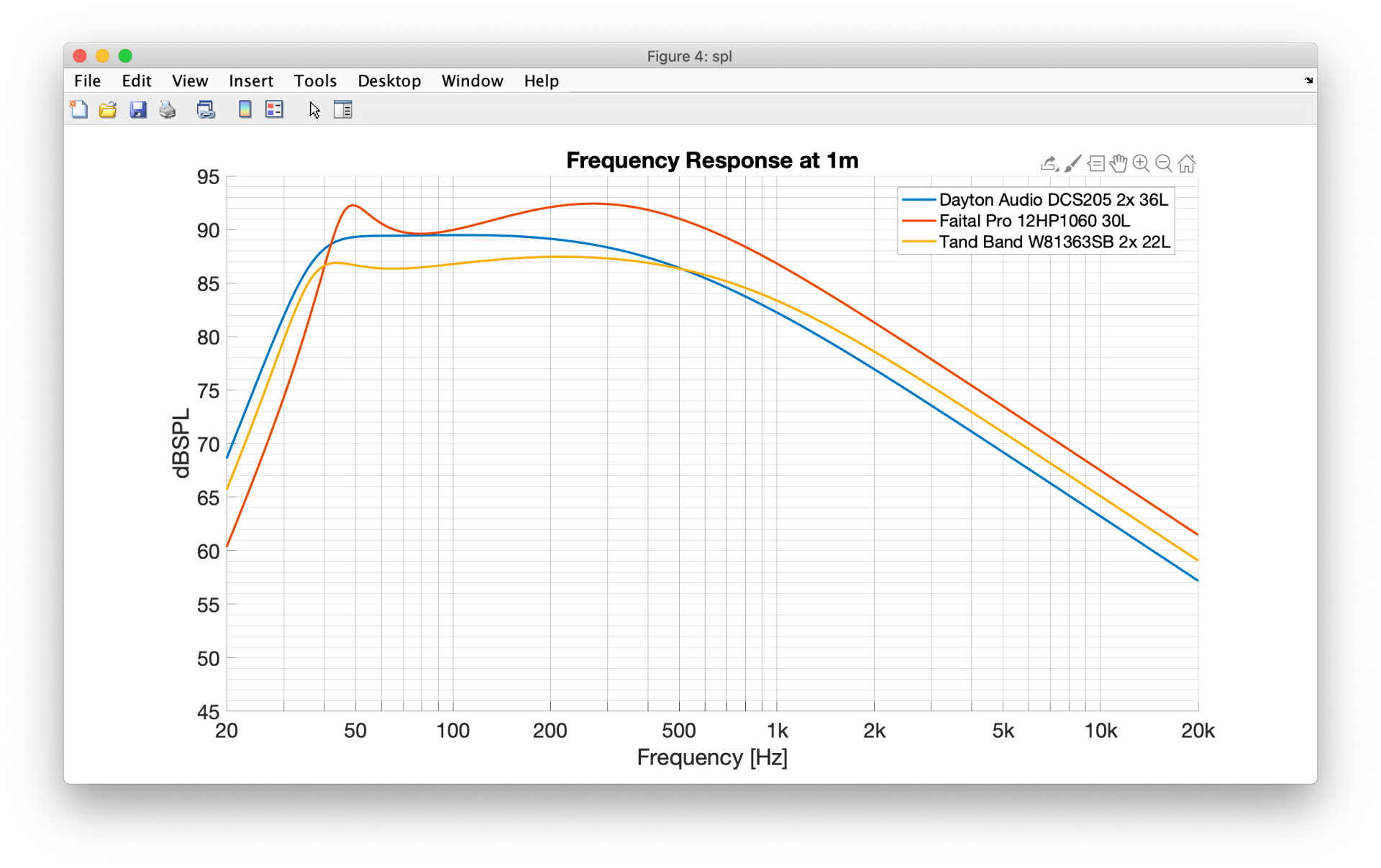
The Iron Law clearly demonstrated here: The Dayton design is in the middle for sensitivity but sacrifices on size to get extra bass. The Tang Band, which will never have the sensitivity of the DA or the FP design, loses a little bass to be small, but has overall good LF extension. The Pro design is huge and efficient but loses on LF extension. But wait! This is battery powered! We’re voltage limited! How do 2 4 ohm drivers shake out against 1 8 ohm driver?
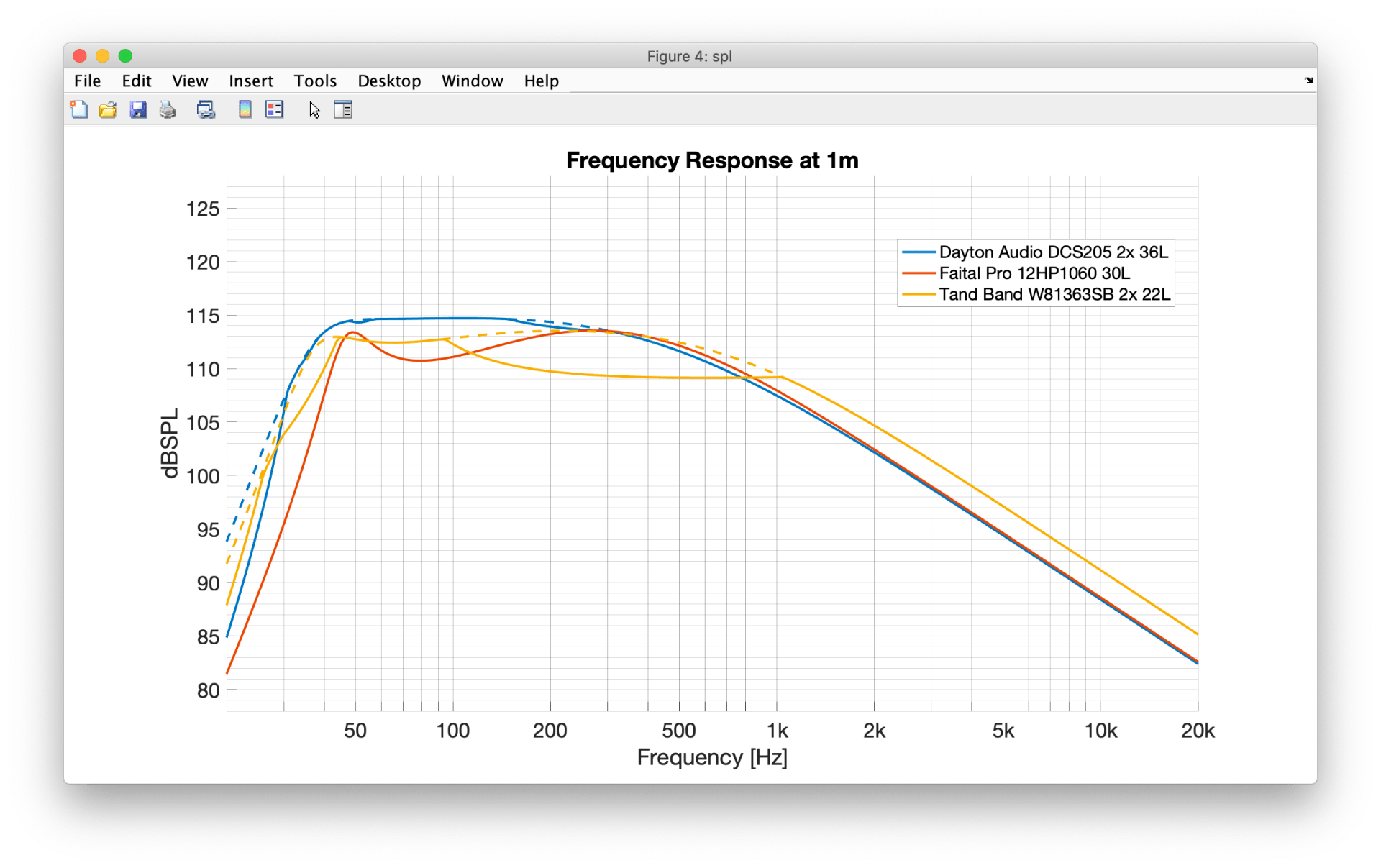
The Dayton Audio design clearly wins out (dotted lines are theoretical response vs Pmax/Xmax limited response). The final question: can we kill the Soundboks? If we disregard all concerns for safety, in theory—nearly:

At 1100 Watts of input power (rms), 2 DCS205s are capable of outputting 121.2 dBSPL @ 1m @ 100Hz. The Xmax limitation cuts heavily into the bass output below that. But this design will sound better, look better, and be smaller, so DCS205 it is!
The final choice for bass—sealed, ported or passive? A simple one; sealed sucks for battery-powered. The port would’ve had to have been huge to handle the requisite volume velocity with grace, so after modeling every single DSA, I opted for 2x DS315 12″ PRs + 100g to tune to 38 Hz. These are quite wonderful passives—huge xmax, Rms for days, low enough Fs, and their ID matches the DS205s.
Full send:

MIDRANGE
Knowing that we’re in the neighborhood of 115 dBSPL@1m @ 50V input makes things a bit tricky from 300Hz to 20kHz. Pro sound options are mainly focused on output efficiency, with the sacrifice being directivity and flatness of response (DA PK165-8 below, which had neither the efficiency nor the response I was looking for):

which would essentially demand that you cross it over at 2kHz—untenable for a tweeter capable of 115 dBSPL.
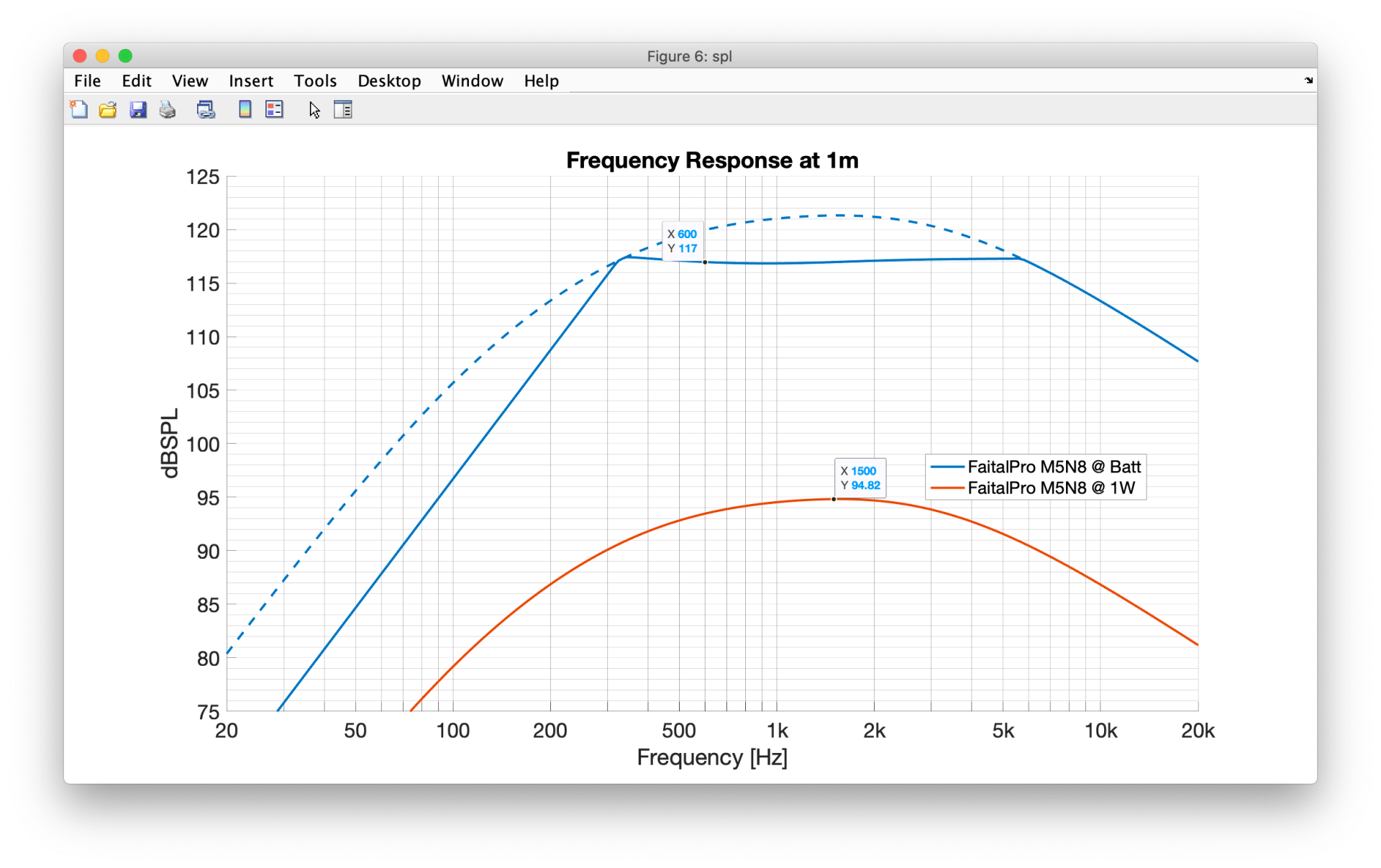
Luckily, there weren’t that many options, and when one can’t sacrifice loudness, quality, or size (i.e. directivity), you must pay a lot of money. I landed on the beautiful and beautifully expensive FaitalPro M5N8 which measures like:

Their claimed efficiency of 99dB @ 1W/1m is a little short of the truth (95dB@1W/1m) but they manage an easy 117 dBSPL with xmax and plim constraints:
Throw it in (a 3D printed back volume to separate it comes in later):

HF
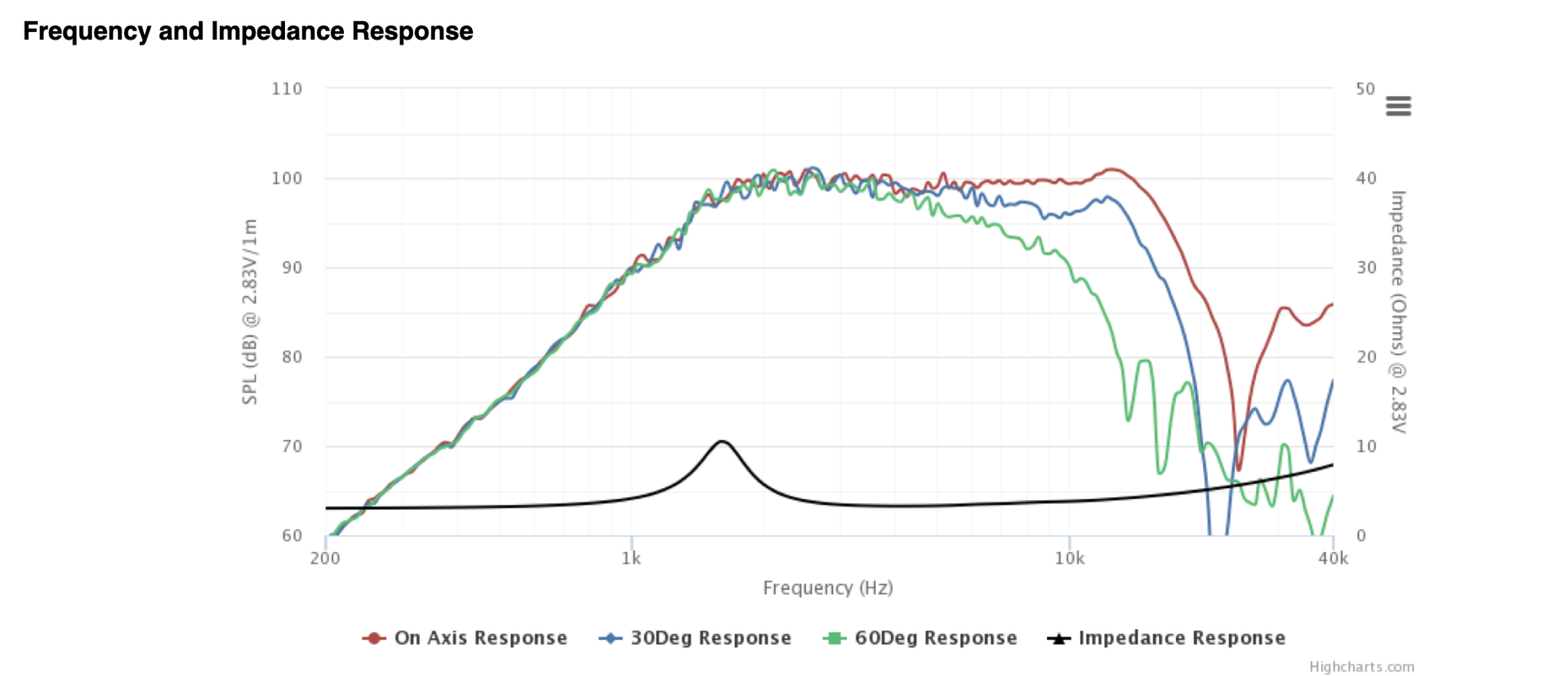
There was really only one option: the Peerless by Tymphany BCS25SC08, a silk dome tweeter + a (small) horn for efficiency. 98 dB, 100W of power handling (they get ragged before that, though), and the horn rather small so the directivity actually rather pleasant (this is in 30 deg intervals compared, the midrange plot was at a 45 deg intervals).
Throw that in the bag too:

And then for a back volume, the passives, and a rainbow inlay:

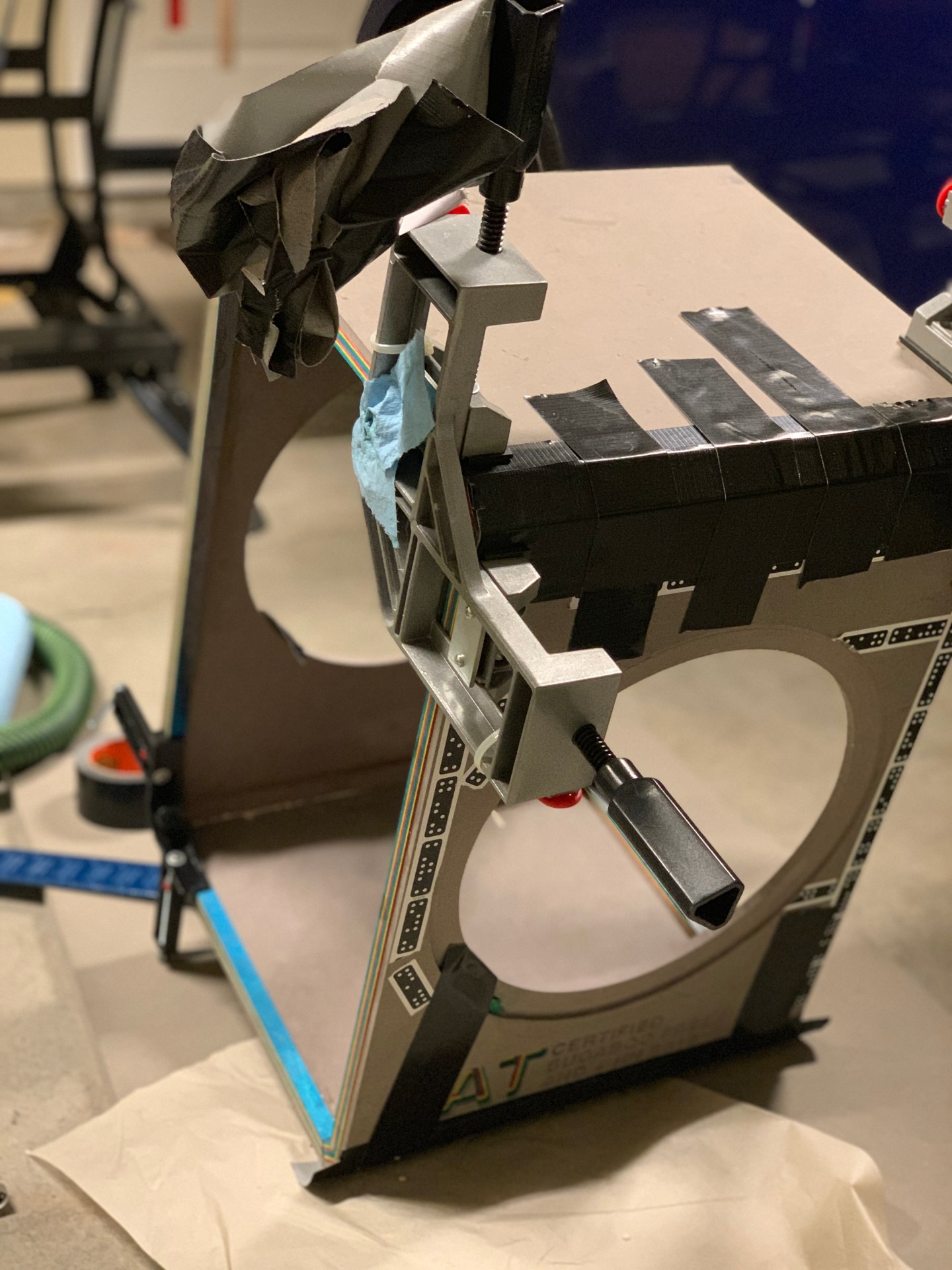
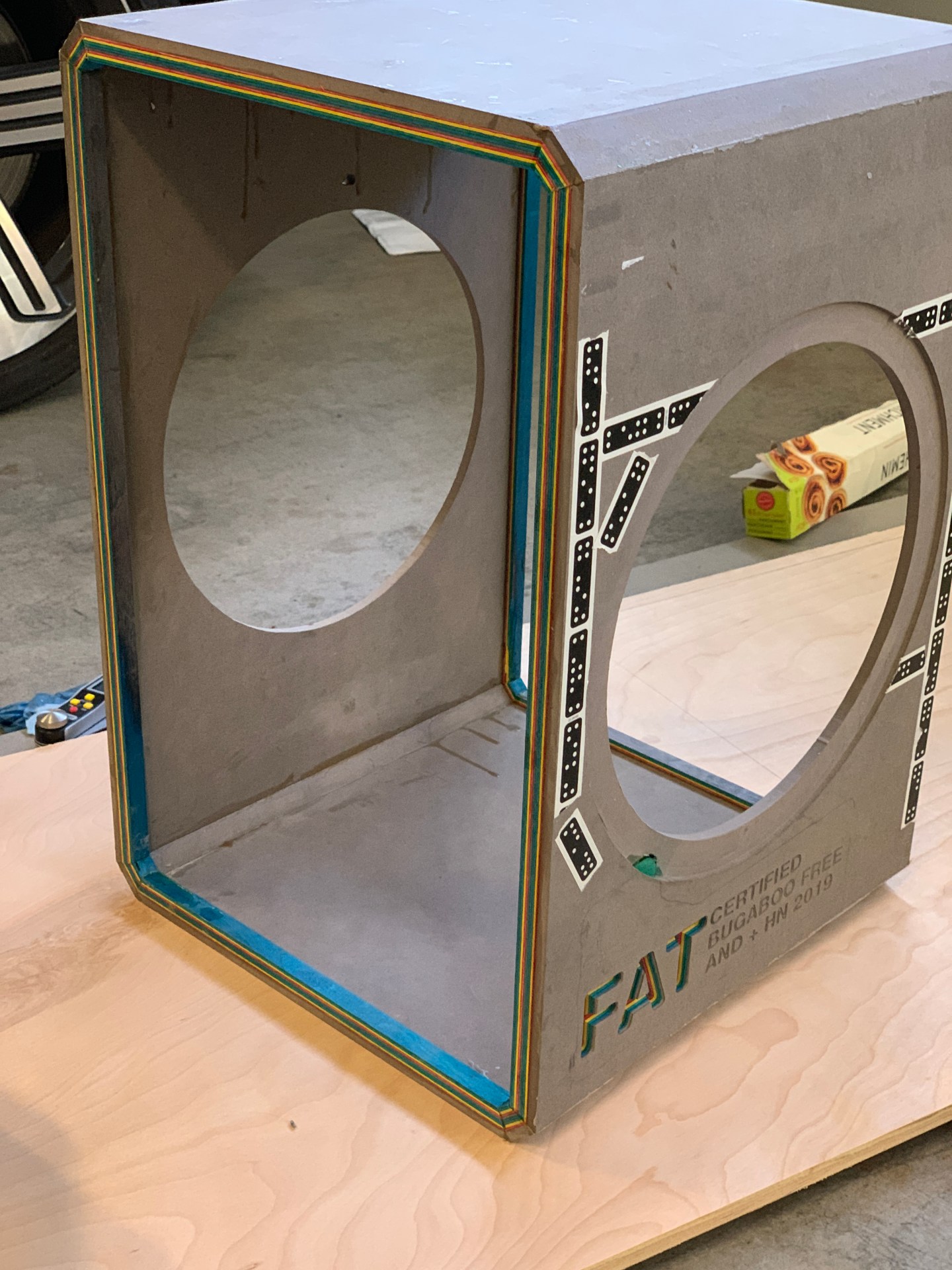


The base material (gray) is an engineered wood called ForesCOLOR which is basically MDF+ sold in fancy colors — in America it’s sold as Valchromat and solid B2B only (be forewarned: I ordered a few sheets online and a few days later an 18-wheeler pulled up to my house, dumped off several hundred pounds of Valchromat and charged me $600 for shipping). The rainbow inlay is a laminated plywood sold by CWP, and it’s awesome.
Next up is an (incredible delayed) article on the specifications of the mechanical and electrical design. UPDATE—Finally posted. Read more here:
 MATLABGONEWILD
Would like to build one too! Any followups on this like electronics?
LikeLike
Awesome!! I have it drafted…I’ll try to post soon, you know how life goes. What kind of information are you looking for? Feel free to reach out if you have specific questions
LikeLike
Hey mate, Love this design. Like Anthony above I would be very interested in some more information in the electrical design, specifically the amp chosen and how the crossover was setup
LikeLike
gotta give the people what they want! gonna drink some coffee and get to it
LikeLike
I would like to build the same Speaker Always wanted a super boombox and this looks like my end game. Lord please guide me . Plans electronics crossover etc
LikeLike
Hey man, incredible craftsmanship. I’ve been going through your page looking at everything. And this build is my favorite. Looking to build one for myself, do you have plans I could follow?
LikeLike
Thank you! I appreciate that. I don’t have plans made per se but I can share what I’ve got in terms of CAD/BOM/electrical design
LikeLike
Hi, great work with the FAT, I would love to build it but need your support in the build, electronics and cross over. Can you contact me with the details, and/or if you want any payment for it?:) I am running a podcast in Norway and would love to mention it there if it sounds interesting. Br Olav
LikeLike
Thank you! I’m still working on writing up the plans, busy end of year with Christmas orders to fill. I’d love to help out with the podcast!
LikeLike
hi, this looks awesome and is just what I’m looking to build, do you have any more info on the electronics side of things?. on a separate note but sure where your based (im in UK) I have an industrial CNC router so could cut parts for this out for you if required
cheers
toby
LikeLike
hey this is amazing..just what I want to make myself only I don’t know what im doing! do you have any more info on the eletronics side of things?
I have access to a large CNC router if you need anything cutting (UK)
LikeLike
thanks! ah man I gotta post the electronics. Give me a week, let’s chat.
LikeLike
yes please, super keen to get one made for the summer!, even if you could explain what sort of amp id need and what the volume of the enclosure should be (im told thats important)…
LikeLike
Hi there, this seems like a very nice build and I am on the verge of building it, because I am unhappy with the sound of my Soundboks GO. I even purchased a Soundboks 4 and had to return it because I was just as unhappy as with the GO.
It would be so nice if you could provide at least the essentials of the electronical part.
I would mainly need crossover frequencies and slope. And volume of the 3D printed housing for the Faital.
Info on the amp, and DSP or analog crossover circuits, used would be nice too.
LikeLike
hey what sort of amp are you using? currently looking at a Dayton Audio KABD-4100, but I think it might be a bit overkill, what you think?
LikeLike
Totally depends on integration. Due to the high power handling of the DCS-205 woofers, I opted for a TPA3255, which can provide ~3x the power of the KABD-4100. KABD series is great for an all-in-one solution, though!
LikeLike
thanks, did you use one of those Chinese boards? or something branded?, to be honest I’ve admitted defeat trying to work out the electronics for myself, I will wait for you to post on here (pretty please) all the differants options, specs powers etc are beyond me at the moment
LikeLike
posted electronics section! Chinese board but from a pretty good source who unfortunately stopped selling B2C recently.
LikeLike
Please, we want to know something about the electronic stuff inside this beautiful speaker
LikeLike
posted!
LikeLike
Looks gorgeous! What are the specs on size, weight, and the ply thickness you used? A half-size Soundboks replacement is one of my current projects, but with a mono amp, single 12″ full-range triple-cone driver, two PR ( and being an EE so not really knowing what I’m actually doing when it comes to acoustic)
Have you ever build with other materials besides ply? Another silly project of mine is seeing how large of a somewhat portable folded horn I could build using a composite panel like Coosa (52 lbs for a 0.75″ 4×8, 8lb driver, extl. amp + battery, I think I could strap a 60 lbs 15″ THAM to my back with reasonable discomfort, but don’t know how much extra fiberglass & bracing I’ll need, the Coosa has a bit more flex than mdf)
LikeLike
Thanks! For the front panel I used 1/2″ which needed bracing; for the shell I think I used 19mm Valchromat, which is a composite wood (not ply wood)
If you’d like help optimizing the PRs for the driver, let me know! It all boils down to lumped element circuits so EE is not too far off!
Coosa sounds similar to Valchromat which has relatively favorable mechanical properties for acoustics, but the composites tend to be heavier. In my experience, a lighter shell with adequate bracing will achieve a good balance of stiffness and weight—the stiffness from bracing far outweighs the added stiffness of a thicker material, within reason.
LikeLike
Thanks for the offer ! I’m using WinISD which has the option to add multiple PR and play with the weight. Idk how accurate it is, but it seems like something that can also be easily tuned in hardware.
Thanks for the input with the braces. I was unsure if I should go for the 3/4 or 1/2″ version for the sub ( 52 vs 34 lbs). It sounds like 1/2″ might be the move. I’m going to throw the whole 4×8 on our water jet, so can make a lots of bracing, also more fancy shapes, with high accuracy and no extra effort cutting.
LikeLike
Ah, yeah WinISD is good. The biggest source of inaccuracy is often actually the manufacturing variance on the components.
re: braces, grain of salt that it’s a slightly more “new school” approach, but if you’ve got a water jet, brace away! Depending on how you design it, you can take it a step further and test the structure throughout assembly (either with the woofer dry fitted or by knocking on the box) and add bracing as required
LikeLike