A SOMEWHAT UNUSUAL APPROACH TO LUMPED ELEMENT MODELING: TIME DOMAIN IMPLEMENTATION OF COMPUTER-AIDED POLYNOMIAL SOLUTIONS TO LTI SYSTEMS VIA THE BILINEAR TRANSFORM (LUMPED ELEMENT TRANSDUCER EDITION)

INTRO

Imagine you want to simulate a speaker, utilizing Thiele-Small parameters. It’s traditional and “easy” to obtain a Frequency Response, but we live in the time domain, and you can’t hear a graph. I’ve stumbled into a method for directly translating any lumped element model of an LTI system into a set of filters which allow you to model the system’s response in time! Not only can we obtain the frequency response of a driver, but we can listen to it directly. Imagine being able to simulate a few speakers and select the one that sounds best!

In addition to an efficient means for auralization directly from the lumped-elements, I offer a unique solution to simulating the impedance of a loudspeaker.

THE LUMPED ELEMENTS

In the basic assumption of a lumped element model for a loudspeaker, where the 3 domains of a speaker are “analogized” to circuit elements, coupled via a gyrators (transformer shown due to Kicad limitations), the above circuit can be simulated (choose your poison) to examine transducer behavior in any of the three domains. The trick here is that the behavior of a speaker in the time domain is a mess of differential equations but circuit elements themselves have very nice solutions once you flip over to the frequency domain. Let’s start with a simple example.

A SIMPLE EXAMPLE AS A JUSTIFICATION FOR USING FREQUENCY DOMAIN

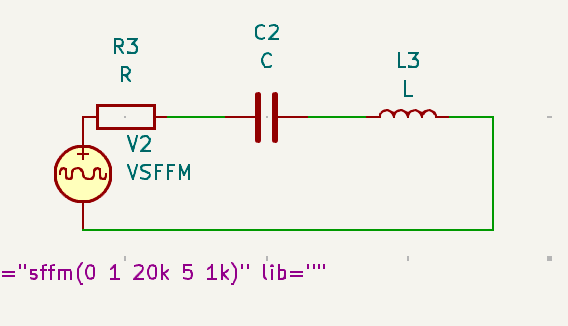
For example, for an RLC circuit ((R=0Ω for simplicity, resistance is not differential with frequency)

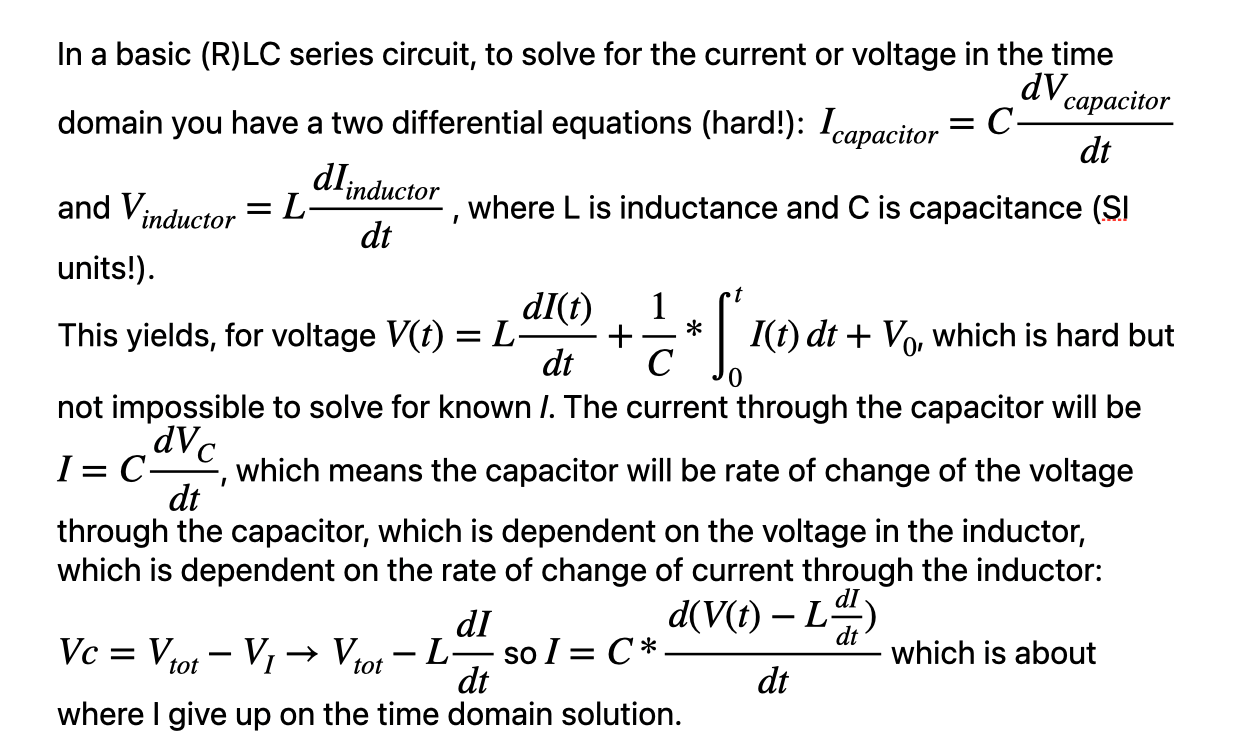
The time domain analysis looks something like this, where I is current and V is voltage.
written in keynote because LaTex

The main issue here is that to calculate current you must evaluate an expression which itself requires knowledge of the derivative of the current. This is a differential equation! It’s not impossible to compute this numerically (that is, assume a small δ and step through time little by little) but obtaining an “analytical” solution to the equation requires a special set of skills.

If instead you instead do some clever stuff with frequency, based on 1) Euler’s Identity and 2) the understanding from the Fourier Theorem that any signal may be represented by an infinite series of sine waves, there are some very handy and very useful solutions to differential equations. (warning: I’m using j notation for imaginary numbers)

Here’s my mini proof, where j is the square root of negative 1, ω is frequency, and t is time:
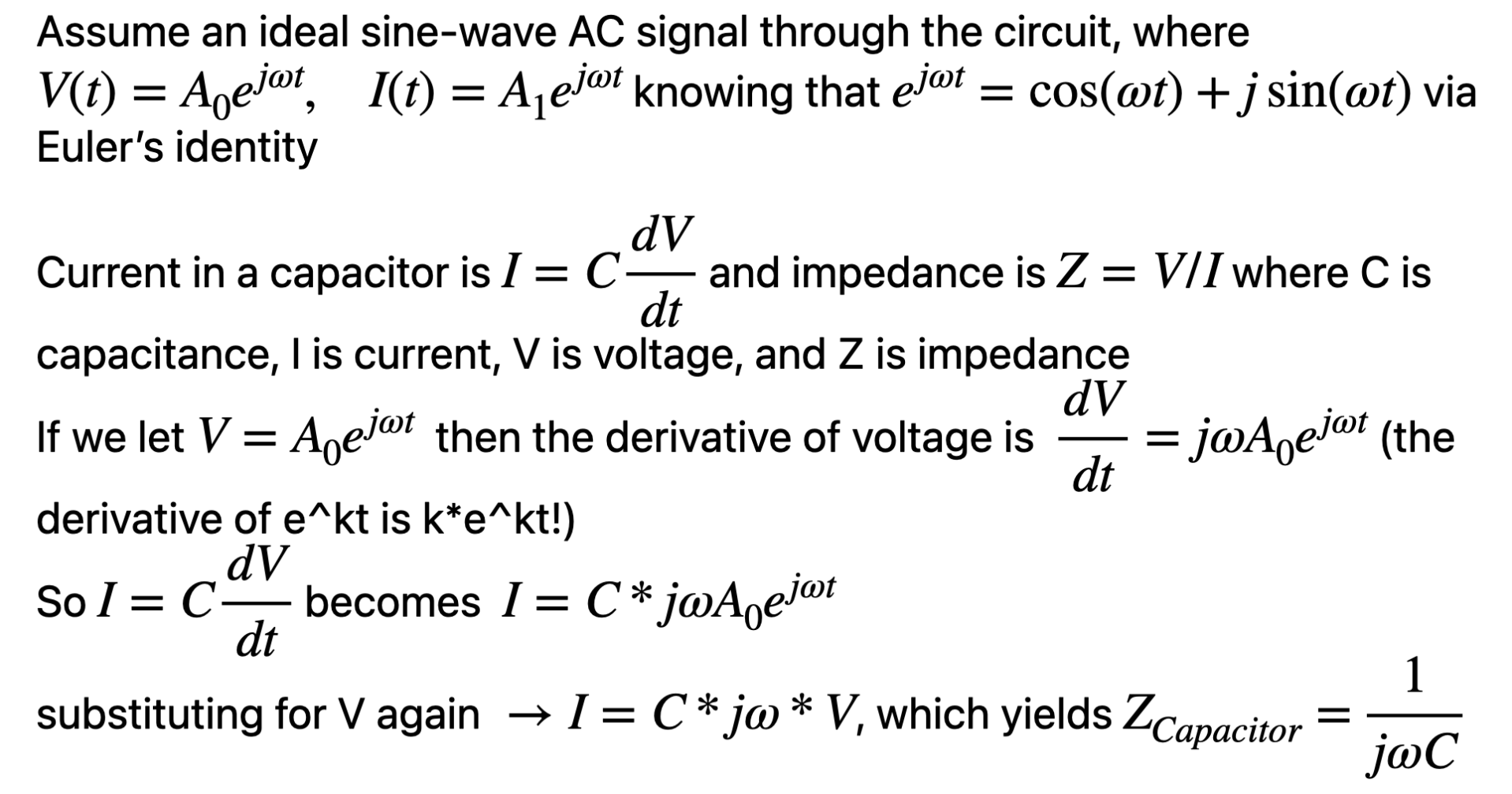
By taking advantage of the Euler identity and the very special property of e that it’s derivative is itself, we can evaluate the differential equations and reduce them to simple polynomial math (more on that later).
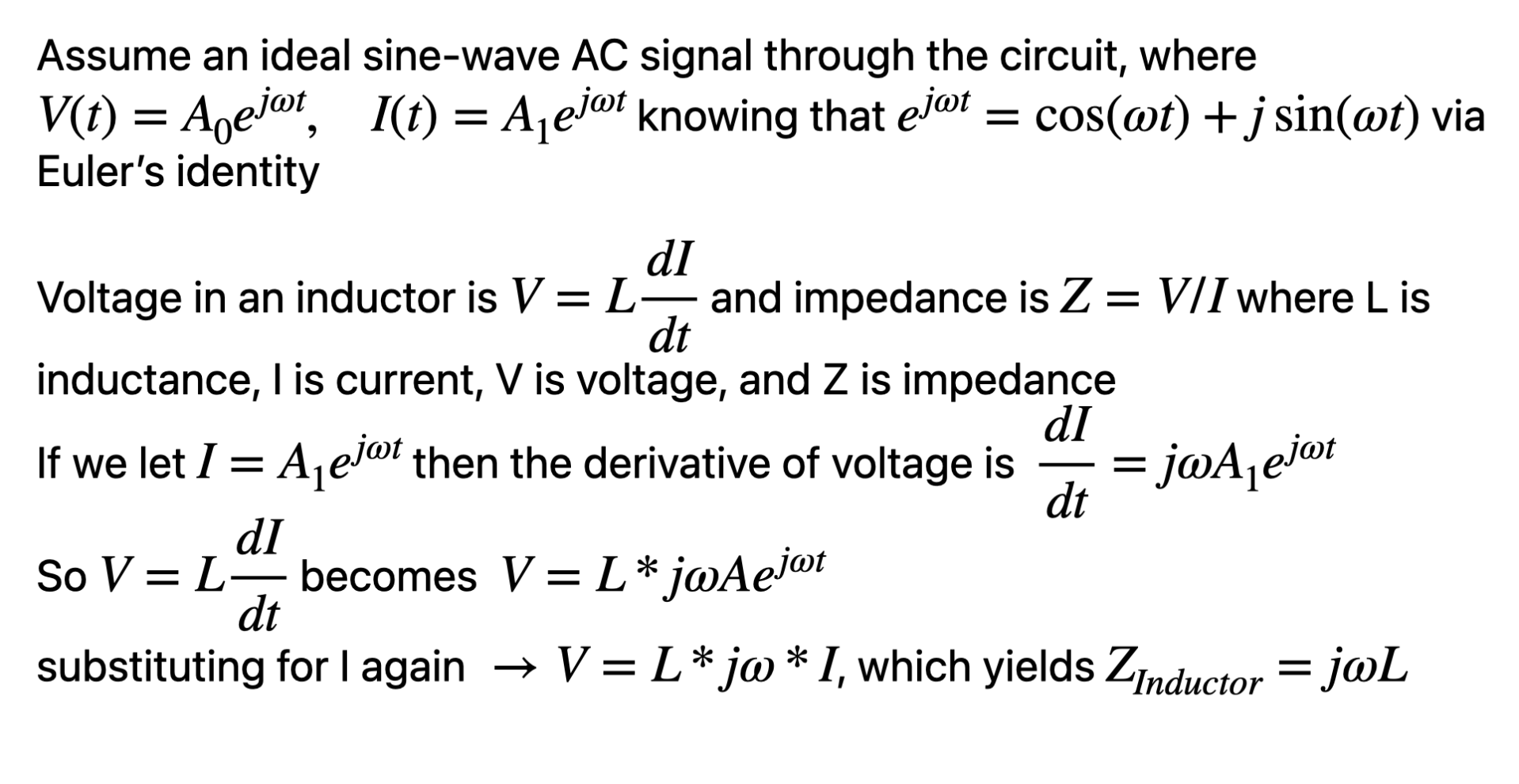
Since we now know the complex impedance of these circuit elements, the series circuit can be “solved” as such:

The final expression is a fully accurate solution to the circuit, and it tells us a lot about the behavior of the circuit. For instance: for a given current and frequency, increasing capacitance will lower voltage (the capacitor will proportionately charge less) and lowering frequency will increase voltage (capacitor will charge more!) but this is counteracted by the decreasing impeance of the inductor. Makes sense, but let’s visualize it to get the wholes story!

If the poison you so choose is a frequency domain analysis, you can easily plot the frequency domain response by substituting s = j*2*pi*f where f is an vector of sample points in Herz (e.g. f=[1,2,3…48kHz]). Here’s some simple Matlab code to do this:

f = 1:fs; %sample points
omega = 2*pi.*f; %convert to angular frequency
s = 1i*omega;
C=100e-6; %Farads
L=10e-4; %Henries
R=1; %Ohms
Z=1./(s*C)+s*L+R; %series circuit impedance

An interesting note before we go to the Laplace domain: the impedance of this circuit looks a lot like a graph of a quadratic function. In fact, if we replace with a variable…say s, it can be written as:

So, we’ve turned a differential equation into a polynomial equation!

BUT WHAT ABOUT TIME?

Bing, bang, boom! Frequency response of a lumped element circuit with an elegant polynomial solution! But what about time the time domain filter I promised? Armed with a frequency response (hitherto known as FR), it is certainly possible to create a time domain transfer function or filter. Here are some methods I’ve tried:

Methods to convert a Frequency Response (FR) to a time-domain filter

methodbig Opros, cons
IFFT(FR) → time domain convolution with signal O(m*n)
m is resolution of FR
n is signal samples
+ simple, rather direct
– accuracy limited by FR resolution
– super slow
DFT(signal) x FRO(m log n)+ relatively easy to understand and implement
– not “real-time” i.e. requires “frames” with overlap and add
– time domain artifacts due to finite signals, finite resolution
FIR2: Frequency sampling-based FIR filter designO(m log n)?+ brute force solution
– memory intensive filtering: very high order filter required for any reasonable accuracy (N==Fs)
– accuracy limited by FR resolution
filter coefficient optimization:
run steepest descent optimization on filter coefficients until filter matches FR
∞ for optimization (optimality not guaranteed)
O(n)* once filter is converged∞
*technically O(m*n) but filter order can be kept as low as order of system
+ kind of cool
+ extra brute force solution
– optimizing the filter is not a guaranteed-to-work process depending on FR complexity

None of these are especially satisfying to me because they’re all rather messy approximations with a few levels of abstraction. This is the meat and potatoes of this post. There are two handy dandy pieces of math we need: the Laplace transform, which converts from time domain to the complex frequency s-domain, and the bilinear transform which converts directly from the LaPlace s-domain equation to the discrete time domain of digital signals (airhorn noises). This is huge! We already did the frequency domain math for Rs, Ls, and Cs!

There’s just one thing: the Laplace domain is in terms of the complex frequency variable 𝑠 where 𝑠=𝜎+𝑗𝜔. We are allowed to convert from the Fourier domain to the LaPlace domain if we set 𝜎=0, which is more-or-less an assertion that the system is stable and the input is continuous (in time) and real (in frequency). Then we can simply replace every 𝑗𝜔 with an 𝑠:

This last expression is what is sometimes referred to as the polynomial solution. Let’s take that into the time domain:
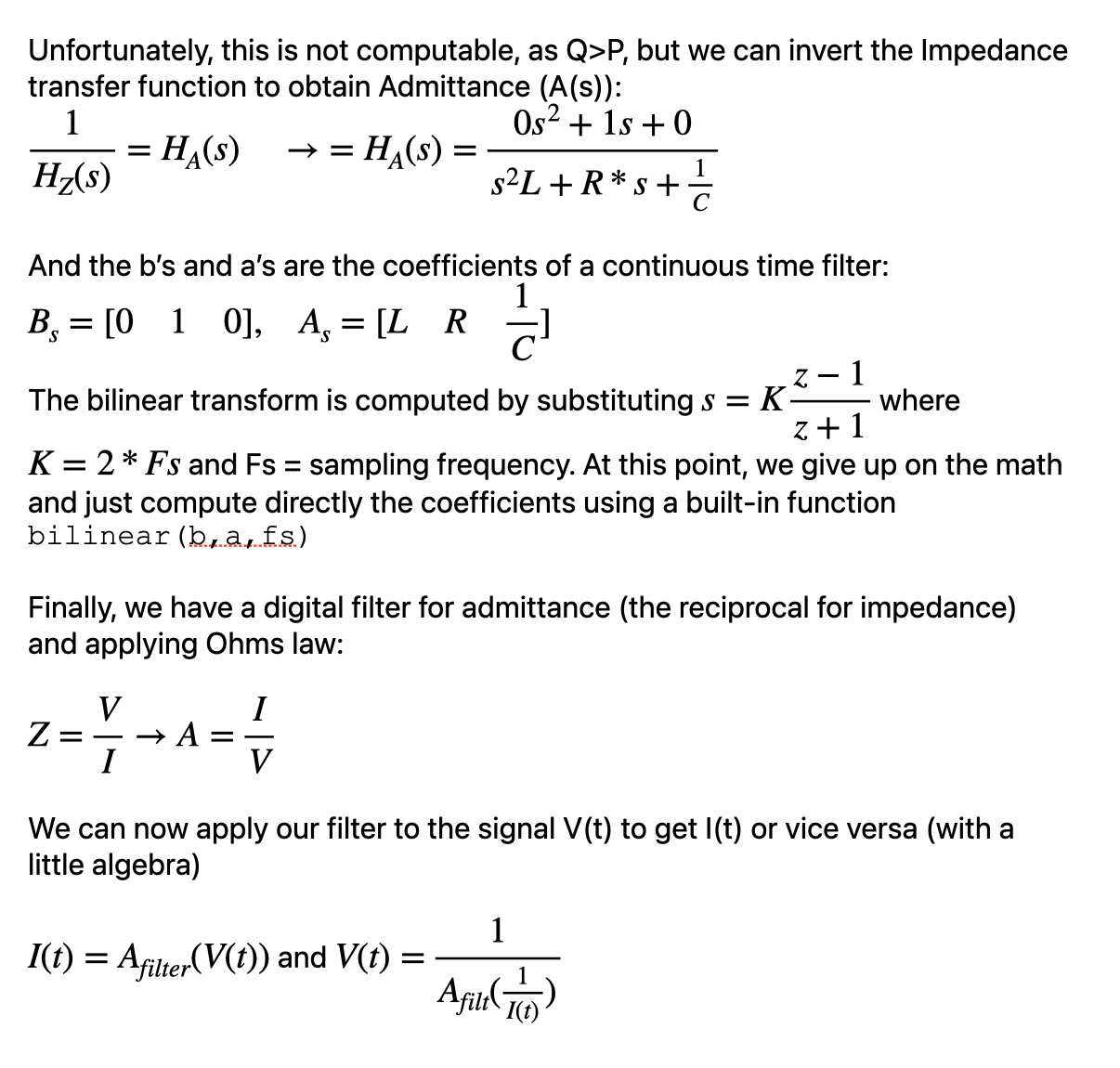
Example code:

C=100e-6; %Farads
L=10e-4; %Henries
R=1; %Ohms

%polynomial expression
a=[L R 1/C] %denominator
b=[0 1 0] %numerator

[B,A]=bilinear(b,a,fs);

%results — this is all you need to filter any signal!
B = 0.0103 0.0000 -0.0103
A = 1.0000 -1.9751 0.9794

Checking the results shows alignment (of course!)
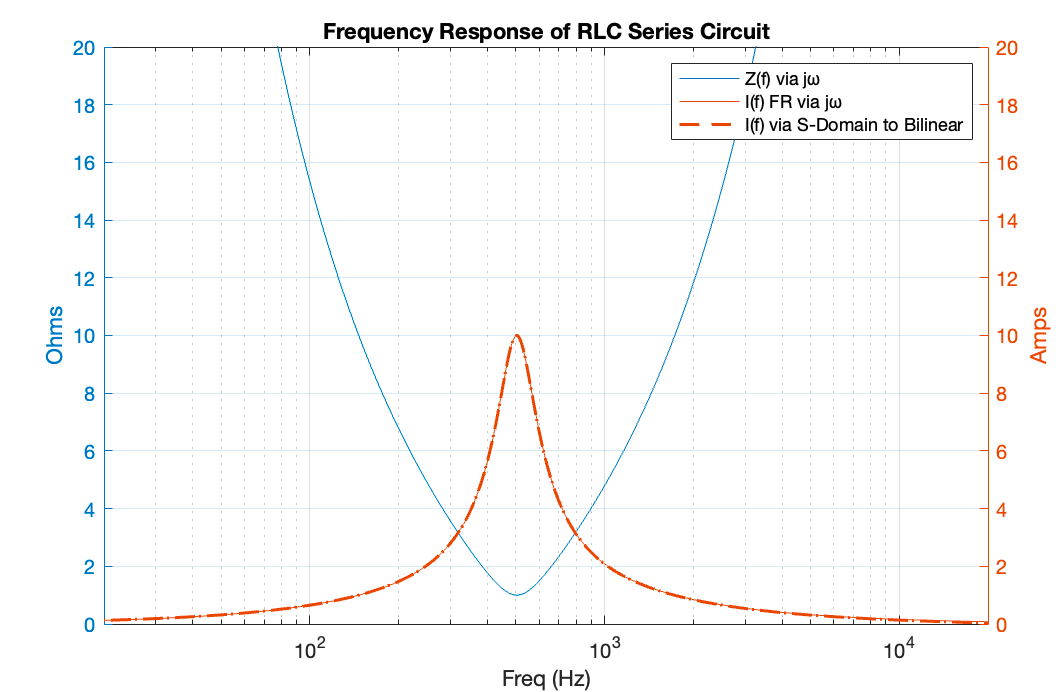
Ain’t that great? What’s great about this method is that this is the exact answer to “how will this circuit behave in response to a signal?” There are no cons (except for sampling frequency)!

methodbig Opros, cons
Bilinear transform of polynomial solutionO(n)*
technically m*n where m is the order of the system
+ it’s the exact solution
+ super fast
+ gives you F(f) and F(t)
+ sounds cool
– you have to “solve” the circuit

To bring it home, we can also filter any time signal with our RLC circuit, giving us the time response. Here’s a 10V stepped input:

Or a stepped sine wave:
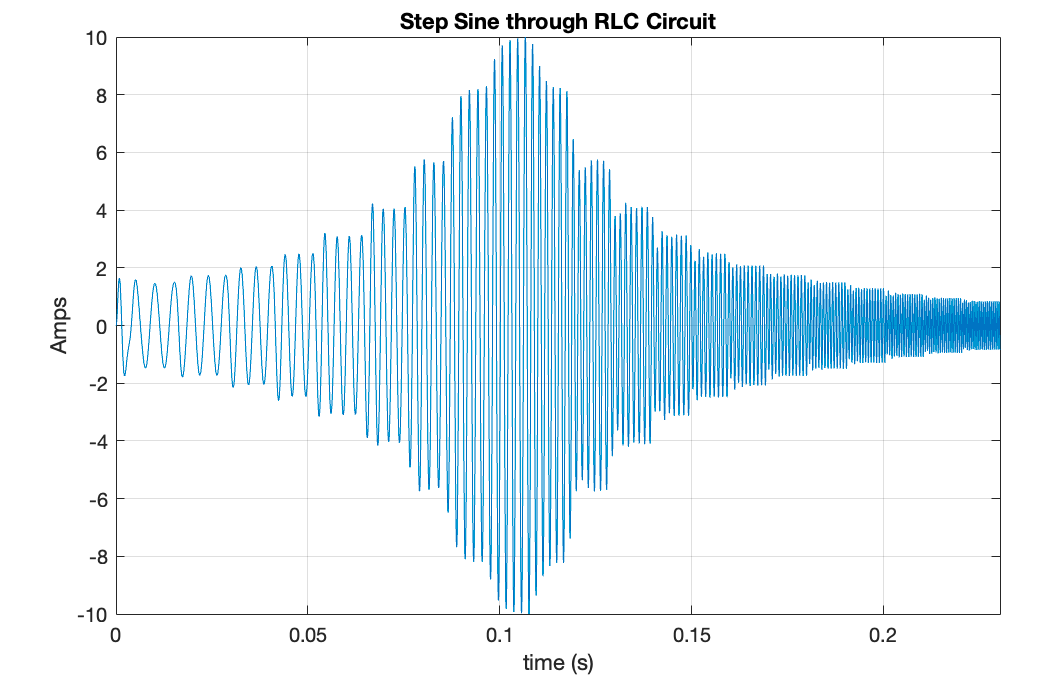
Admittedly, the bilinear transform is a discrete time approximation of a continuous time object—and so is a digital signal— but in comparison, say to a the FIR2 approach, which requires, for reasonable levels of accuracy, a 48,000-term filter, I find it much more satisfying to have a 6-term filter derived directly from the physical properties of the circuit.

APPLYING THIS METHOD TO ACOUSTICS

Now that we have a method that’s copacetic for a simple example, let’s apply this to the electro-mechano-acoustic domain! This is where the cons come in. While the math is simple and exact, the algebra quickly becomes nightmarish for complex systems. A simple transducer model is relatively simple until you chase down the acoustic terms, and then it becomes hellish, but I have a solution for that, too. Observe:

Factoring this chonky conglomeration to obtain coefficients yields something so grotesque it cannot be displayed readably with LaTex:

But using the power of the symbolic library, we can easily collect the terms and calculate the coefficients:

Turning Z(s) into a time domain filter Z(t) is as simple as taking the bilinear transform of 1/Z again! The results are validated with a comparison to a full speaker simulation software. If you’re wondering where the orange line is, it’s directly beneath the yellow line.
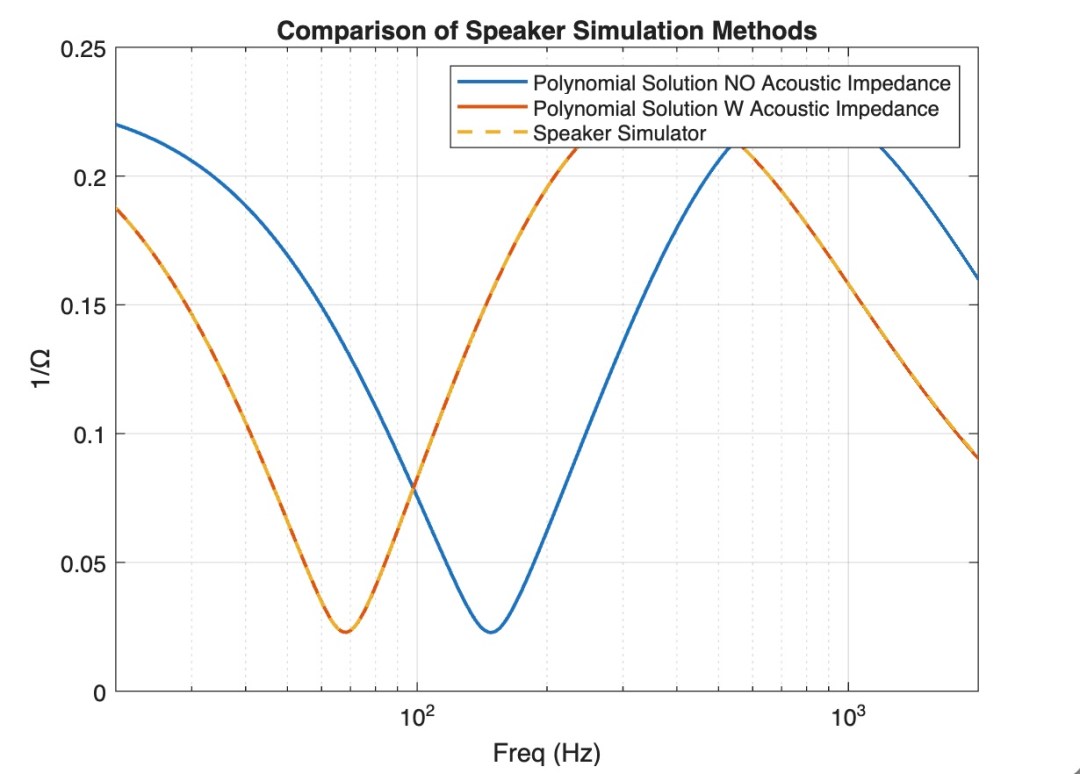
Admittedly, the model with acoustic impedance added is very close to the one without, but we’re here for precision anyway!

Inverting to impedance:
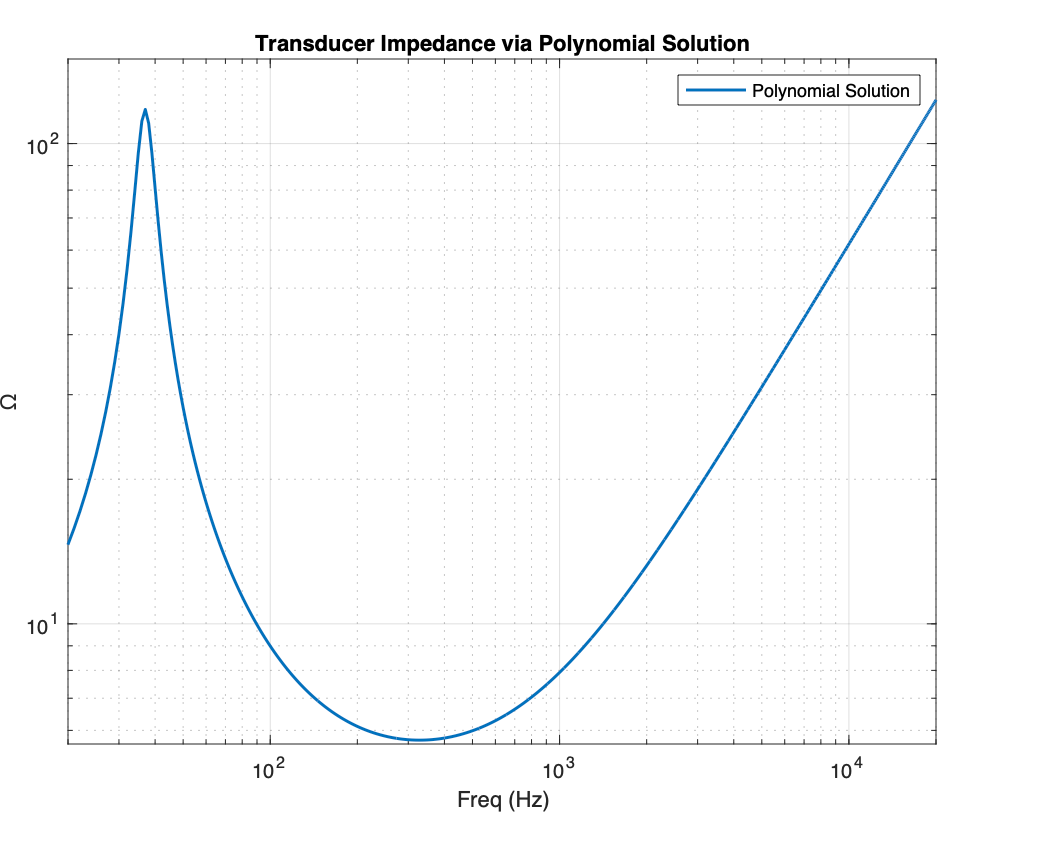
Checking it against a real transducer (I switched TS parameters for this one to the ND91-4 by Dayton Audio, a classic mini-woofer)—overlaying the simulated response on top of the DATS measured impedance response (blue line) by Dayton Audio vs our orange polynomial line, it looks pretty damn close up to 1kHz! The loss off accuracy above 1k is most likely due to the secondary inductance/resistance of the magnetic circuit, which is not typically reported by manufacturers in the TS parameters or datasheets and therefore not modeled.

Et voila! with a little bit of computer assisted algebra, we can take a lumped element model and convert it into a time-domain filter to be applied directly to incoming signals. In this case, we solved the algebra to get us the time-domain impedance of a transducer model, but with some simple re-arranging and a little code we can convert voltage to excursion, SPL, velocity, transmitted force, and much more!
RETURN II-II: THE ELECTRIC BOOGALOO

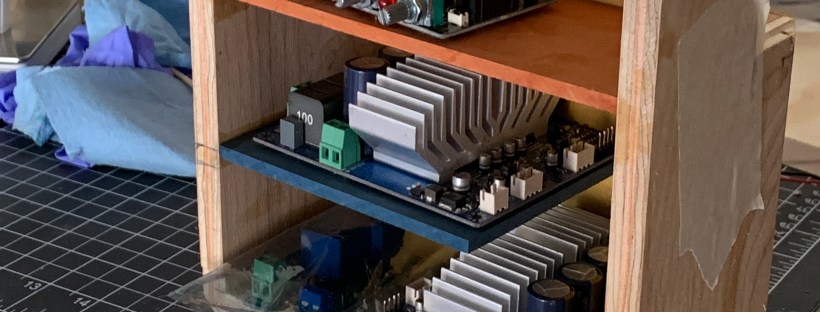
Back by popular demand. Here’s how I designed the electronics to power the 120 dBSPL (@ 1m, ±3dB 40Hz-20kHz) beast to defeat the new generation of super mid “Soundboks” type devices.

As you can tell there are some peculiarities to this design, including a dual battery rails supporting the “low power” section.

POWER

THE AMP
The first thing to do is to down-select the amplifier chip-set to deliver the hundreds of watts required to hit target levels.

There are very few amplifiers in this power range that will meet this need.

  • IRS 2092 with ±50V rails and adequate MOSFETs
    • ruled out for the reason that I don’t want to source ±50V
  • WONDOM AA-AB31395: 1 X 1000Watt Class D Audio Amplifier Board – T-AMP – LV
    • Out because 500W into 4 Ohms @ 10% THD @ 60V
    • No THD/Power curves
  • WONDOM AA-AB35511 3 X 500Watt Class D Audio Amplifier Board – T-AMP
    • Out because it actually can only sink 300W into 3 ohms @ 50V @ 10% THD
  • ICEpower 300A1: single channel 300W @ 1% THD @ 55V
    • this is a strong contender, but it’s single channel and requires a ±12V input and is therefore slightly more expensive and complicated than the TPA3255
  • ICE Power 500ASP
    • Honestly more than perfect but requires 120V AC
  • ICEpower 300A2
    • Also an incredible amp but requires ±35-65V which is annoying with batteries
  • TPA3255 Capable of 500W into 4 ohms (PBTL) @ 50V @ 1% THD
    • best contender
    • 3e-audio sells a balanced input version which is great for low noise!
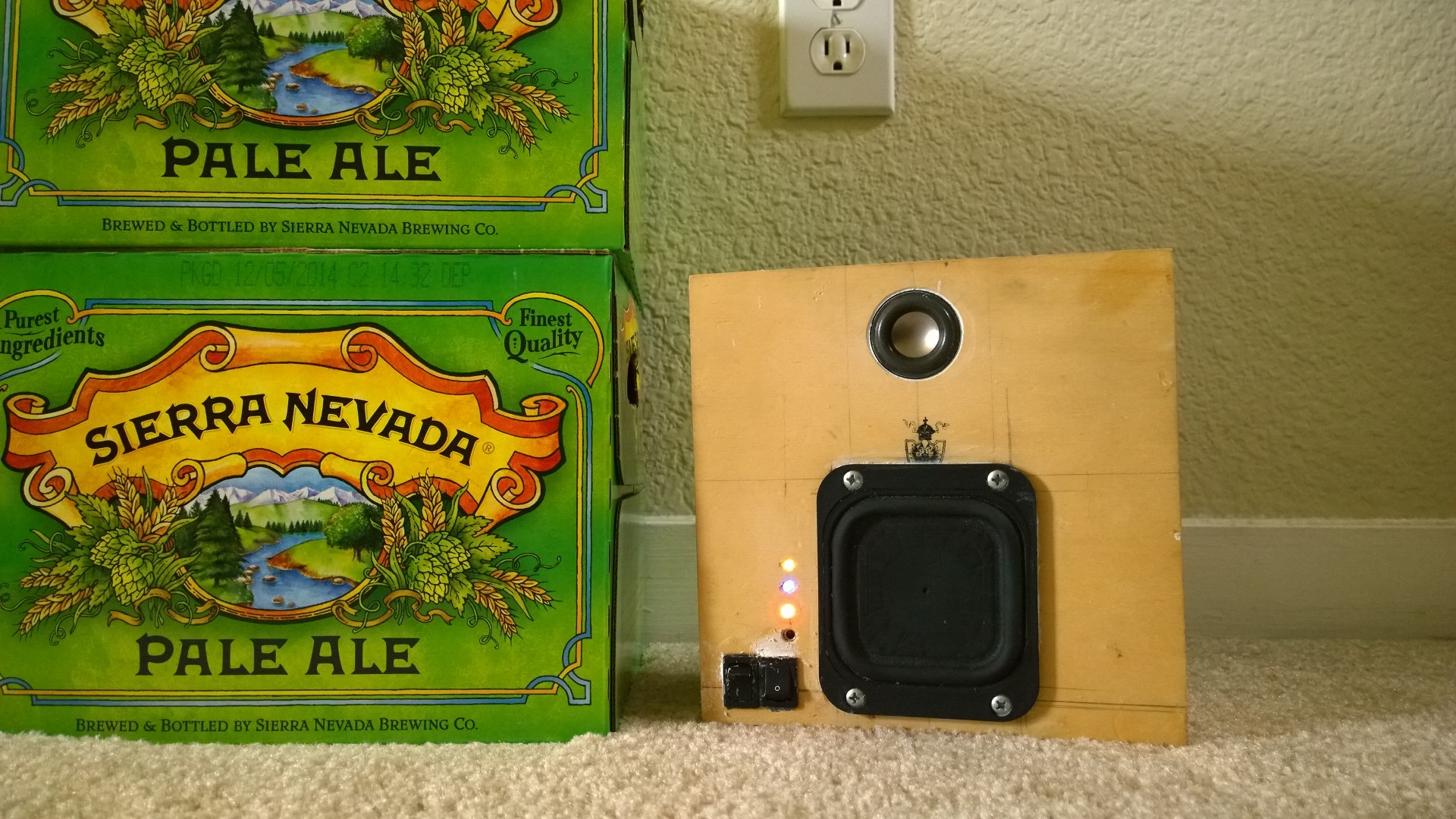
The TPA3255 chip-set is the winner here for cost and simplicity while maintaining high quality.

In my experience, a lot of these amps will “overspec” their power output, as they’ll rate their amp in a very specific set of conditions. Let’s dive further into the TPA3255 to confirm it can meet our needs. There are a few dimensions we care about:

  • power required by speaker to hit target SPL
  • impedance of speaker at frequencies of highest power
  • voltage/current required by amplifier at highest power

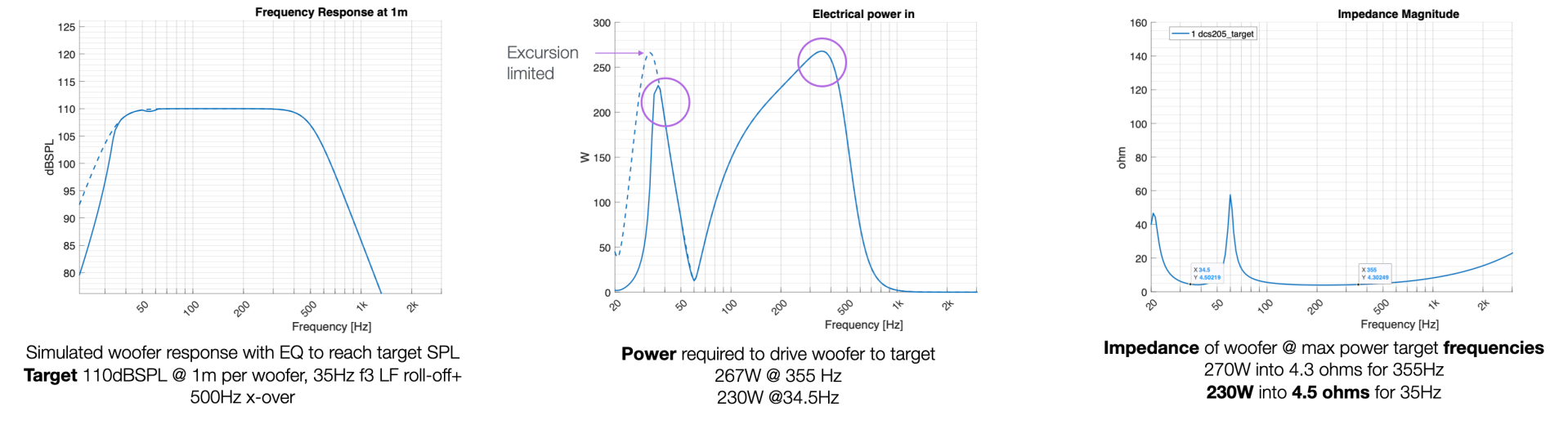
Woofers are almost always the least efficient and most power intensive part of an acoustic system, so we’ll focus on the woofers for now. To determine “how much power into what impedance” we refer to the target response from the simulation in part 1 and check power required and impedance:

So we need 270W into 4.3 ohms at 355Hz and 230W into 4.5 ohms at 35 Hz! Then we refer to the TPA3255 data sheet to determine if it can deliver that power:

Based in the data sheet, it looks like we can do 260W into 4 ohms, which is precisely 231W into 4.5 ohms—perfect!. The amp will not be able to deliver the full power required at 355Hz, but that’s OK—that’s firmly in the lower vocal range, where I expect less general signal level in normal use. The data sheet also informs us that the amplifier expects 54V to deliver this wattage. We can then refer to the efficiency curves to understand the maximum current the amplifier will draw:

Based on these two graphs we can expect that for two woofer channels we’ll be looking at a maximum power draw of about 700W. We can apply this same process to the mid-range and tweeter to determine the total power draw of all 4 channels of this speaker, but to cut to the chase, we’re looking at a power draw of about 1kW peak.

From Ohms law, we can determine that 1000W at 54V is about 18 Amps, which we’ll use to spec the power supply portion. For now, we can be confident that the TPA3255 amplifier will suit our needs.

3e-audio’s TPA3255 boards are also beautiful, compact and expensive. Here they are in the (as typical for every project I do) completely undersized electronics box.

THE BATTERY
Based on the acoustic simulations above, the power draw for the whole system looks something like this:

The peak load of about 1kW is an absolute maximum— all of the driver’s stated power handling exceeds their actual linear excursion (in simulation). We need to be able to deliver 1kW for transients but an actual input (sine wave being the worse case equating to 1kW peak) would destroy the speakers rather quickly. I accidentally verified this fact when I mis-programmed the DSP, which caused it to output full-scale white noise; the tweeter burnt immediately. Armed with this knowledge, I can happily specify a 48V 1kW battery to handle the peak demands. The continuous load—i.e. the crest factor (or the ratio between the RMS value and peak value of a signal)—for very loud music content will be <-10dB below this peak, so the battery will be chillin’. Not only is -10dB the 99th percentile of music loudness (more on this later), but most playback environments (e.g. Spotify) have a metadata normalization scheme that limits CF to < -14dB.

Moving on to runtime, my target was “a while” at max volume, 6 hours for party usage and ~all day for normal-to-loud listening levels. I added a quick calc in the bottom of the power table—a typical battery capacity in the 48V range is 20Ah, which yields about 2.75 hours at maximum power output with music, and 5.63 hours at a click or two down from that (-6dB). Keep in mind, this is still using -10dB CF, which is, like, hella loud. For reference, the crest factor of a loud metal song like System of a Down’s “Take the Power Back” is -14.2dB. Taking that into account, 20Ah seems like a reasonable capacity.

Writing this from the perspective of having already built the device and used it for parties, the battery life is great. Max volume is enough to irritate the house next door and more than enough to cover a 30 person party on the beach, the battery typically lasts for about 6 hours in this usage, so -10dB CF is certainly a very aggressive estimator for battery life.

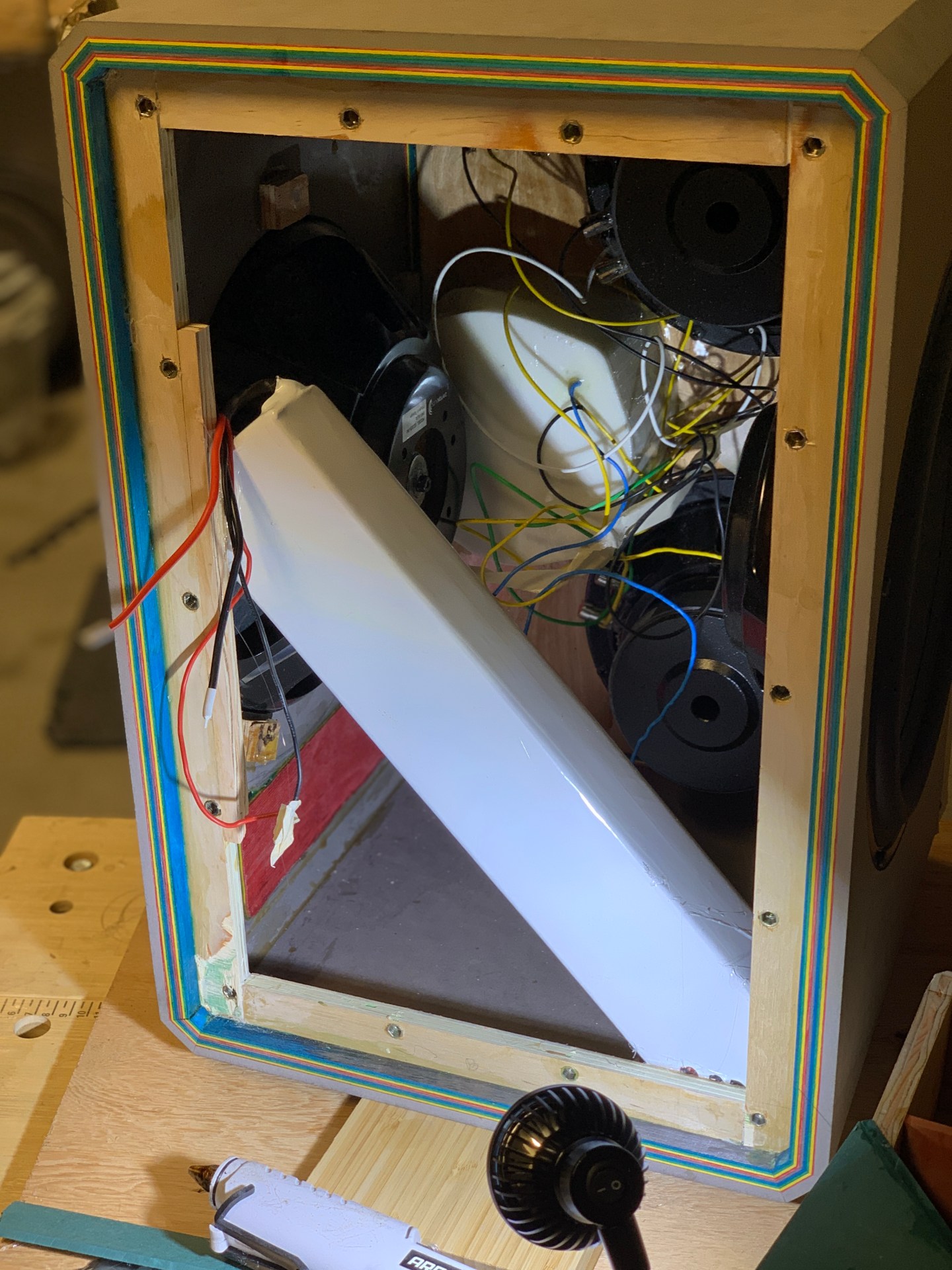
One thing not mentioned so far: a 20Ah 48v battery is massive. I had trouble fitting it into box in any orientation that did not interfere with the isolated electronics box, so I had to glue it in at an angle and take a chunk out of the electronics box:

big white rectangle is battery
electronics box from above with a nice miter through it

DSP AND TUNING

SIGNAL CHAIN

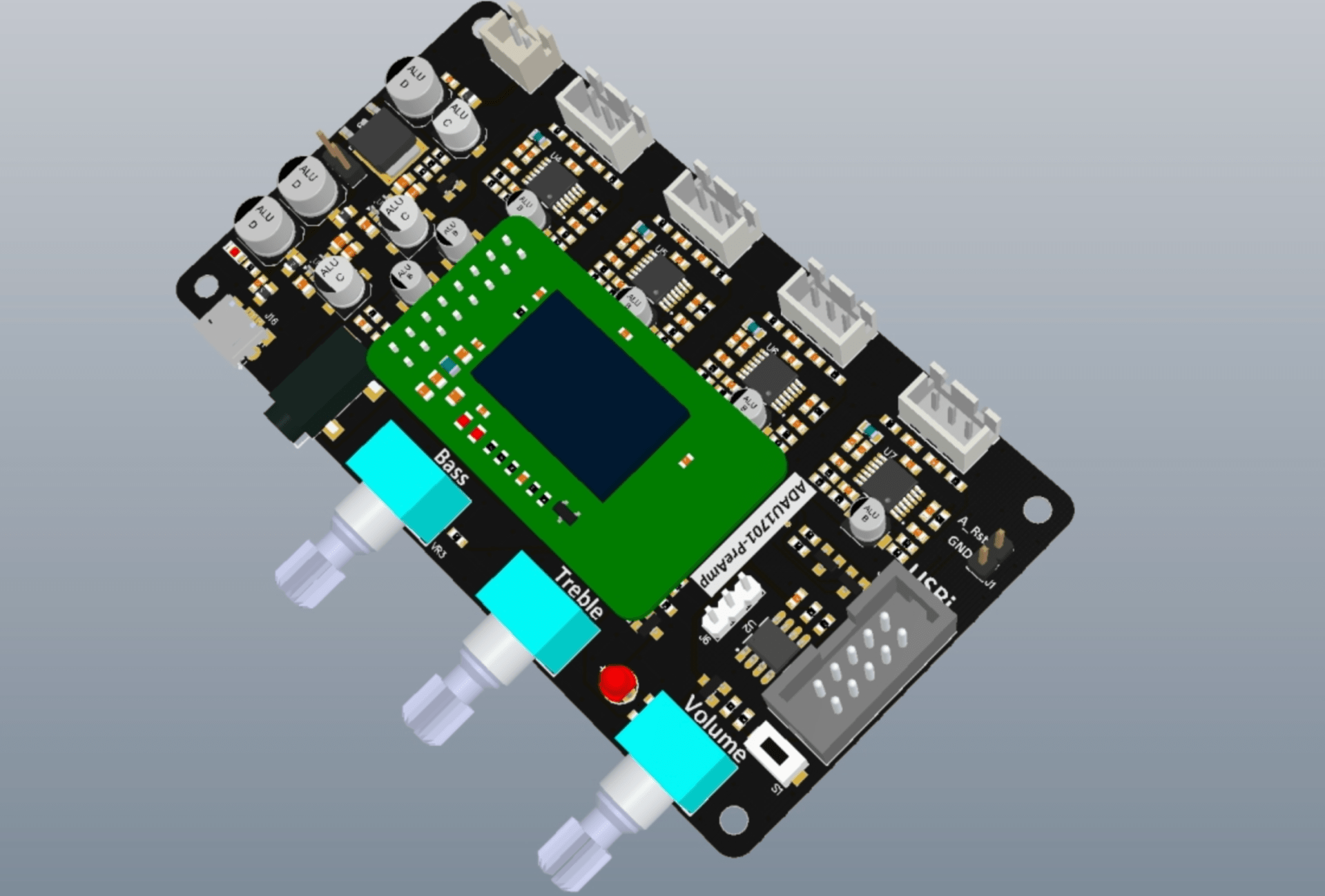
The beauty of the TPA3255 by 3eAudio is that it runs a differential input which is massive for noise management. At the time, 3eAudio also sold a beautiful differential-out DSP board with an integrated Bluetooth chip. The integration of the BT chip eliminates BT radio noise at the source while the differential signal chain allows the removal of any injected EMI or ripple noise on the voltage sources.

from 3e-audio’s website

This nearly fully integrated solution simplifies a lot of the process for creating a low noise signal chain. The amps themselves have a 12V line to run the DSP off of! However, I ended up forgoing this 12V rail for something much more ridiculous (see noise section)

Tuning with ADAU1701 is a breeze once you figure out SigmaDSP’s interface and how to write to EEPROM (hint: you have to right click).

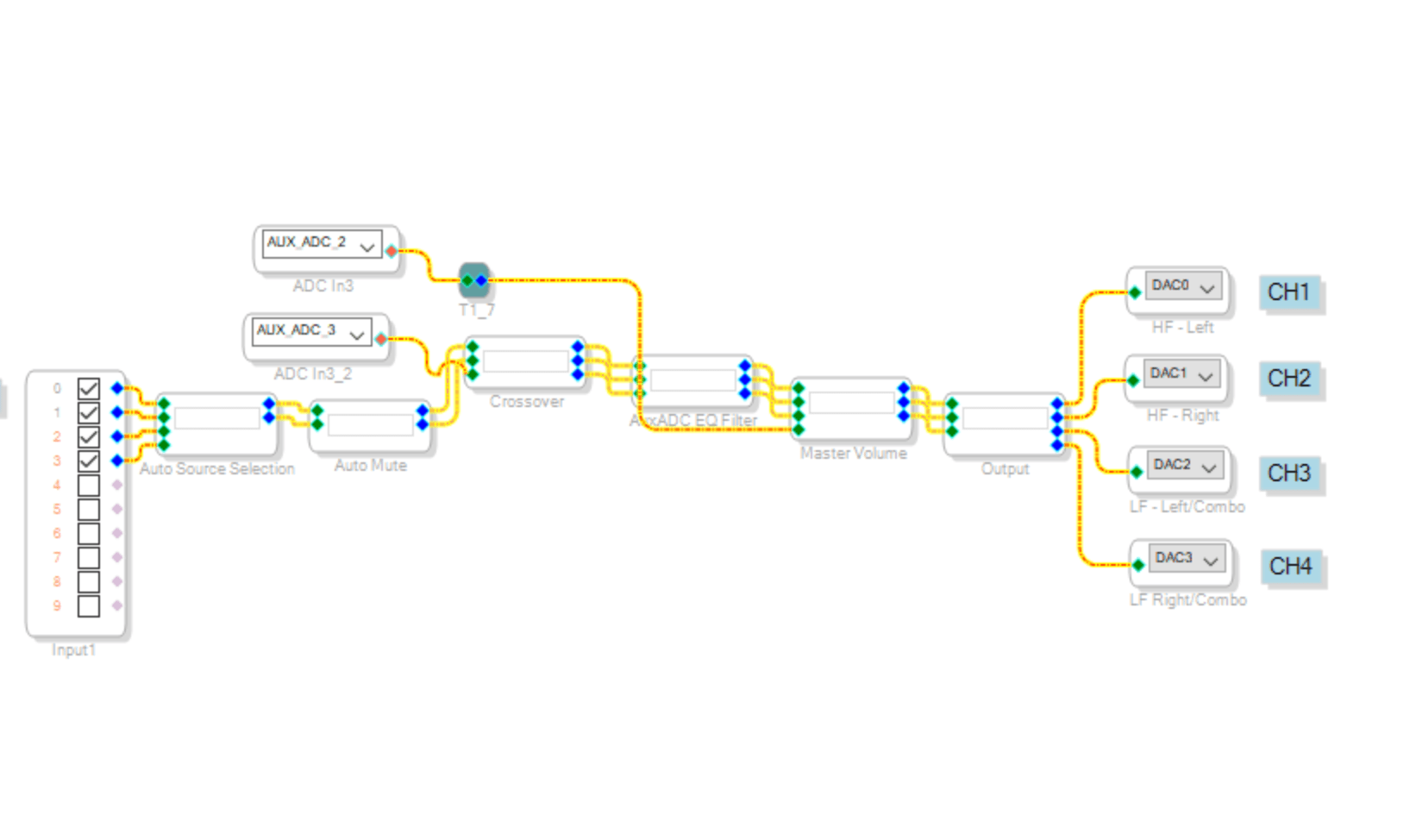
Here’s an overview of the DSP employed to get this beast of an acoustic system sounding good at all levels:

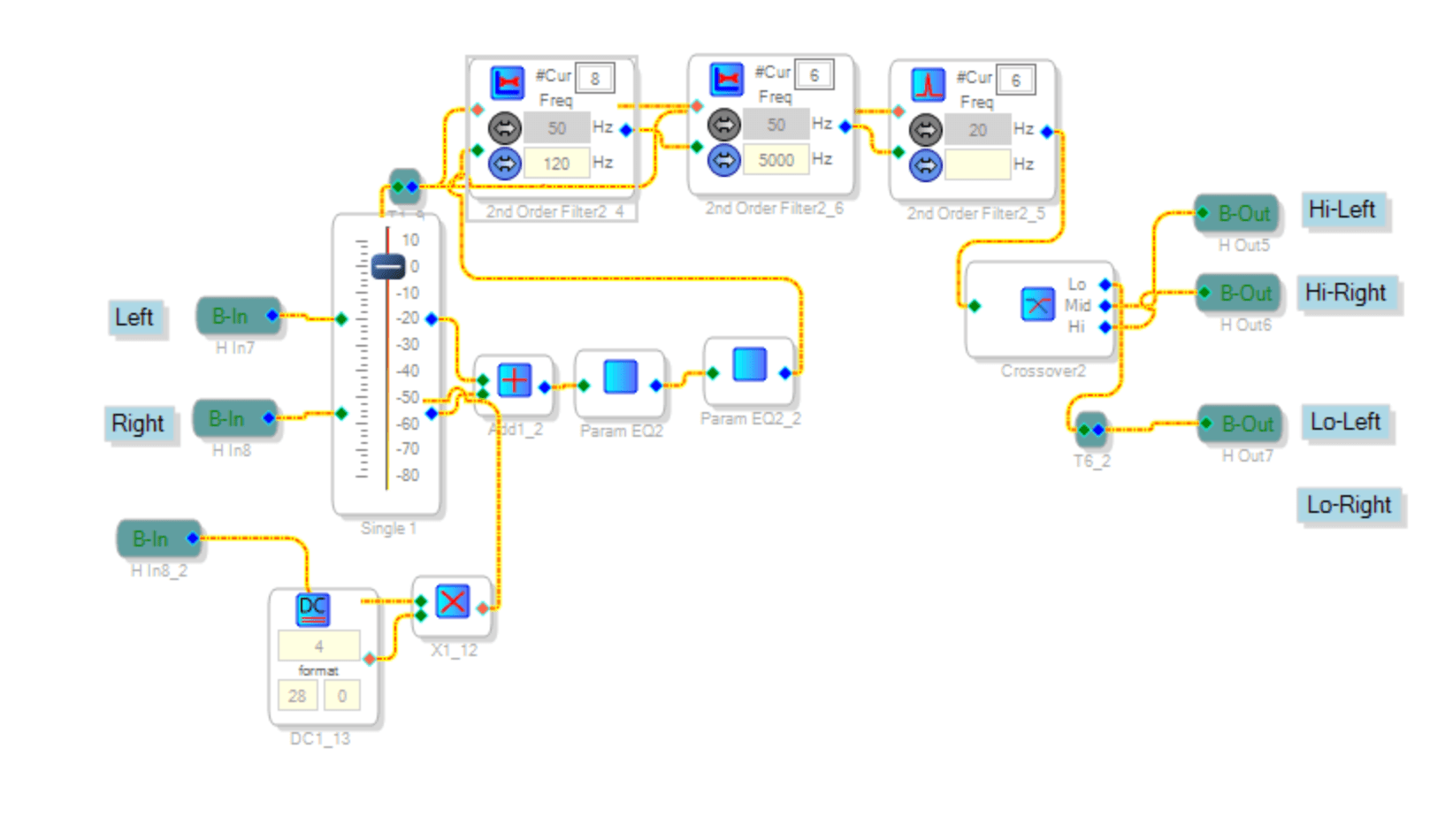
The first block labeledx-over handles several global EQs as well as some volume-tone compensation. Here’s the signal flow:

Inside the first parametric EQ, the analytical for the midrange and tweeter takes out the resonance peaks (occurring from horn loading, and the rear-mounted design of the mid-range).

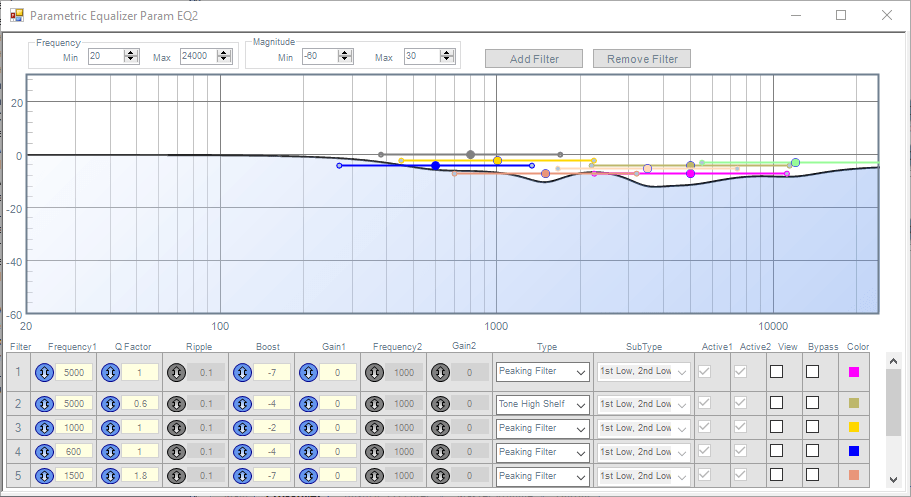
Inside the second EQ block is an absolute mess of peaking filters to carefully control the excursion and system resonances of the woofers and the woofer box.

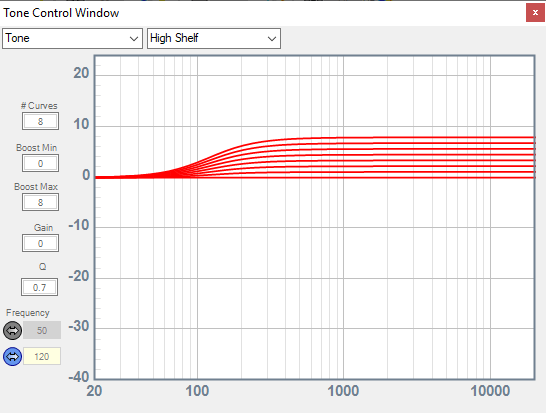
After the parametric EQs are a bunch of volume control filters which have a very specific and unusual function: to enable party mode. The intent of the party mode knob is to shape the output of the whole system to be focused on higher output. Ideally, the whole system has been tuned for a very pleasant Hi-Fi response, with rich, deep bass, balanced vocals, and sizzling highs. But sometimes you just want a little extra punch, and that’s what party mode is for.

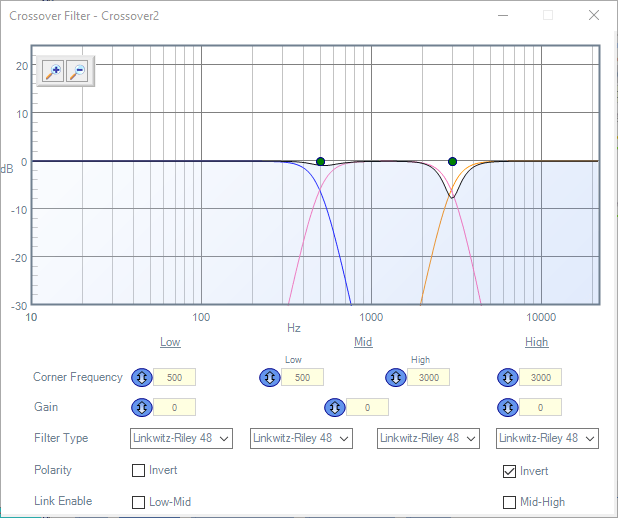
X-over, as low as possible for the midrange and tweeter to limit directivity effects. Two notes:

  1. Typically crossovers are a bit higher for this kind of application (800-900Hz), I am of the personal preference to push crossovers as low as possible for better efficiency and directivity. Generally I think the worry for low crossover is either distortion due to high excursion at resonance, but with careful calculation and proper DSP, this can be easily avoided.
  2. The LR alignments often prefer a phase inversion for the TW for proper summation, which can be confirmed in real life by measuring in the farfield.

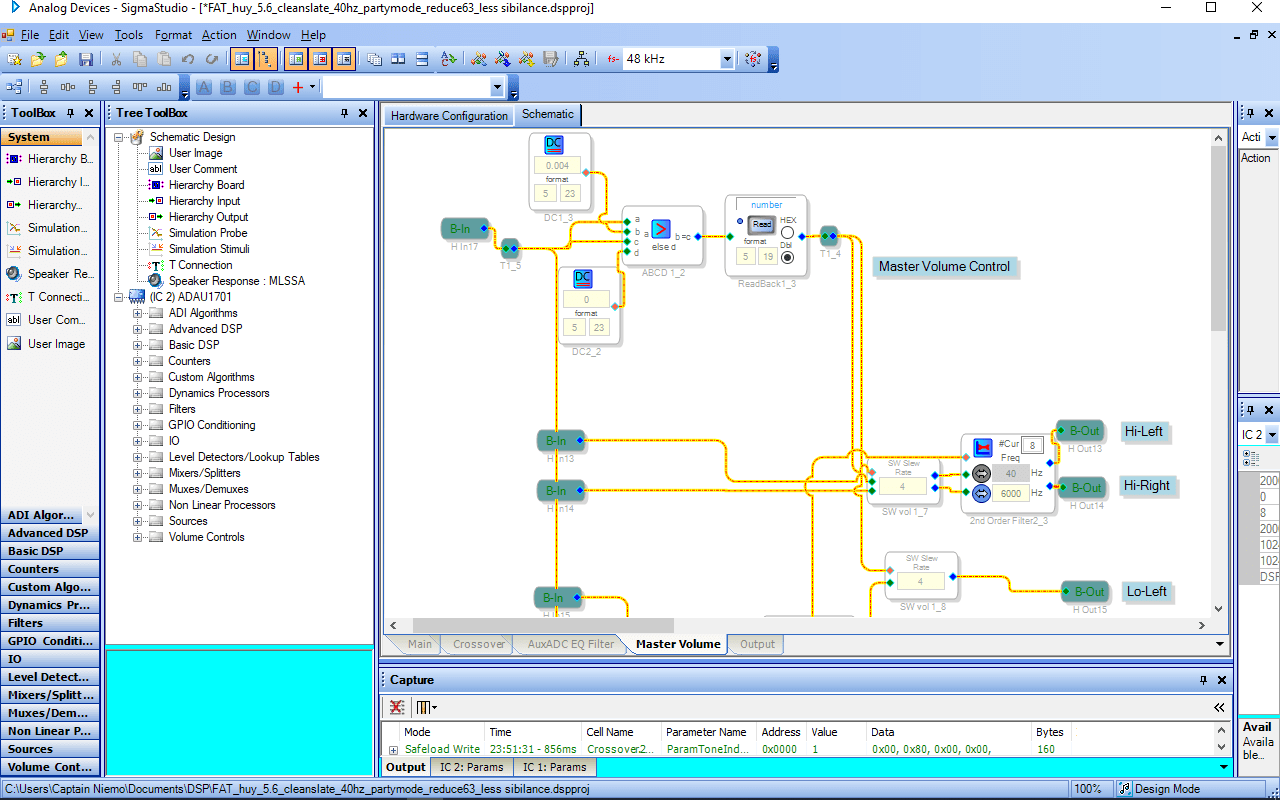
Moving on the the next section: the master volume!

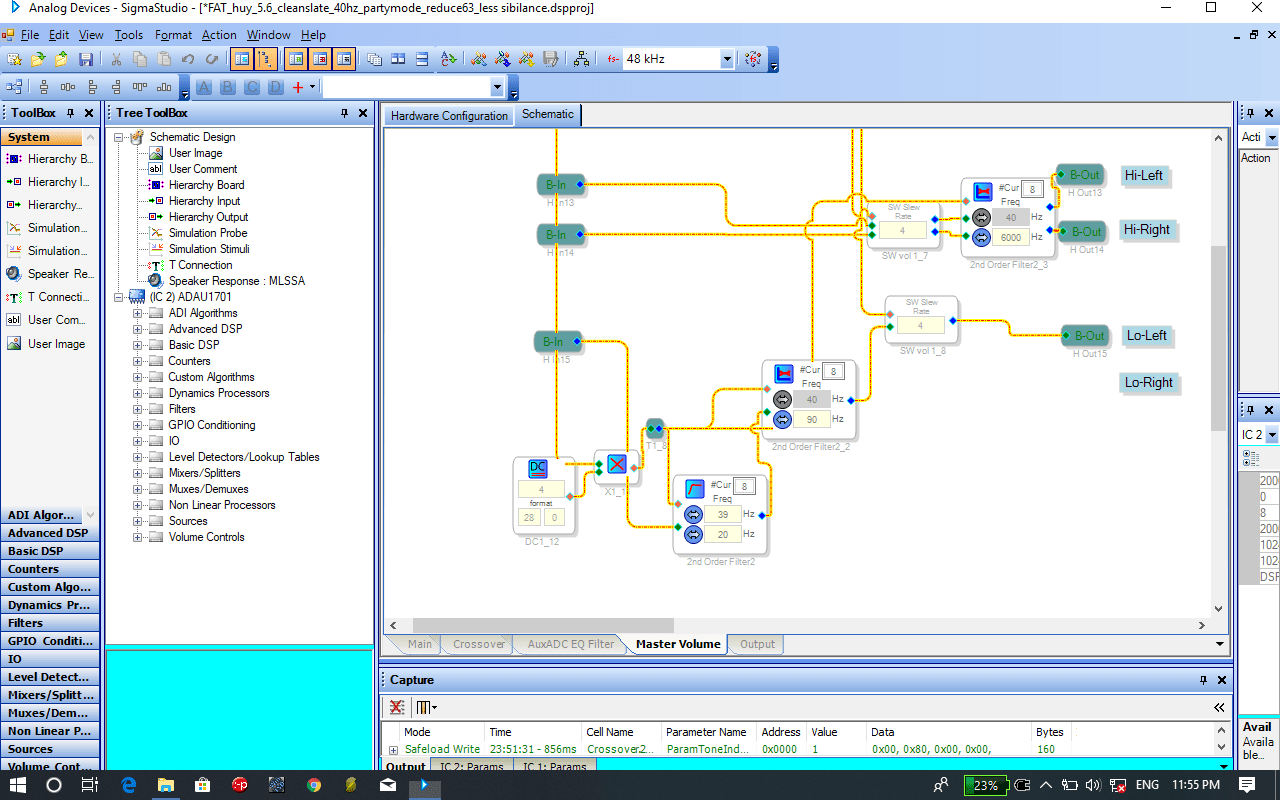
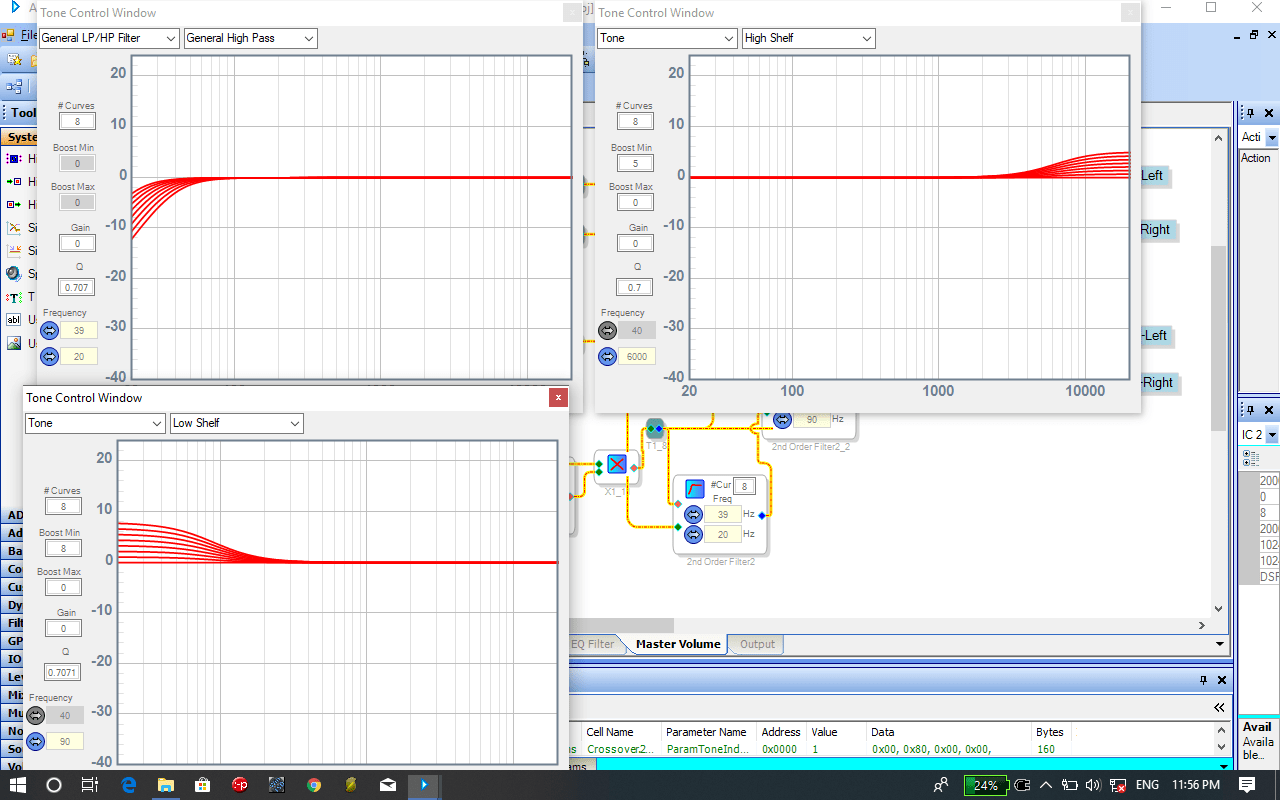
These essentially are optimized to allow maximum excursion at a variety of levels, while also respecting the equal-loudness contours (in short, our perception of a “flat” frequency response changes with a change in output level; lower listening levels require more bass/treble to sound balanced). The HP filter moves down as volume moves down, while the low shelf increases LF gain, allowing deep bass at lower listening levels and controlling over excursion at high levels. A similar behavior is required for high frequency.

Finally, the output stage requires some gain reduction for the more sensitive mid-range/tweeter, an overall lowpass for the subwoofers, and a soft clipper to limit digital distortion:

THERMALS, NOISE AND ACCESORIES

THERMALS

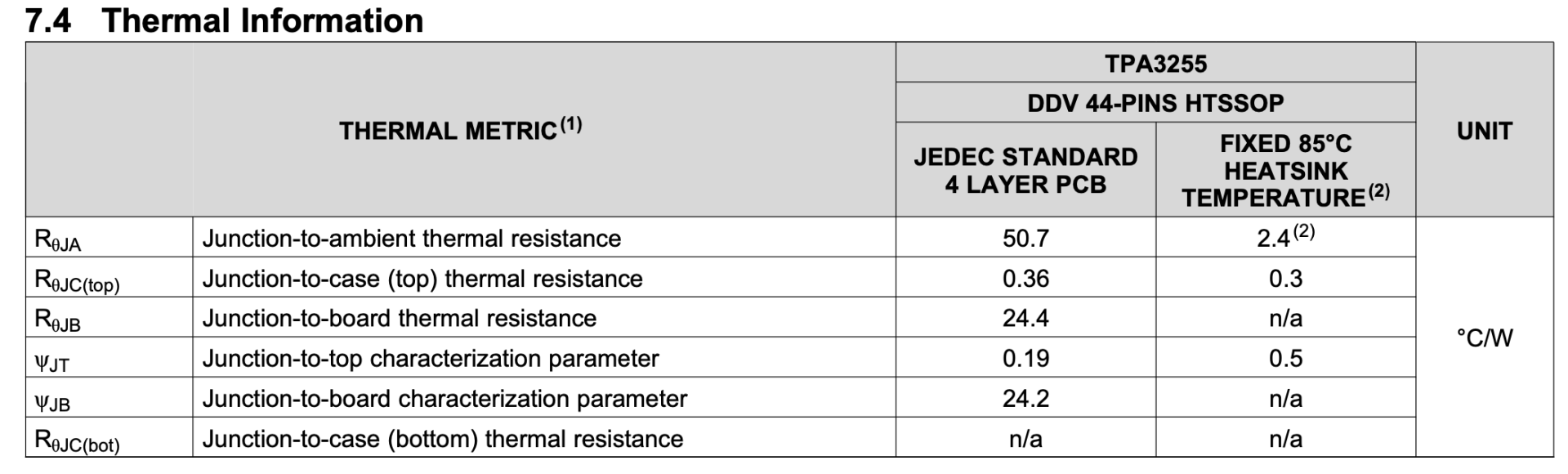
While in theory the idle losses of the TPA3255 (2.5W) should only imply a 6°C rise with Junction-to-ambient thermal resistance of a fixed 85°C heatsink, it turns out that 1) thermals are much more complicated than that and dependent on a multitude of design factors 2) in reality the TPA3255 with a heatsink gets quite hot at idle.

Further still, the power dissipated by the amplifier rises non-linearly with output power, and at the (woofer) rated 600W total output power, the amplifier will be dissipating nearly 90W in heat. While 600W is the upper boundary (consider duty cycle, crest factor, etc), again, in practice, what I observed is that the amplifier gets hot hot. For instance, standard wire (PVC) temperature ratings are ~80°C which only allows a maximum output power of 100W total (assuming ambient at 25°C and an ideal heatsink).

To combat this, I installed thermo-couple controlled 80mm case fans to the heatsinks, with exhaust vents in the electronics box, to enhance the heat dissipation capacity of the system and prevent heat-soak. I also upgraded some the wiring for this project to silicone-sleeved wires, which besides tasting great being luxurious in quality and feel are much easier to route, handle and bundle.

in this terrible picture you can see the Arctic F8 TC case fan nestled right above the heatsink

ACCESSORIES AND NOISE

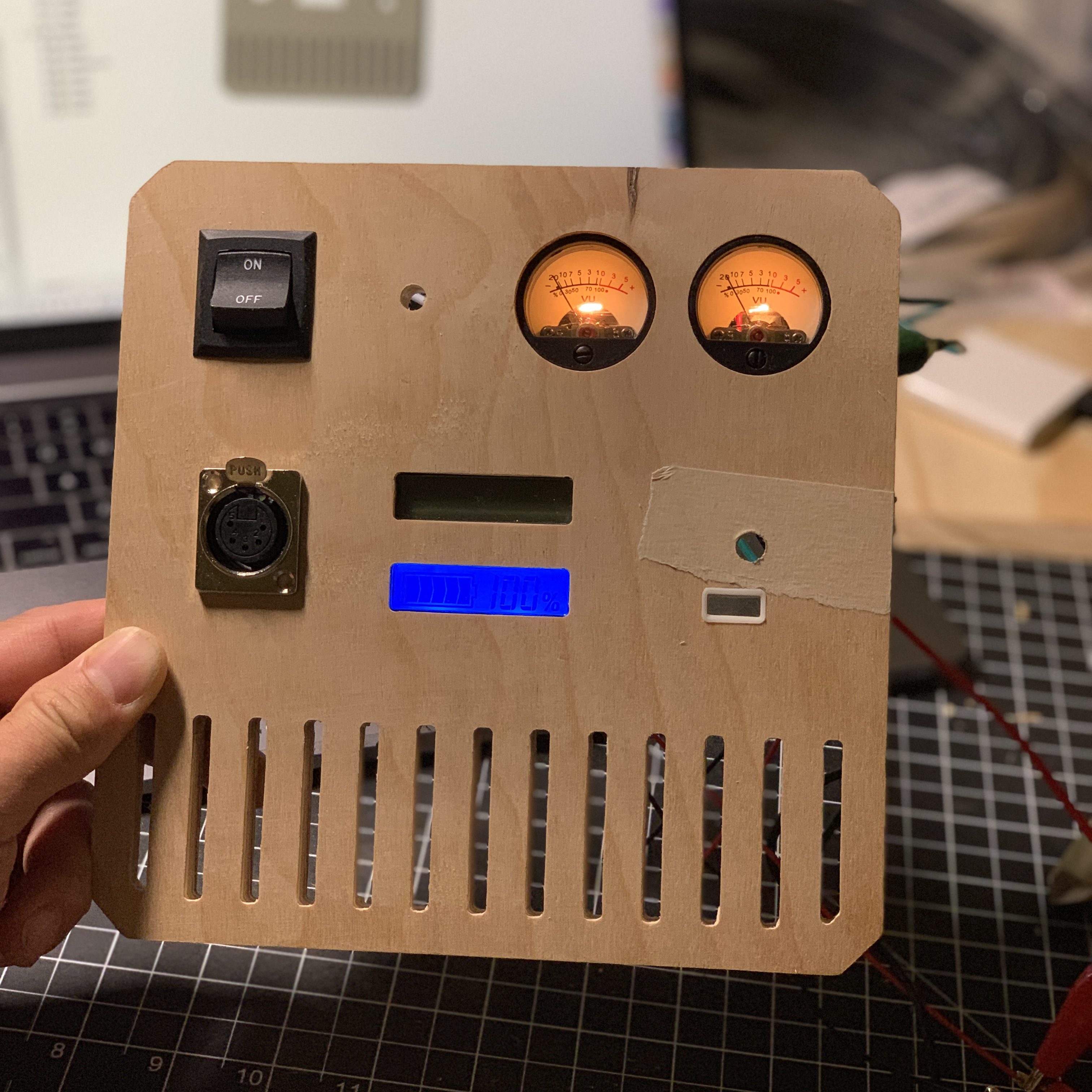
The fans themselves consume enough wattage that the TPA3255 onboard 12V line was not sufficient. I also wanted a battery meter, and a backlight VU meter. I trialed a HV DC-DC step down to run all the 12V auxiliary bits; in most applications, I would use a simple low noise buck converter like an LM2596, but these tap out around 36V. To step down the 50V battery voltage, I had to find specialty voltage converters, but the ones I found for reasonable prices tended to inject too much noise into the signal path. Due to the high gain and high efficiency of the acoustic section, the whole set up caused tons of quiescent noise, which only increased with the power draw of the aux electronics (e.g. fans). So I opted for a truly ridiculous solution.

‘DC-DC converters do come in various flavors of ground-loop isolation, ranging from 0 isolation (cheap) to kV of isolation (very expensive for higher ampacity), but you know what’s cheap and intrinsically highly isolated? A completely floating power supply.

Having lost all sense in the pursuit of FAT bass, I built a separate 3S battery pack to run all auxiliaries which has the advantage of excellent isolation and the massive disadvantage of added complexity. In addition to having to have two battery management boards, two separate grounds, carefully calculated battery capacities, the device now requires two separate chargers and a 4-pin charging connector.

But it was all worth it for the VU meters, which flick to the beat independently:

FINISHING THE BUILD

At this point, all that was left was to put everything together

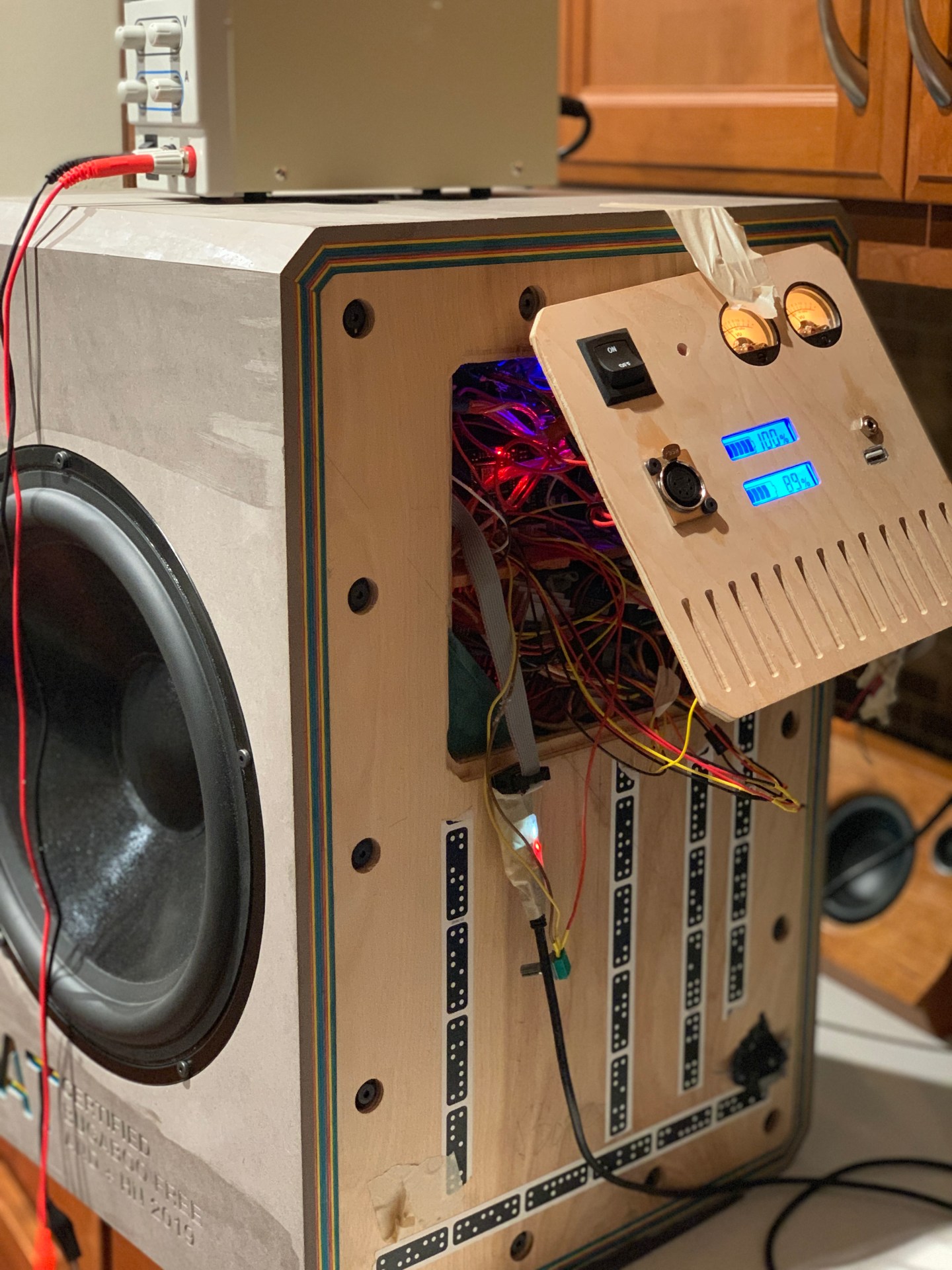
Testing the cut outs for the rear electronics panel:

The VU meters look amazing:

Adding stuffing, and a mess of wiring

The wiring can only get more messy

Sound testing before finally assembly:

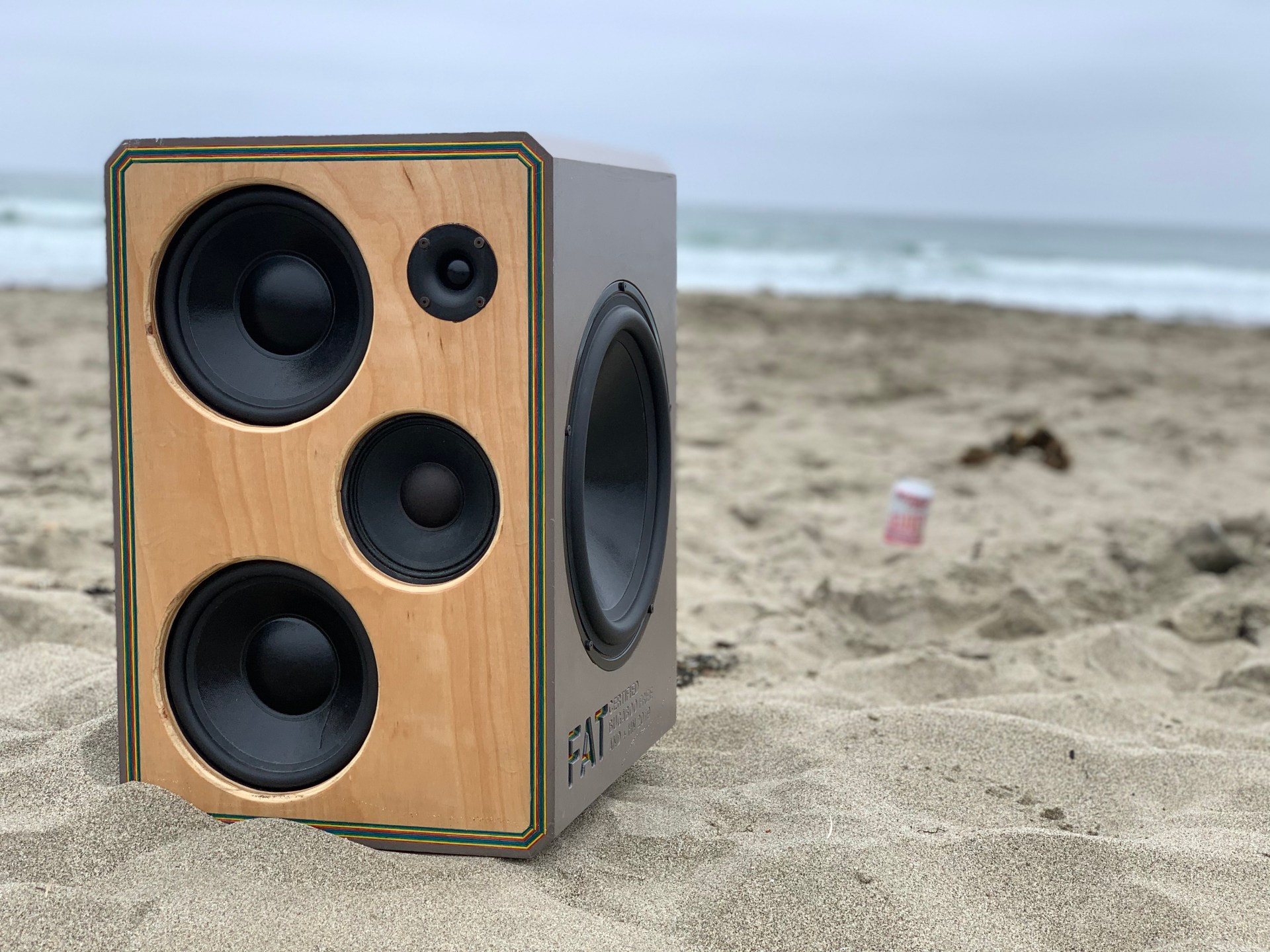
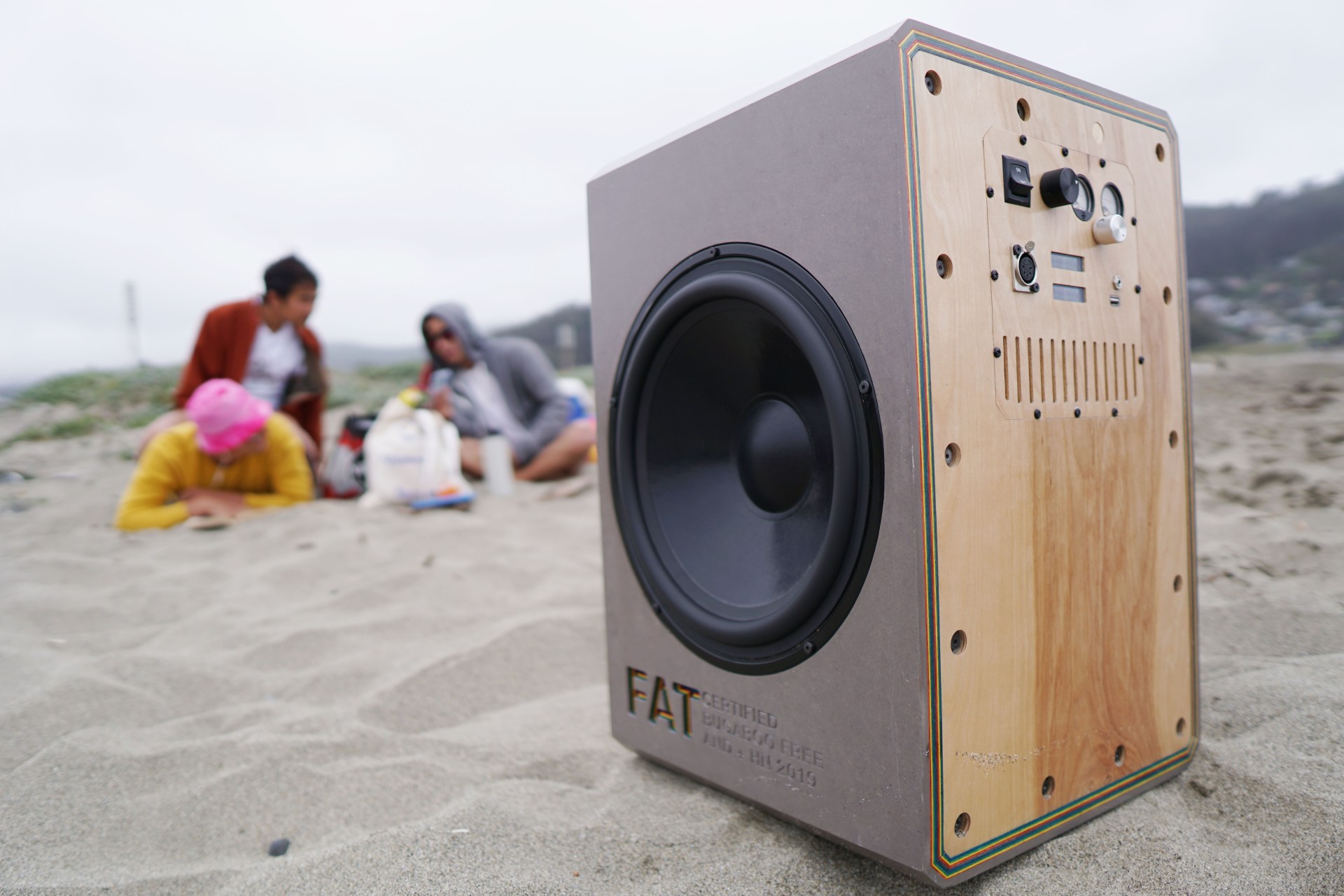
Finished product:

A BRIEF HISTORY AND MUSINGS ON GRADUATION

Boombox The First

IN the way that most things in life are, there was no moment where the stars aligned and a beam of silver brilliance illuminated me with inspiration; it was not a sudden cataclysm of grand events or even a single moment of clarity. It was more the lucky coincidence of a few small dust mites, just little things, which only in detailed retrospection, could one notice an amount of circumstantial  alignment, that lead to thiswhich, of course, is on par with the scale of endeavor.

I was confronting my post-graduation ennui, as the evaporation of two of the more fulfilling experiences in my life (leading the water polo team, and learning tons of shit with tons of new people) had left me both without purpose and without the satisfaction of achievement of purpose. This was compounded by the fact that I had a degree in Mechanical engineering, which is a certification that I have all the necessary tools to be achieving things, but no job, which rendered those tools somewhat useless. I also other aligned mites; I had a little bundle of cash from graduation, a garage full of random bits of electronics, a shit load of time, and a best friend who wanted portable bluetooth speakers.

So I told him, I could build those for cheaper. He said fuck yeah, and I went to Urban Ore, where a quite lucky mite of dust fell into place; I found a use pair of drivers which just so happened to be the AuraSound NS4-255-4D. If this set of esoteric numbers doesn’t cause heart flutters, the NS4 is one of the best small format full-range drivers in the world, and it’s also impossible to get, because AuraSound was shut down by the feds. Th NS4 some how managed to sneak a little performance past the Iron Law;  it’s loud and it’s got bass in a small box, and it’s cheap (well, used to be cheap; the last commercially-available pair was bought by me, 1.5 years ago for $50). And somehow I had found a pair of these fuckers for $4.

And so I built him a damn boombox, and it’s design was mediocre, and the electrical engineering was shoddy, and the panels were cut from slightly different bits of wood, and nothing was quite lined up right, and it took all summer to get the right parts, and I ran up against the deadline of his birthday so I had to build for 2 days straight, and then it was the day of, and I hadn’t eaten all day because I had to finish it, and I was supposed to be leaving to go his house for a BBQ, and I was late, and I was and had been focusing for the last 8 hours to an extent that makes me wonder about the exact nature of my mental health, and I had my doubts about the whole thing because in someway the little guy’s success was entangled a bit with my own soul, but then it was time to go to his house, and since it was too late to turn back, I turned it on, for the first time, on the porch looking out to the sun setting over the Golden Gate, fog and clouds glowing with orange warmth, with my parents drinking a beer and my little siblings watching, and when the power light flicked on, and the beast was awakened with a bit of thunder, and the peaceful calm of a idyllic Berkeley summer sunset was shattered, I grinned.

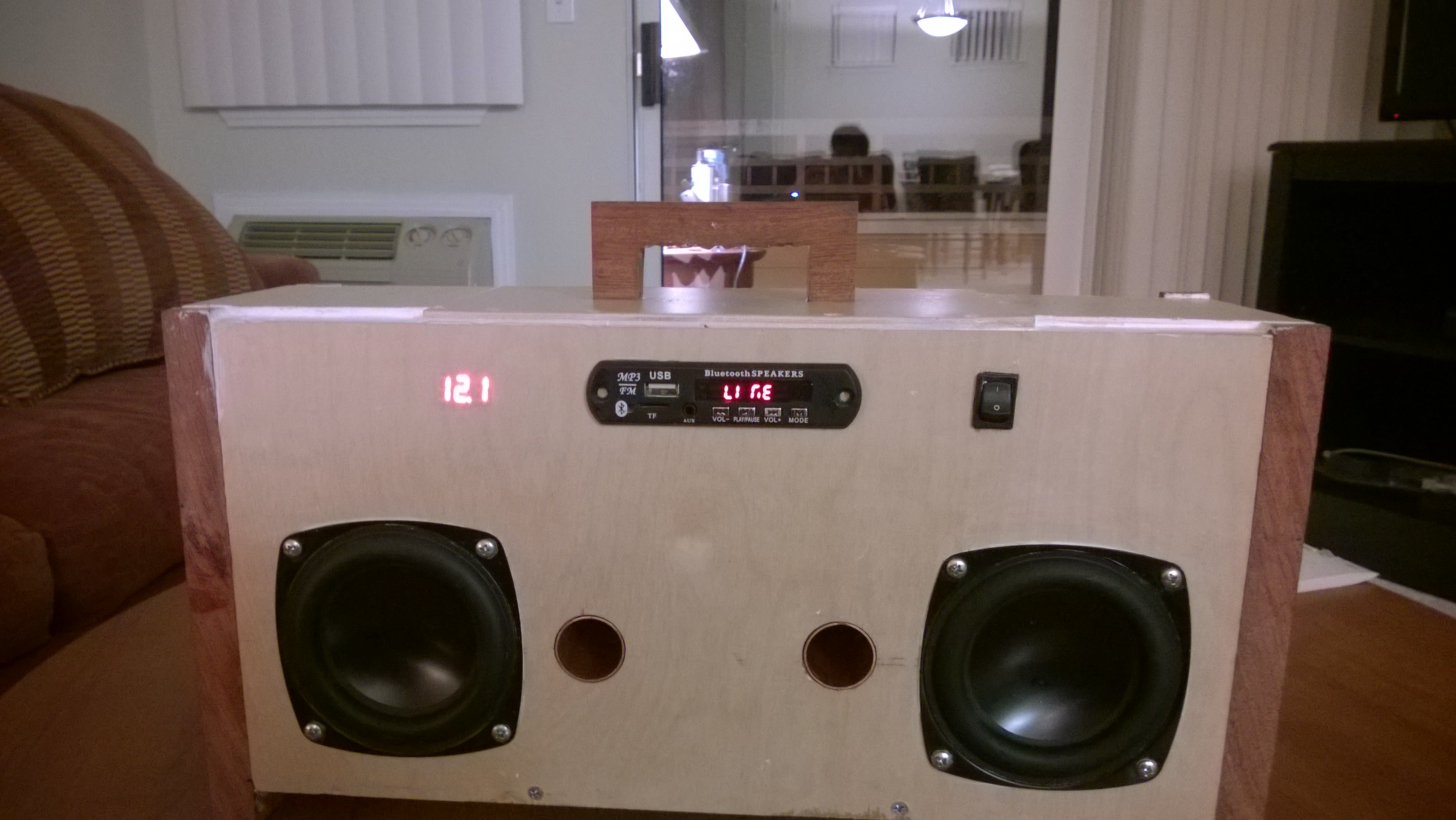
Here’s the guy from that exact moment:

bbx1_front.jpg

And Then The Rest

The response was positive, so I built a few more. Though, the first few efforts up until recently were a bit sophomoric, here are a few of them:


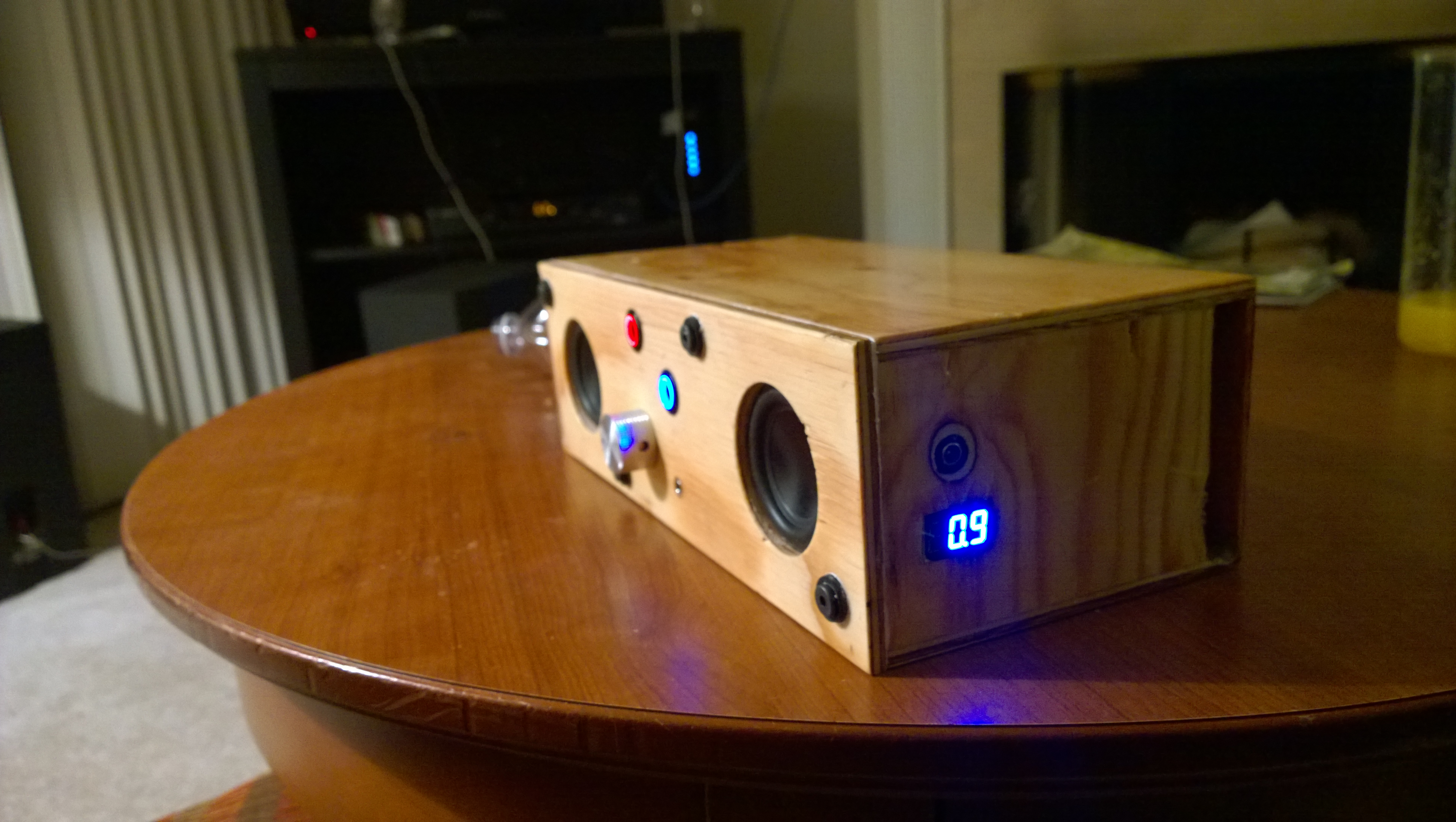
Here we’ve got some unfinished pictures of an ultra mini build with a 2 way design using a very surprising 3-inch sub that kicked low-end ass. Built into a (small) cake box.

WP_20150116_20_26_58_Pro

Here’s some beer for scale:WP_20150117_11_02_35_Pro

Here’s the second NS4 build, with some Brazilian cherry I found on the side of the street. Shipped this one to the east coast. Not the most finished product I’ve made but it worked ok.

WP_20141120_017WP_20141119_005

Eventually I realized that the finish (wood pun intended) is as important as the start so I worked on getting a cleaner look and looking into wood varnishes.WP_20150604_21_01_22_Pro

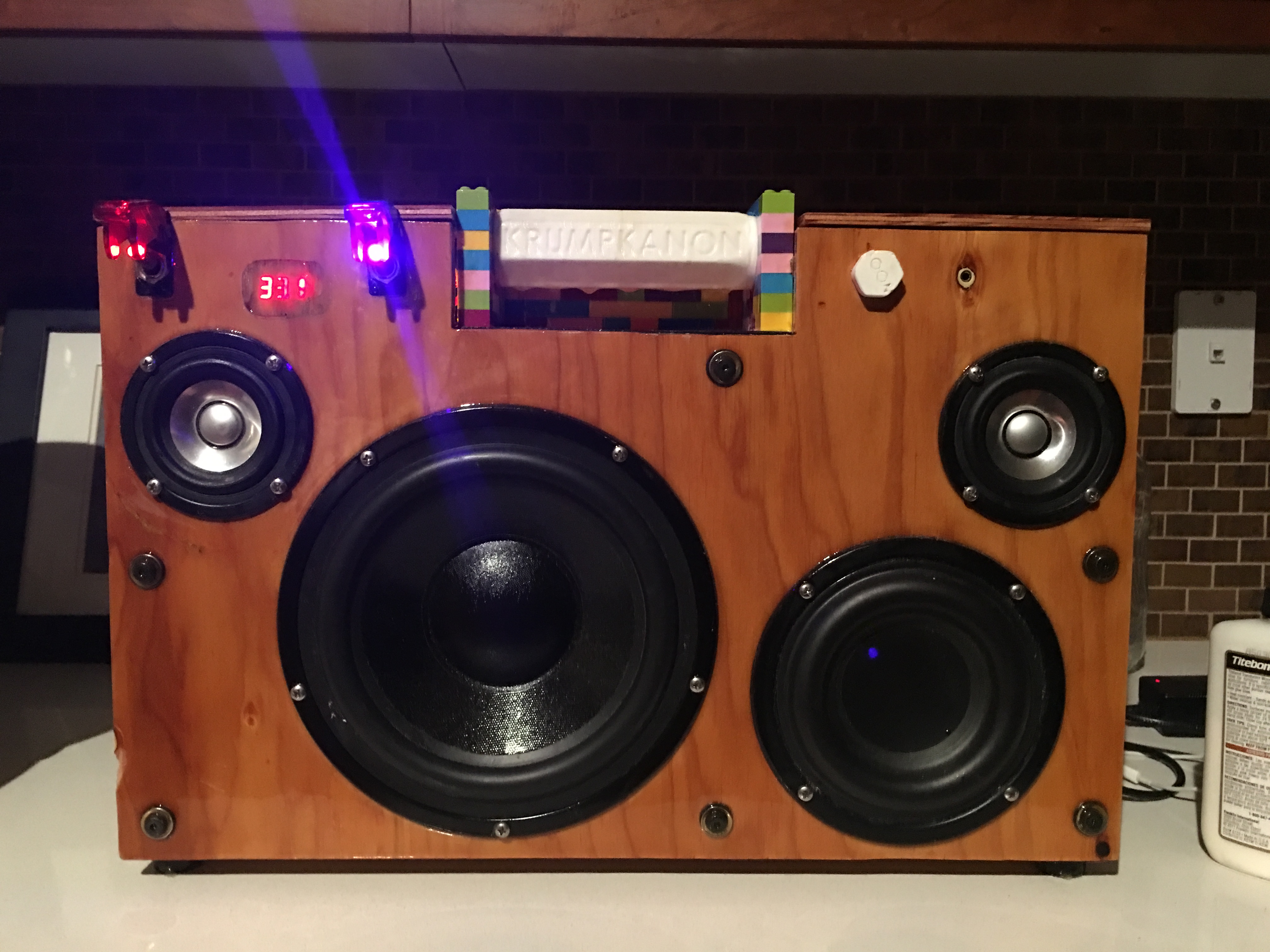
And the most recent piece, the KrumpKanon for Keith “I’ve been lifting so it can be heavy” Savran, complete with Lego detailing, a 200W sub, missile launch switches, and a marine spar varnish. It’s quite heavy.

IMG_2138.JPG

IN BUILDING

So after all that talk of efficiency v extension, I figured I’d actually build something. It worked out that I ended up building on both sides of the coin, as the “Extension” build ended up being pretty gigantic. But the review of both approaches is in and it turns out that in some regards efficiency is more pleasant; I used the Faital Pro 5FE100 in a ~8L enclosure tuned to about 45-50 hz with a 3 inch x 15 inch port which I 3D-printed.  It WOMPS. Sounds great, crisp, powerful. Really pushes the “effortless” bass feeling, until you get below resonance and the woofer starts whacking around. It becomes excursion limited quite fast on songs with a lot of low frequency content, and it sounds pretty alarming. This forces my hand in ASP to put in a high pass around 32Hz-20Hz, adding complexity and heartache. But all in all, not a bad design.

As for the extension, which also sounds good, a different set of issues comes into play. I went with the Tang Band W5-1138SMF ~14L tuned to around 40 hz with a PR, and for starters, the thing is fucking gigantic. Despite the apparent size, 40 hz in 14L is pretty damn good, and it definitely has a presence visually and sonically. It sounds large, powerful, and it’s exceedingly hard to push the woofer itself into distortion. However  pushing the low efficiency of that driver is it’s ridiculous excursion capability, which brings an unexpected issue into play: high excursion means a lot of acceleration. A lot of acceleration mechanically means all kinds of shit is moving around, including things coupled to the boombox through the surface it’s on; put the boombox on the counter and all of a sudden the beer bottles on the counter start wiggling around too. Additionally, in the electrical domain, a lot of acceleration means a lot of voltage, which means more batteries.

These factors push the design to seem a lot less effortless than the 5FE100, potentially because the 1138 design seems to promote higher THD. It’s not necessarily a fair comparison, because the ASP, amp, and battery management on the 5FE100 design happens to be a lot better (I built it second, learned from previous mistakes). Normalizing for those factors, though, the smaller size is pretty great as it turns out that there is usually very little content from 40 Hz and below, and because larger boxes tend to be less efficient in terms of materials.


This slideshow requires JavaScript.

IT HAS BEEN DECIDED

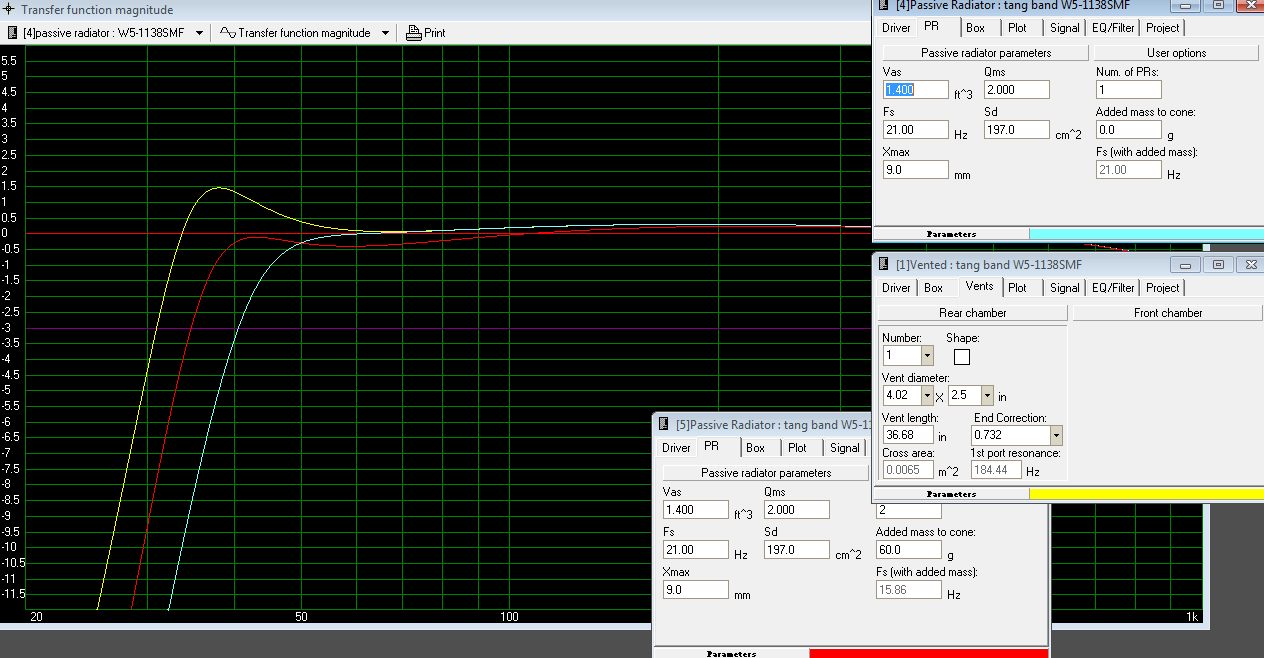
So for  the KrumpKanon I’m going with the W5-1138SMF, and for Keith’s, the W6 version of the same driver. Why? Because it has the excursion, Fs, and general specs to have solid bandwidth and linearity at loud volumes. Unfortunately, if you look at the models:

eliseBoxGrabTB1138VentSpecs_PRChoice2.PNG


The yellow line represents the optimal ported design, while the blue is the optimal 8″ Dayton Audio PR design. The vented design is more efficient, has higher bandwidth, and requires less box volume. However, for a 4″x2.5″ port, opening I’d need 36 inches of port to get the 12L box resonating at 36 Hz. That’s absurd, and what’s more absurd is that at 50W, the airspeed would be ~40 m/s. That’s 90 mph, and the air has to move 90 mph through a folded port 3ft long. I have low expectations for the laminarity of the air flow in that scenario, but an educated guess tells me it would sound like an elephant farting through a muffler.

PR’s it is. With dual 8 inch passive radiators, I could be pretty near the vented design, but a) that’s a ridiculous amount of radiator area for a 5 inch  area, b) that’s 2x the cost, machining, surface area dedicated to the radiator, and c) trying to fit two 8-inch radiators, a 5-inch woofer, and 2 full ranges onto the front of the boom box would be ridiculous. Why not throw them on the back? Well, then the front will look stupid, barren. I want the raw visual and auditory power of a fat fucking 8″ blasting you in the face. But fitting 2 8’s on to the front of a reasonably sized boom box (using the esteemed [boombox name to go here once I find my notes] as a template) would be geometrically dubious.

So at the sacrifice of about 1/3 of an octave of bass, I’m going with a single 8. I hate leaving bass on the table, especially when it’s easy, efficient bass, but given the constraints and my desire for a simplistic design…it’ll have to do. Additionally, and this is the most important part, but, if you look at an analysis of the most popular music being played these days, there’s  little content beneath 40 Hz, and therefore, little need for sound below 40. So I guess 40 Hz it is, and we’ll hope it sounds good. There’s only way to find out.


IT WILL BE DECIDED

After modeling 20+ woofers, including the attractive ScanSpeak classic series, the illustrious semi-pro Morel and FaitalPRO designs, and the uncategorizable SB Acoustic woofers, I’ve decided that there are only two viable designs. For the purpose of listening to  party music in party situations (Keith’s BuffBox), I want something like 104 dB at 48-42Hz at max, solid directivity, and about 3dB head room to handle over-compressed music and power compression that comes with party scenarios. For Elise’s use (KuadKrumpKannon), I’m probably going to want something slightly smaller and with slightly less performance. We can go with 100dB 50-40Hz with 3 dB of head room.

That leaves me with two options, the classic crux, the bane of boomboxes, the designer’s dilemma,  the iron law. For a given size, you can either have more bass but lose sensitivity, or have less bass bandwidth but more loudness. The third unspoken option is get both and pay $$$.

One the one hand, I could go for a 2.1 type set up with the boombox-friendly micro-subwoofer designs like the Tang Band 1138-SMF with it’s extreme 45 Hz free-air resonance, it’s lovely 9.25mm linear x-max, 5-something liter Vas and 82 dB sensitivity. Yeah, it sacrifices sensitivity for low Fs+high xMax at a decent cost point, but with 2^6.3 watts power handling we can potentially get to 99 dB at 1m down to 32 Hz in a 15L cabinet. In my experience, having deep reach with slightly less output can be more enjoyable despite not being as overwhelmingly loud. Essentially, I’d give up loudness for an extra  bass half-octave.

Alternatively, I can go for sensitivity over bandwidth. The FaitalPRO 5FE100 is a great example of this, as it maintains decent excursion and could potentially hit low 50’s in a small box while still being 6 dB more sensitive than the 1138-SMF. In fact, it could  hit 103 dB  in a 8L box, for a 51 Hz-3dB points, or and 40 Hz -3dB in a 15L box. It actually could handle producing about 108 dB (that’s at 100W, it can handle 160W) but above and below the port resonance we’d be we’ll out of the linear excursion range of the woofer. It starts to get directive at 1.5 kHz (beam forming begins at f=c/λ which is 2.7 kHz for a 5 inch woofer), so I could easily cross it over with some equally sensitive 1-2.5 inch speakers around 300 hz and call it a day.  Lots of out put, lots of head room, good package. Only two factors to consider: 1) whether it will work with available  passive radiators and 2) What Would Heathor Trainor Think? About the missing half octave?

On the other hand, I could go for a more sensitive design dual-fullrange or dual woofer tweeter with slightly less reach, but I get 3dB off the bat because I’ll have two woofers. The NS4 would be perfect for this but alas, they are gone from the world. The second best thing is the AuraSound NS3-193-8A , and it’s copy cat brothers: Dayton ND90, ND91, ND105, and DS115 are all great candidates for this. But after modeling I found:

  • AuraSound NS3: Great response, pretty design, 50hz in a 4L box. Play nice with passive radiators. All around solid drivers at a good price. Definitely on the table. The only issue is they’re not that sensitive and they don’t hit super duper hard.
  • ND90: good for this application, but still, lots of ripple. -3dB at 40-38 in 9-7.7 liters. Good news is xMech for days, so bottoming out shouldn’t be an issue for these ND series. Doesn’t work
  • Dayton ND91: great for 1-4 liter enclosures. Looots of ripple otherwise, still a lot of ripple.
  • ND105: lots of ripple, needs at least 14L but can get down to 33 hZ  at -3dB, or in 9L, 38 Hz with a bit of extra efficiency in the pass band.
  • DS115: Kind of a middle ground. In 6 liters, could go to 50 hZ -3dB. They look pretty, and with two of them, I could get 104 dB while staying in the linear region.

The downsides to this approach are: raised complexity (I’ll have to fit 2 4th order systems in the same form factor), limited design flexibility (long ports are almost out of the question and passive radiators are harder to fit), potentially greater cost, and of course, half the space which usually ends up meaning less bass.

Here is a graphical explanation of all that jazz ^.

TF ELise session

Transfer Function of Speaker. -3dB point marked in red.

But what do the colors mean? See next photo.

20w legend

Legend of which colors match up with with speaker/box designs.

Transfer functions are great but we want to know the absolute level.

20W comparison

Absolute level. Compare the sensitivity vs the bandwidth of the various drivers. The ND105 manages to be a good combination of both.

But how loud do they really get with linear excursion constraints?

maxSPL Elise session

Maximum (linear excursion) loudness. Note the FaitalPROs (magenta, green, teal) manages massive power handling until the excursion limit kicks in. The previously impressive ND105 (orange) has little-to-no advantage over the 1138SMF (yellow) due to its lower power handling and limited excursion.

So…what to do?